

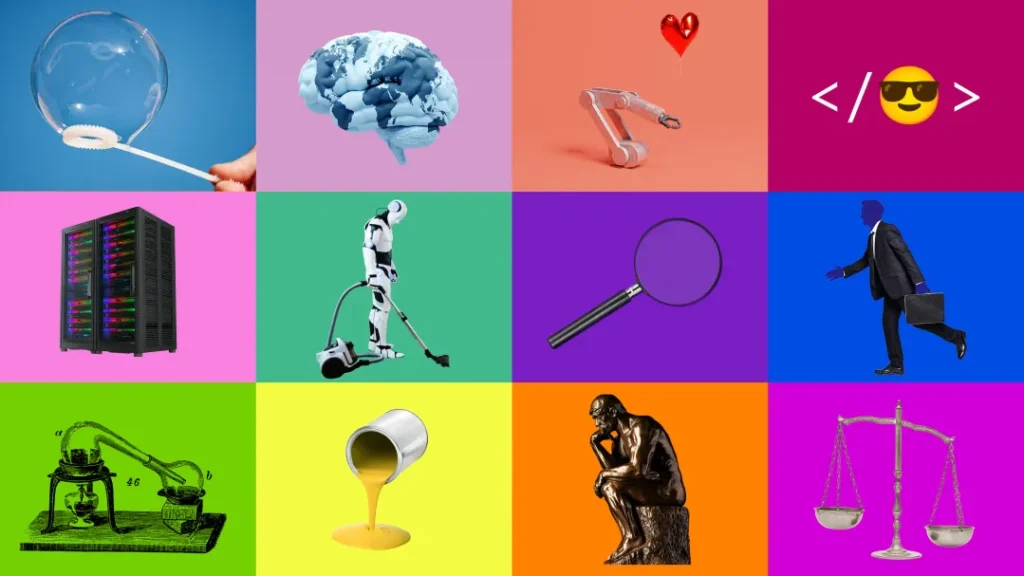
If 2025 felt like a nonstop stream of AI buzzwords, it wasn’t just hype—it was history being written in real time. Artificial intelligence didn’t merely advance this year; it forced society to invent new language to describe how power, labor, creativity, and decision-making are changing.
From boardrooms to classrooms, courtrooms to content feeds, AI terms once reserved for research papers became everyday vocabulary. And that shift matters, because language follows influence. The words that dominated 2025 reveal not only what AI can do—but who controls it, who benefits, and what risks we are now living with.
This article unpacks the AI vocabulary that defined 2025, expands on what quick explainers often miss, and shows why understanding these terms is no longer optional.
Why AI Vocabulary Exploded in 2025
AI crossed a threshold this year. It stopped being experimental and started becoming infrastructure.
As AI began shaping:
- Hiring and workplace productivity
- Media and creative industries
- Education and assessment
- Healthcare, finance, and governance
people needed new words to explain what was happening to them.
These terms didn’t spread because they were trendy. They spread because they described real shifts in power and control.
The AI Terms That Defined 2025 and What They Actually Signal
Foundation Models
Large general-purpose AI systems that power countless applications.
What’s often overlooked is how foundation models centralize power, concentrating influence among the few companies that can afford to train them.
Multimodal AI
AI that understands text, images, audio, and video together.
This mattered because it pushed AI closer to human-like perception—while also making deepfakes and synthetic media dramatically more convincing.
AI Agents
Systems that can plan, decide, and act across tools with limited supervision.
In 2025, agents moved from demos to real-world use, raising urgent questions about accountability when machines initiate actions.
Hallucinations
AI confidently generating false information.
Instead of disappearing, hallucinations became something users learned to manage—shifting responsibility from developers to end users.
Alignment
The effort to ensure AI systems follow human values and intent.
Alignment became urgent as AI gained autonomy, revealing how hard it is to define whose values get enforced.
Synthetic Data
Artificially generated data used to train AI models.
While it reduces privacy risks, it can quietly reinforce bias and distort reality if not carefully controlled.
Compute
The raw processing power behind AI.
By 2025, compute emerged as a geopolitical issue tied to energy, chips, and global supply chains—not just technical progress.
Guardrails
Rules designed to limit harmful AI behavior.
Guardrails sound neutral, but they embed political and cultural priorities into technology.
Open-Weight Models
AI models whose parameters are publicly available.
They expanded access while simultaneously lowering barriers to misuse.
Fine-Tuning
Customizing AI for specific tasks.
Fine-tuning became the primary way companies differentiated products without building new models from scratch.
Retrieval Augmented Generation
Combining AI with external knowledge sources.
RAG rose as a practical response to hallucinations and outdated training data.
AI Safety
An umbrella term covering bias, misuse, autonomy, and catastrophic risk.
In 2025, safety shifted from academic debate to executive and regulatory priority.
Model Collapse
The degradation that occurs when AI systems train on AI-generated content.
This concept exposed a hidden fragility in the AI ecosystem itself.
AI Governance
The rules and institutions shaping how AI is built and deployed.
Governance moved from theoretical discussion to urgent policy reality.
What These Terms Don’t Fully Capture
AI Is Becoming Invisible Infrastructure
AI is no longer a feature—it’s an underlying layer shaping decisions quietly and continuously.
Control Is Concentrating
Despite talk of democratization, access to compute, data, and advanced models is consolidating in fewer hands.
Human Judgment Remains Essential
The most repeated but least glamorous insight of 2025 is that AI performs best when paired with informed human oversight.
Why Understanding AI Language Now Matters
Knowing AI vocabulary isn’t about sounding informed—it’s about protecting agency.
Understanding these terms helps people:
- Spot hype versus substance
- Recognize who benefits from AI decisions
- Participate in workplace and policy debates
- Avoid manipulation and misinformation
When technology shapes society, language determines who gets to question it.
Frequently Asked Questions
Why did AI terms spread so fast in 2025
Because AI moved from experimental tools into everyday systems affecting real lives
Are these just buzzwords
Some are overused, but most describe real structural changes in technology and power
Which terms matter most for the future
Compute and AI governance because they determine control and constraints
Do non technical people need to understand this language
Yes because AI decisions increasingly affect everyone
Will AI vocabulary keep changing
Absolutely as AI evolves new risks and capabilities will demand new language

Final Thoughts
The AI terms that dominated 2025 weren’t noise—they were signals.
They revealed a technology growing more powerful, more embedded, and more political than ever before. Understanding this language isn’t optional anymore. It’s a form of modern literacy.
Because in the age of artificial intelligence, the words we understand often determine the choices we’re allowed to make.
Sources MIT Technologies Review

