

For years, the public imagined artificial intelligence as a technology pushed by fearless Silicon Valley engineers intoxicated by progress.
But something strange is happening inside the tech industry itself:
many of the people building AI are increasingly terrified by what they are helping create.
Not because they misunderstand the technology.
Because they understand it too well.
Across the industry, software engineers, AI researchers, designers, and data workers are beginning to organize around fears involving:
- mass automation
- workplace surveillance
- loss of human agency
- concentration of corporate power
- misinformation
- military applications
- social destabilization
- erosion of creative labor
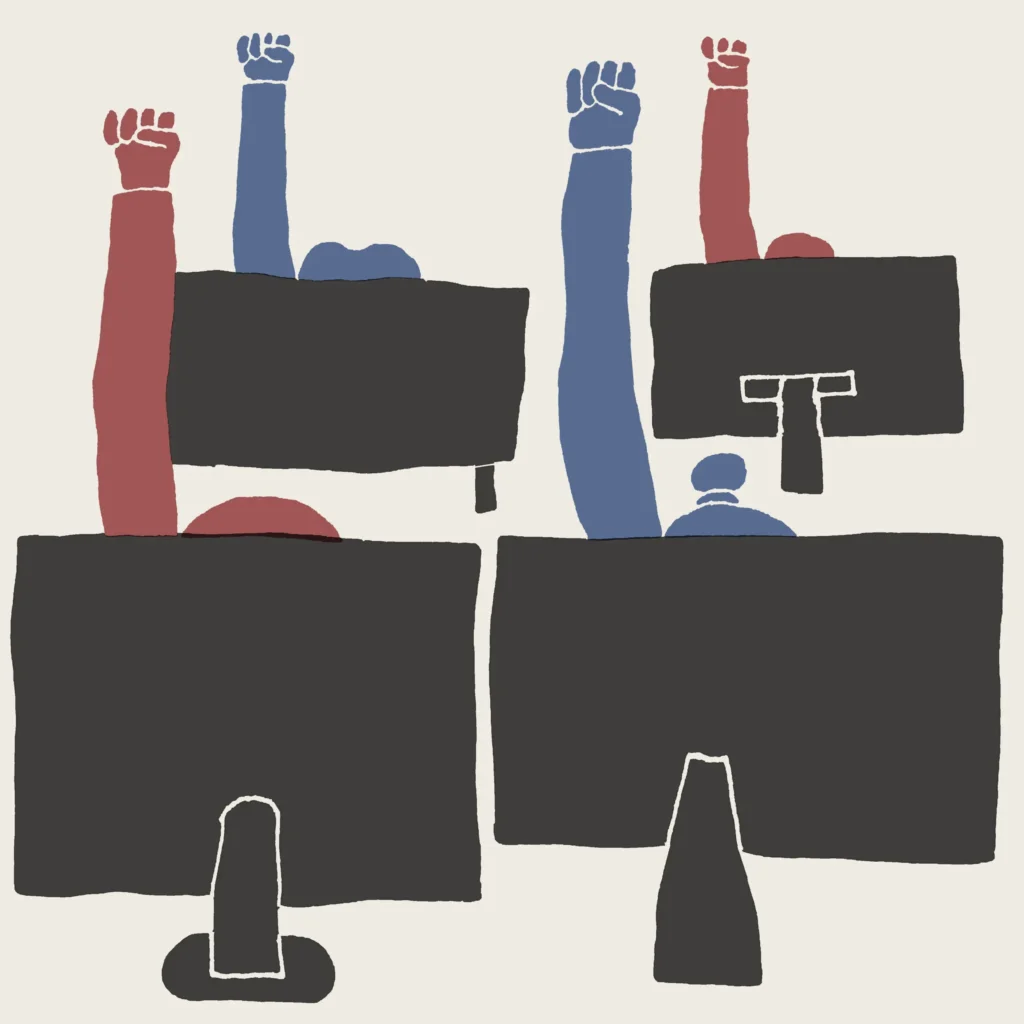
And unlike earlier tech controversies, this movement is emerging from inside the machine itself.
The builders are starting to sound like whistleblowers.
🤖 The Myth of the Fearless AI Engineer Is Cracking
Silicon Valley historically operated under a simple ideology:
build first, worry later.
That philosophy helped create:
- social media platforms
- recommendation algorithms
- surveillance advertising systems
- smartphone ecosystems
But AI feels different even to insiders.
Why?
Because many workers increasingly believe AI is not merely another software wave.
It may fundamentally alter:
- labor markets
- information systems
- human cognition
- economic structures
- political stability
And the speed of change is frightening even industry veterans.
⚡ Tech Workers Are Experiencing the AI Contradiction Firsthand
The contradiction is brutal:
The people building AI tools are often simultaneously:
- excited by the technology
- dependent on it financially
- worried about its consequences
- uncertain about its safety
- fearful for their own futures
This creates enormous psychological tension.
Inside major technology firms, employees increasingly wonder:
“Are we automating society faster than society can survive the transition?”
And increasingly:
“Are we training systems that may eventually replace us too?”
🏢 AI Workers Are Watching Their Own Industry Get Restructured
The fear is not theoretical anymore.
Tech companies are already:
- flattening management layers
- automating coding tasks
- reducing support teams
- reorganizing around AI-native structures
- increasing worker surveillance
- cutting operational roles
Recent restructuring across major firms has intensified employee anxiety about AI-driven labor compression.
Workers increasingly describe feeling trapped inside a system where:
they are helping build the infrastructure of their own professional instability.
🧠 The Most AI-Anxious People May Be the Ones Closest to the Technology
One of the biggest public misconceptions is that AI fears mostly come from people who do not understand technology.
In reality, some of the strongest warnings come from:
- AI researchers
- machine-learning engineers
- former tech executives
- alignment scientists
- AI ethicists
Even pioneers of modern AI have expressed concern about:
- runaway capabilities
- misinformation
- job disruption
- alignment failures
- concentration of power
- existential risks.
This matters because:
the skepticism is increasingly internal, not external.
🔥 Worker Organizing Around AI Is Quietly Growing
A major labor shift is emerging.
Tech workers increasingly support:
- union protections
- AI governance rules
- transparency requirements
- workplace oversight
- human review safeguards
An AFL-CIO poll found overwhelming support among workers for union-backed AI protections and human oversight in workplace decision-making.
This is historically significant.
For decades, Silicon Valley largely resisted organized labor culture.
AI may change that.
Because workers increasingly believe individual employees cannot negotiate against algorithmic systems alone.
📉 AI Is Creating a New Class Anxiety in White-Collar Work
For generations, white-collar workers believed automation mainly threatened:
- factory labor
- repetitive industrial work
- manual processes
AI shattered that assumption.
Now automation increasingly targets:
- writing
- coding
- design
- analysis
- research
- administration
- communication work
That psychological shift has been enormous.
Especially for educated workers who previously viewed themselves as automation-resistant.
Some analysts now warn AI could significantly reduce entry-level white-collar opportunities in coming years.
💻 Software Engineers Are Quietly Facing an Identity Crisis
Software engineers once occupied one of the safest and most prestigious positions in the digital economy.
Now AI coding systems increasingly:
- autocomplete functions
- generate applications
- debug software
- automate testing
- optimize codebases
Many developers still see AI as productivity-enhancing.
But others fear:
the profession itself may shrink dramatically.
The concern is not necessarily total replacement.
It is workforce compression.
Fewer engineers producing vastly larger outputs.

⚠️ AI Surveillance Is Becoming a Workplace Flashpoint
One under-discussed issue involves surveillance.
Companies increasingly deploy AI systems that:
- track worker behavior
- monitor productivity
- analyze communication patterns
- record computer activity
- generate performance analytics
At Meta, employee protests erupted over mouse-tracking systems reportedly tied to AI training and workplace monitoring.
Workers fear these systems may:
- intensify micromanagement
- reduce autonomy
- increase burnout
- weaken trust
And in many workplaces, employees report limited transparency regarding how AI monitoring tools are used.
🧩 The Industry Is Dividing Into “Accelerationists” and “Skeptics”
Inside AI culture, a philosophical split is growing.
Accelerationists believe:
- rapid AI progress is inevitable
- society should adapt quickly
- innovation should move aggressively
- economic disruption is manageable
Skeptics argue:
- deployment is moving too fast
- safety systems remain weak
- labor protections are insufficient
- concentration of power is dangerous
- human oversight is eroding
This conflict increasingly shapes:
- corporate policy
- AI governance debates
- employee activism
- regulatory pressure
🌍 AI Workers Fear Society Is Unprepared
Many tech workers increasingly believe governments, schools, and labor systems are not ready for:
- rapid automation
- workforce disruption
- misinformation
- deepfake abuse
- AI-enabled scams
- psychological manipulation
Researchers now warn that many real-world AI harms differ significantly from earlier public fears.
Instead of cinematic robot uprisings, current harms increasingly involve:
- emotional fraud
- impersonation scams
- labor displacement
- manipulation systems
- workplace destabilization
The danger may be slower…
but more socially corrosive.
🧠 Some AI Researchers Fear “Agent Sprawl”
Another growing concern involves:
autonomous AI agents.
Companies increasingly experiment with systems capable of:
- independent task execution
- workflow coordination
- agent-to-agent communication
- autonomous decision-making
Researchers warn many organizations are scaling agentic AI faster than governance and oversight systems can keep up.
This creates fears around:
- accountability
- explainability
- security vulnerabilities
- loss of human oversight
The technology is moving faster than organizational safeguards.
Again.
📚 AI May Be Weakening Human Skill Development
Some tech workers also fear long-term cognitive effects.
Experts increasingly warn that overreliance on AI could:
- reduce critical thinking
- weaken memory formation
- hollow out skill development
- encourage intellectual dependency
Recent commentary and research have raised concerns that younger workers may confuse AI-assisted productivity with genuine expertise.
This creates a dangerous paradox:
AI increases short-term productivity while potentially weakening long-term human capability.
🏭 Silicon Valley Is Starting to Resemble Heavy Industry
Another reason worker fears are intensifying:
AI is no longer just software culture.
It increasingly resembles industrial infrastructure:
- giant data centers
- enormous capital expenditures
- utility partnerships
- geopolitical competition
- military implications
- labor restructuring
Workers increasingly feel they are participating in something much larger than a normal technology cycle.
Something systemic.
Something difficult to control once fully deployed.
🔮 What Happens Next?
Several major shifts are becoming increasingly likely:
1. Tech labor activism grows
AI fears may trigger stronger worker organizing movements across the tech industry.
2. AI governance becomes a workplace issue
Labor protections may become central to future AI regulation debates.
3. Public distrust intensifies
Workers and consumers increasingly question whether AI deployment is happening responsibly.
4. The industry splits culturally
The divide between aggressive AI acceleration and cautious deployment may deepen significantly.
❓ Frequently Asked Questions (FAQ)
Why are tech workers afraid of AI?
Many fear AI could destabilize jobs, increase surveillance, weaken human control, and accelerate social disruption.
Are AI workers organizing around these concerns?
Yes. Support for labor protections, transparency, and AI governance is growing among tech workers.
What is “labor compression”?
A situation where fewer employees are needed because AI increases productivity and automation efficiency.
Are software engineers at risk from AI?
Potentially. AI coding systems increasingly automate portions of programming and software development workflows.
Why are workers concerned about AI surveillance?
Companies increasingly use AI monitoring systems to track productivity, communications, and behavior.
What is “agent sprawl”?
The uncontrolled expansion of autonomous AI agents across organizations without sufficient governance or oversight.
Are AI fears only about superintelligence?
No. Many current concerns involve:
- labor disruption
- misinformation
- scams
- surveillance
- concentration of power
- social instability
Could AI create new worker movements?
Possibly. Some analysts believe AI anxiety may fuel renewed labor organizing and demands for worker protections.

🧠 Final Thought
The most revealing part of the AI revolution may not be what critics are saying.
It may be what the builders are saying.
Because increasingly, the people closest to the technology are no longer speaking with total confidence.
They are speaking with caution.
Sometimes fear.
Sometimes guilt.
And perhaps that should make the rest of society pause too.
For decades, Silicon Valley believed every technological problem could be solved by moving faster.
Now even some of the engineers inside the system are asking a dangerous question:
what if society cannot adapt as quickly as the machines can evolve?
Sources The New York Times

