
Few professions have felt the anxiety of artificial intelligence as sharply as radiology. For years, predictions have warned that AI would soon read scans faster, cheaper, and more accurately than humans — potentially making radiologists obsolete. As AI tools improve and adoption accelerates, concerns are no longer theoretical. They’re personal.
But the real story is more complex than “AI replaces doctors.”
This article expands on recent coverage by examining what AI is actually doing in radiology today, why job fears persist, what’s missing from the public debate, how the profession is changing, and what this means for patients, doctors, and the future of medical work.
Why Radiology Became Ground Zero for AI Job Fears
Radiology sits at the intersection of:
- Large volumes of digital data
- Pattern recognition
- Image analysis
- Standardized workflows
These are exactly the areas where AI excels.
Early AI systems showed impressive results in:
- Detecting tumors
- Identifying fractures
- Flagging abnormalities
- Prioritizing urgent cases
This fueled a narrative that machines would soon do the entire job.
What AI Is Actually Doing in Radiology Today
AI as an Assistant, Not a Replacement
In real clinical settings, AI is primarily used to:
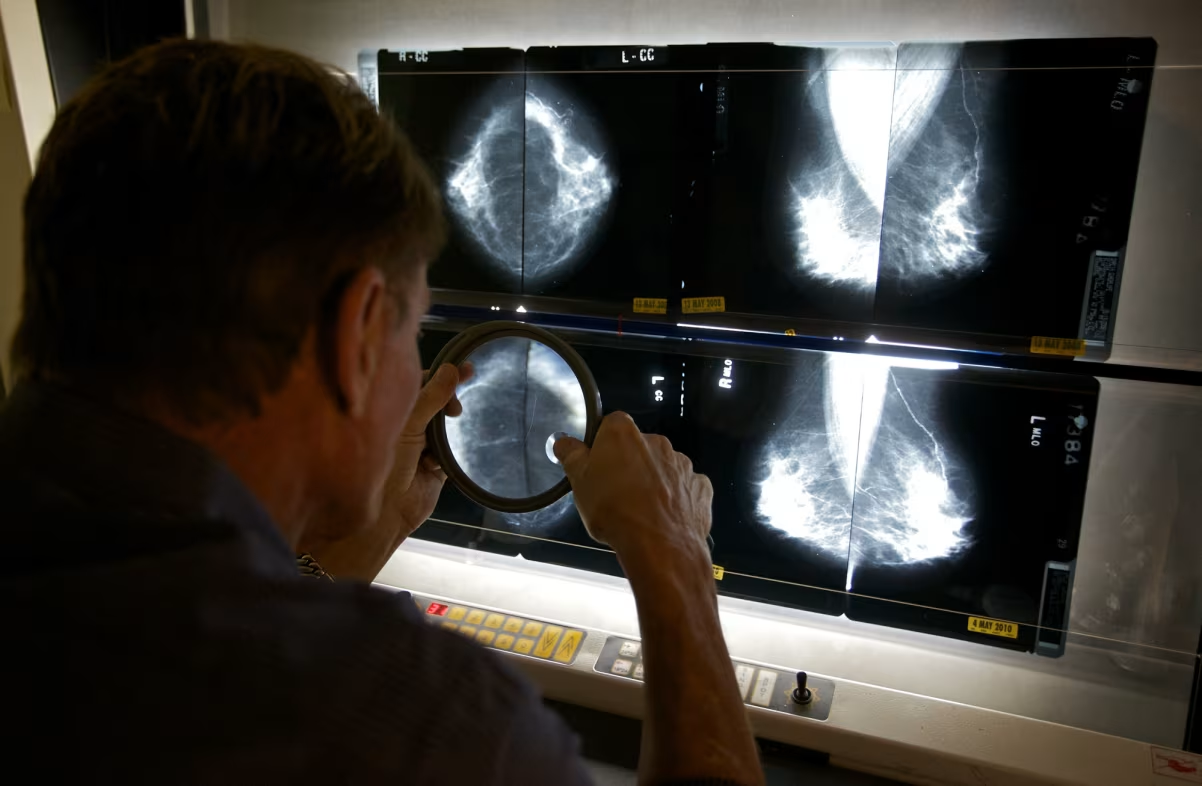
- Highlight suspicious regions on scans
- Prioritize cases in busy workflows
- Reduce missed findings
- Speed up routine tasks
Final decisions still rest with human radiologists, who integrate:
- Patient history
- Clinical context
- Ambiguous findings
- Ethical judgment
AI sees pixels. Radiologists see people.
Productivity Is Changing the Job, Not Eliminating It
AI allows radiologists to:
- Read scans faster
- Handle growing imaging volumes
- Spend more time consulting with clinicians
- Focus on complex cases
Rather than removing radiologists, AI is reshaping how their time is spent.
Why Job Anxiety Persists
Imaging Volumes Are Exploding
Medical imaging demand continues to rise due to:
- Aging populations
- Expanded screening programs
- More advanced diagnostic tools
Even with AI, human expertise is still required to keep up.
Productivity Gains Can Reduce Hiring
Here’s the uncomfortable truth:
AI doesn’t have to replace radiologists to affect jobs.
If one radiologist can do the work of two:
- Hiring may slow
- Job growth may flatten
- Entry-level opportunities may shrink
This feels like replacement, even when the profession survives.
The Myth of “Perfect AI”
AI models still struggle with:
- Rare conditions
- Poor-quality scans
- Bias in training data
- Edge cases outside their training
Overestimating AI’s capabilities increases fear — and risk.
What the Conversation Often Misses
Radiology Is More Than Image Reading
Radiologists:
- Advise treatment decisions
- Coordinate care with physicians
- Communicate risk to patients
- Ensure imaging is appropriate
These human-facing roles are growing, not shrinking.
Liability Still Falls on Humans
If AI makes a mistake:
- The radiologist is legally responsible
- The hospital bears the risk
This ensures humans remain central to decision-making.
AI May Make Radiology More Valuable, Not Less
By reducing routine burden, AI can:
- Improve diagnostic accuracy
- Reduce burnout
- Enhance patient outcomes
The profession may evolve upward, not disappear.
How Radiology Jobs Are Likely to Change
New Skills Will Matter More
Future radiologists may need:
- AI literacy
- Data interpretation skills
- Systems oversight expertise
- Strong communication abilities
Radiology becomes more strategic and less mechanical.
The Role Will Expand, Not Shrink
Radiologists may increasingly:
- Serve as diagnostic consultants
- Oversee AI systems
- Validate and audit algorithms
- Lead imaging-based care teams
AI shifts the center of gravity — it doesn’t erase it.
Risks That Should Be Taken Seriously
While replacement fears are overstated, real risks exist:
- Overreliance on AI recommendations
- Reduced training opportunities for junior doctors
- Unequal access to advanced tools
- Pressure to read faster at the expense of care
Managing AI well matters as much as building it.
What This Means for Patients
For patients, AI-assisted radiology can mean:
- Faster results
- Fewer missed diagnoses
- More consistent care
But only if:
- Humans remain in the loop
- Errors are transparently addressed
- AI tools are rigorously tested
Trust depends on oversight.
Frequently Asked Questions
Will AI replace radiologists?
No. AI is changing the job, but radiologists remain essential for interpretation, judgment, and accountability.
Why do people keep saying radiology will disappear?
Because image analysis is a visible part of the job — and one AI happens to do well — but it’s not the whole job.
Will there be fewer radiology jobs?
Possibly slower growth, not mass unemployment. Productivity gains affect hiring more than outright replacement.
Is AI better than doctors at reading scans?
In narrow tasks, sometimes. Overall diagnosis and care still require human expertise.
Should medical students avoid radiology?
No. Radiology is evolving, not dying — and AI-literate radiologists may be more valuable than ever.
Final Thoughts
AI isn’t coming for radiologists — it’s coming for radiology as it used to be.
The profession is shifting from image reading to decision-making, from volume to value, from isolation to collaboration. Fear thrives in uncertainty, but the evidence points toward transformation, not extinction.
The real risk isn’t that machines replace doctors.
It’s that we misunderstand what doctors actually do.
And in medicine, misunderstanding has consequences far worse than automation.
Sources CNN

