
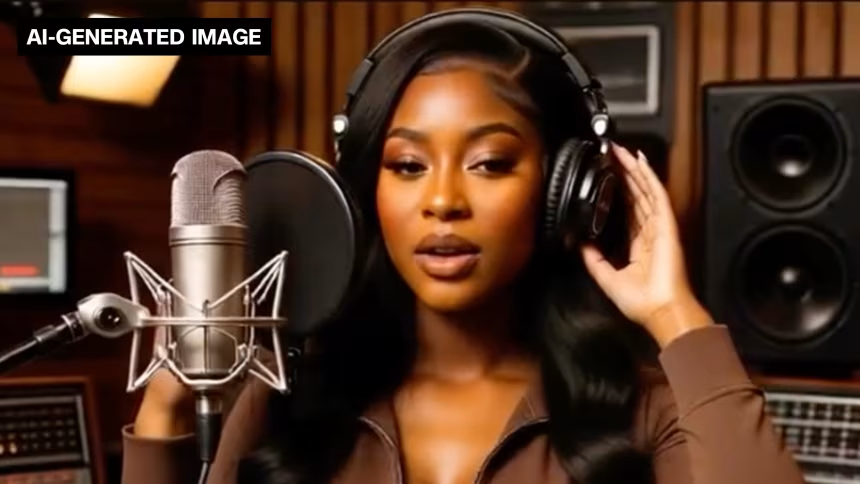
In 2025, Xania Monet became the first-ever artist generated (at least in large part) via artificial intelligence to appear on a Billboard airplay chart. Her single “How Was I Supposed to Know?” climbed into the R&B Digital Song Sales chart, cutting into territory historically held by human artists. She also signed a multi-million-dollar record deal (reported at around US$3 million) with a label after gaining traction on digital charts.
Xania Monet isn’t a typical “virtual avatar” in the sense of being a cartoon — she was created via the AI-music platform Suno, with lyrics written by songwriter Telisha “Nikki” Jones, and AI-generated vocals and production. The project was packaged, marketed and positioned as a real artist act, not as a novelty.
In short: what once would have been a curiosity or gimmick has now gone mainstream.
Why This Moment Matters
Creative disruption
Xania Monet’s breakthrough signals a shift: AI is no longer just a tool for human artists; it’s entering the realm of artist identity itself. That raises the question—what does “artist” mean when the voice, instrumentals and even brand may be largely machine-generated?
Business model implications
For record labels and streaming services, an AI artist offers potential advantages—scalable content, lower live-tour constraints (at least initially), and data-driven production. The fact that an AI act can chart and secure a major deal means new entrants can bypass some traditional barriers.
Talent and human creativity
While AI assists many human musicians today, Xania Monet flips the model: a human lyricist/jammer + AI singer/producer = artist. It challenges the notion of “front-person star” and puts the spotlight on the interplay between human creativity and machine execution.
Industry tipping point
Charting on Billboard isn’t just symbolic—it means radio play, streaming volume, label investment and mainstream recognition. This moment suggests that AI-artists are moving from side experiment to legitimate market players.
Ethical, legal and cultural questions
With AI artists climbing charts, issues arise: copyright (who owns the vocals/instrumentals), attribution (is it art or a machine output?), cultural authenticity (how do fans connect?), and economic fairness (what happens to human artists?).
What the Original Coverage Didn’t Fully Explore
Here are several deeper angles worth highlighting:
- Entry‐level and emerging artist displacement
Xania Monet’s rise suggests that new human artists may face competition not just from major stars but from machine-driven acts. For unsigned musicians working to break through, the presence of AI artists adds another layer of disruption. - Live performance, touring and monetisation gaps
While streaming and chart success matter, a big chunk of music income comes from touring, merch and live presence. How will AI artists perform live? Can they tour? Will fans pay the same? The economics of “virtual stable act” are less proven. - Fan connection and authenticity
Music fandom often hinges on personality, story, vulnerability and human connection. What happens when the “artist” is partially or wholly machine-generated? Will fans feel the same loyalty? Will industry measure engagement differently? - Infrastructure and cost inequality
Building an AI-powered artist still requires tech (AI tools, data, production pipelines, marketing budget). Smaller indie artists might lack access. Thus, the “AI artist” space may concentrate advantage in well-funded hands rather than democratise. - Regulation and disclosure
As AI artists gain visibility, questions will arise: Do platforms need to disclose “AI-generated artist” status? Should there be separate metadata? Are listeners entitled to know how much human vs machine creation was involved? - Genre and cultural dynamics
AI artists may initially succeed in digitally-friendly genres (R&B, pop, hip-hop) where production, streaming and viral growth dominate. But how will they fare in genres reliant on live instrumentation, improvisation or cultural heritage? - Environmental & ethical externalities
Generative music and artificial-voice models consume compute and generate data. The rise of AI-artists increases demand on AI infrastructure—and raises questions about energy, sustainability and algorithmic bias in cultural production.
The Road Ahead: What to Watch
- Chart traction + live viability: An AI artist may stream well, but can they sustain attention through touring, brand deals and public persona?
- Hybrid human-AI acts: Instead of purely AI artists, we may see more bots + human collaborations, where identity is purposeful and machine augmentation is transparent.
- Platform and contract innovation: Labels, streaming platforms and publishers may create new contract types: AI-artist deals, voice-model licensing, shared revenue with tool providers.
- Fan and creator backlash: Human artists already express concern. Leading musicians have publicly criticized AI-artists’ deals, citing authenticity and creative labour issues.
- Disclosure standards: Platforms like Billboard or Spotify may require tagging AI-generated content or provide transparency around creation.
- Global expansion and genre diversification: If AI-artists gain foothold in multiple regions and genres, the disruption will broaden beyond U.S. pop/R&B to world music, rock, country, gospel and beyond.
Frequently Asked Questions (FAQ)
Q: Is Xania Monet 100% AI-generated?
Not entirely. The project involves human lyricist Telisha “Nikki” Jones writing much of the content, and an AI platform (Suno) generating vocals and production. So it’s a hybrid—human creativity + AI execution.
Q: Does this mean that human artists are obsolete?
No. While AI artists pose a new competitive dimension, masterful human artists bring story, presence, performance, improvisation and live charisma that machines currently struggle to replicate. It’s more about adaptation than replacement.
Q: Will fans accept AI artists?
Some are already engaging with them (streams, social media), but broader acceptance depends on storytelling, marketing, authenticity and connection. Fan acceptance may vary by genre and demographic.
Q: What happens to royalties, rights and contracts?
New complexity emerges: If AI-tools generate vocals, production or songwriting, who owns the model output? Contracts may need to account for tool-licensing fees, creator contributions, and revenue for infrastructure owners.
Q: Are AI artists ethical or fair?
The ethics are contested. Critics argue AI-artists may benefit from datasets built on human artists’ work without adequate attribution or compensation. Supporters say AI is another tool for new kinds of creativity. Transparency and fair licensing will matter.
Q: Could this trend be a fad?
Possibly, but momentum is strong. Several AI-artists are already charting; record deals are being signed; labels are paying attention. Whether they sustain success depends on economic, cultural and logistical factors.
In Summary
Xania Monet’s emergence marks a milestone: an AI-powered artist breaking into mainstream charts and securing major label investment. But this moment isn’t just about novelty—it’s about a turning point in how music is made, marketed and monetised.
For artists, labels, fans and technologists alike, the question is no longer if AI-artists will exist — it’s how they will coexist with human creativity, infrastructure and culture. The future of music may very well include machines, but the success of that future depends on fairness, creativity and humanity.
Sources CNN

