
In labs across the United States the message is clear: artificial intelligence isn’t just a software layer anymore—it’s becoming inextricably linked with the highest tiers of high-performance computing (HPC). The national labs have stepped into a new phase where AI workloads, massive models, simulations and supercomputing merge—creating a hybrid engine of discovery, national security, data modelling and innovation.

Why now?
Several converging forces explain why this moment is more than incremental:
- Model & compute size explosion – A.I. models are growing enormous (in parameters, data and complexity). Training and inference at that scale demands not just many GPUs, but supercomputing-class interconnects, memory bandwidth, cooling, and systems built for scientific simulation.
- Scientific opportunity – The national labs are mission-driven: energy research, materials, physics, climate, nuclear stockpile stewardship. These domains generate massive data and simulation needs—and AI offers a new way to accelerate insight.
- Infrastructure momentum – New supercomputers are being built that explicitly cater for both “traditional HPC” (simulations, modelling) and AI training/inference workloads.
- Sovereign and strategic dimension – From national-security modelling to sovereign computing capacity, the stakes are high. The U.S. recognises that to lead in AI and science, you cannot outsource all infrastructure.
- Public-private partnerships & funding scale – Recent announcements show large-scale investment: labs + technology companies + hardware vendors building next-gen systems, often with billion-dollar price tags. For example: two next-gen AI supercomputers announced at Oak Ridge under a ~$1 billion collaboration.
What the Labs are Doing
- The Department of Energy (DOE) recently announced major new systems at Oak Ridge and Argonne labs. At Oak Ridge, the supercomputers named “Lux” and “Discovery” are being built to serve as AI-“factories” for science and national-security modelling.
- At Los Alamos, the “Venado” supercomputer runs advanced reasoning models (e.g., from OpenAI) for classified research.
- At Argonne, new systems are announced via a public-private partnership to deliver the DOE’s largest AI supercomputer and extend infrastructure capacity.
- Hardware vendors (e.g., Nvidia, AMD, HPE) are integrating GPUs, AI-accelerators, high-bandwidth memory, specialised interconnects and preparing systems that operate at exascale or near-exascale.
- Lab systems are shifting from pure HPC (floating-point intensive simulations) towards hybrid workloads: large-language-models, multimodal AI, scientific discovery, real-time inference, massive datasets.
Key Themes and Trends (Beyond the Basics)
Infrastructure & scale — the new cost centre
Building these systems is extremely capital-intensive. For example, analysis of AI-supercomputers shows compute performance doubling every ~9 months, but hardware cost and power demands also doubling each year.
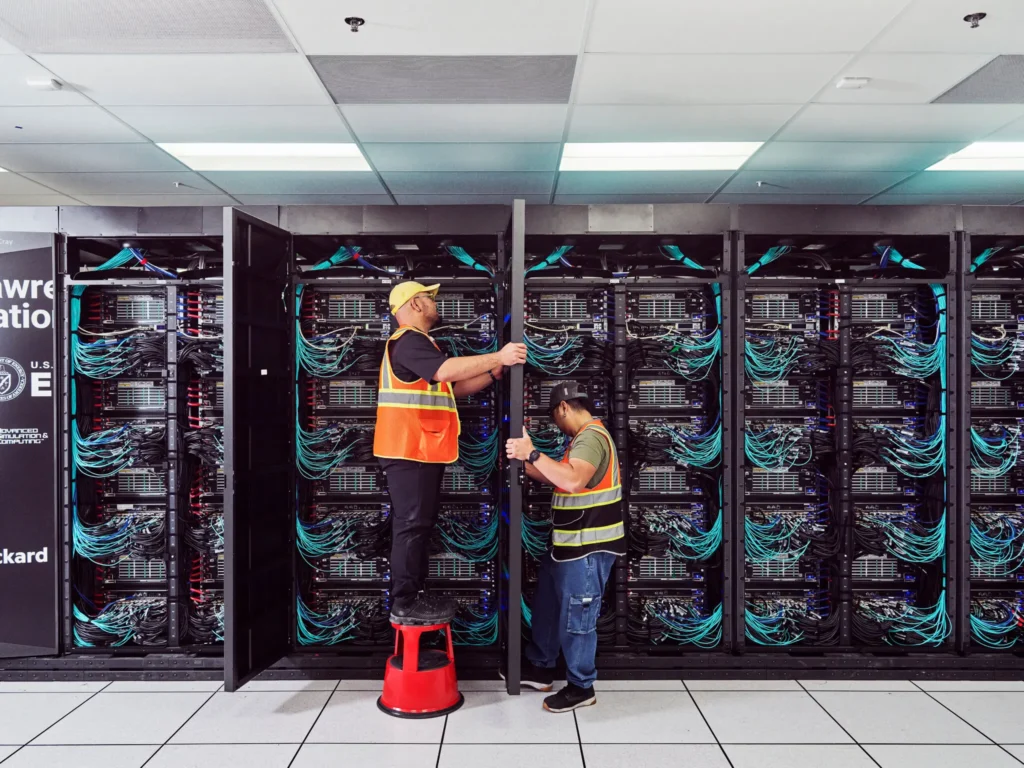
Far from being “just software”, AI at this level is infrastructure-heavy: racks, cooling, power, networking, storage, high-end accelerators.
Hybrid architecture and co-design
Traditional HPC and AI workloads have different requirements (e.g., double-precision for simulation vs FP16/FP8 for inference). Labs are now designing co-architected systems that can serve both — meaning novel unit designs, memory architectures, interconnect topologies. For example, the “Aurora” system at Argonne uses novel memory and node architectures designed for this hybrid mix.
Talent, software stack & workflow changes
It’s not enough to build hardware. The people, toolchains, model optimisation, data management, software frameworks must advance as well. Labs are adapting by hiring AI specialists, creating “AI factories” (in lab speak) and shifting operations to support researchers who want to use the supercomputers for both science and AI.
Strategic & sovereign implications
The labs’ push into AI-supercomputing has strategic dimensions: national security modelling, materials discovery (with arms, energy, climate implications), and ensuring the U.S. remains competitive in a global AI arms race. Export-controls, domestic manufacturing, supply-chain resilience all feed into this.
Risk and bottlenecks
- Power/energy constraints: Enough compute power means huge energy draw—some labs and data-centres are reaching grid or cooling limits.
- Utilisation mismatch: Having huge infrastructure is one thing; having the right workloads, software maturity and user base is another. Under-utilised racks are wasted investment.
- Cost and timeline risk: If budgets slip or technology evolves faster than the build-out, the lab systems may become outdated or mis-aligned.
- Software and data bottlenecks: AI depends on data, curated datasets, model frameworks and efficient software; building hardware alone is insufficient.
- Accessibility and fairness: These supercomputers are often locked behind restricted access (for national labs, security sites) which raises questions about broad scientific accessibility and innovation ecosystem fairness.
What This Means for Science, Industry & Society
- For science: Expect faster discovery in materials, energy, physics, genomics. AI + HPC means simulating and analysing phenomena that were previously out of reach.
- For industry: Companies can partner with labs, leverage the infrastructure, accelerate innovation cycles; spin-outs may exploit models developed at labs.
- For society and policy: Investments at this level shape the technology ecosystem, define who leads in AI academic research, influence national security posture. Ensuring that benefits diffuse (not just concentrated) will matter for equity.
- For global competition: Other countries (e.g., China, Europe) are also racing to build AI-supercomputing capacity; the U.S. labs’ strategy is a key piece of the international technology competition.
Most Commonly Asked Questions & Straight Answers
Q1. What is the difference between a “traditional supercomputer” and a “AI-supercomputer”?
A: Traditional supercomputers focus on simulations (e.g., weather modelling, nuclear physics) using high-precision floating-point operations, massive processors, MPI networking. AI-supercomputers add large-model training/inference, require huge memory bandwidth, specialised hardware (GPUs, accelerators), AI software stacks, and often run different workload types (e.g., LLMs, image/video training) in addition to simulation. The labs are building systems that can handle both.
Q2. Why are national labs building these systems now?
A: Because the scale and complexity of both AI models and scientific questions have increased. Labs require compute far beyond what traditional HPC offered. Also strategic timing: global AI competition, national-security needs, large government funding, and hardware vendor roadmaps align now.
Q3. Can industry use these national-lab systems?
A: Yes, in many cases through partnerships, shared projects or user programmes, though access may be limited for commercial-only tasks or classified work. Some labs make time available for external researchers or industry collaborations.
Q4. What are the major bottlenecks?
A: Key bottlenecks include power and cooling infrastructure, data movement (storage/interconnect bandwidth), software stack (creating efficient code for new hardware), talent (specialised AI/hpc engineers), and cost/return on investment (ensuring hardware is well-utilised).
Q5. How does this impact the average person or business?
A: Indirectly—but meaningfully. Businesses may gain from faster innovations (e.g., new materials, faster drug development, smarter manufacturing). The average person might benefit from breakthroughs in energy, medicine, environment. But access will be mediated by academic, governmental, or partner channels rather than direct consumer use.
Q6. What happens if the U.S. falls behind in building these systems?
A: It may lose some competitive edge in scientific discovery, national security modelling, AI infrastructure, and in attracting talent. Infrastructure becomes one part of the global AI race; lagging may reduce influence or innovation lead.
Q7. Are there environmental concerns?
A: Yes. Supercomputers consume large amounts of power and generate heat, requiring advanced cooling infrastructure. Optimising for energy efficiency, leveraging renewable power, and managing data-centre mid-footprint are important concerns.
Q8. Is this just for government or purely academic use?
A: While these labs are government-funded and mission-driven, many systems also serve academic researchers, industry collaborators and are part of public-private partnerships. The distinction between “academic” and “industrial” is blurred when AI is involved.
Q9. How much will it cost?
A: Costs are large. Recent announcements include partnerships worth around $1 billion or more for new AI-supercomputers. Investment covers hardware, facility upgrades (power, cooling), staffing and operations. (See e.g., Oak Ridge’s new systems.)
Q10. What is the time-frame for these systems to deliver impact?
A: Some systems are already deployed; others are announced for 2026-2029 time-frames. Impact in terms of scientific breakthroughs may lag hardware deployment by months or years, because new workflows, data pipelines and research programs need to mature.
Final Thoughts
The melding of AI and supercomputing in the national labs signals a new era: where giant models, huge datasets and mission-driven science meet the most advanced hardware on Earth. But hardware alone won’t win the race—software, talent, workflows and ensuring broad access matter just as much.
For anyone involved in tech, science, policy or business: this isn’t just a curve in the progress of computing—it’s a junction where infrastructure, AI-capability and national strategy intersect. As the labs pick up the pace, the question is less “if” AI will remake science and industry—but “how” and “who benefits.”
Sources The New York Times

