

Every major technological shift sparks the same fear: this time, jobs will disappear for good. With artificial intelligence now drafting emails, analyzing contracts, writing code, and generating presentations, white-collar workers understandably feel exposed.
Yet despite the anxiety, a growing body of evidence suggests something more complex — and less apocalyptic — is happening.
AI is unlikely to wipe out white-collar jobs wholesale. Instead, it is transforming how those jobs function, what skills matter, and who advances.
The real disruption is structural, not terminal.
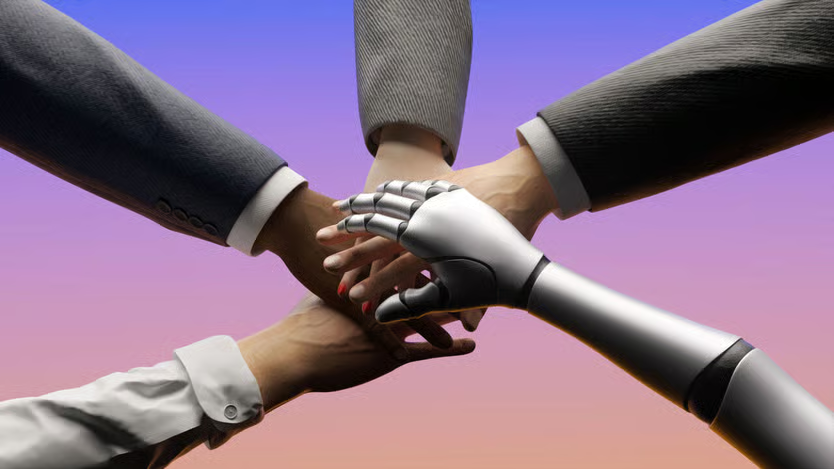
Why White-Collar Work Is More Resilient Than It Looks
White-collar jobs tend to involve:
- Judgment and decision-making
- Client interaction and trust
- Accountability for outcomes
- Ambiguous, evolving problems
- Social and organizational context
AI excels at narrow tasks. White-collar work is mostly task bundles, not single functions.
When AI automates parts of a role, the role itself usually adapts rather than disappears.
What AI Is Actually Replacing
AI is highly effective at:
- Drafting routine documents
- Summarizing information
- Analyzing large datasets
- Producing first-pass outputs
- Handling standardized processes
These were never the highest-value parts of white-collar work — they were the time-consuming parts.
What disappears is not the job, but the drudgery inside it.
Why Entire Professions Rarely Vanish
History offers clues:
- Spreadsheets didn’t eliminate accountants
- Email didn’t eliminate managers
- Search engines didn’t eliminate researchers
Instead, productivity rose, expectations increased, and job descriptions shifted.
AI follows the same pattern — but faster.
The Hidden Trade-Off: Fewer Rungs, Higher Expectations
While jobs persist, career ladders change.
Key effects include:
- Fewer entry-level roles built on routine work
- Faster promotion expectations
- Greater emphasis on judgment early in careers
- Pressure to supervise AI systems rather than learn through repetition
This creates opportunity for some — and barriers for others.
Why AI Often Complements Professionals Instead of Replacing Them
In law, medicine, finance, and consulting:
- AI supports analysis
- Humans make final calls
- Liability remains human
- Trust remains interpersonal
Clients don’t just want answers — they want responsibility.
AI can inform decisions, but it cannot own consequences.

Where Job Risk Is Real
AI pressure is uneven.
Higher risk roles tend to have:
- Highly standardized outputs
- Limited client interaction
- Minimal judgment discretion
- Clear performance metrics
Examples include:
- Basic reporting roles
- Routine compliance tasks
- Entry-level analysis
- Internal documentation work
But even here, tasks are more likely to be compressed than eliminated outright.
Why Productivity Gains Don’t Automatically Mean Job Loss
When productivity rises:
- Costs fall
- Demand often increases
- Services expand
- New specializations emerge
This is why employment often grows even as efficiency improves.
AI lowers the cost of thinking — which increases how much thinking organizations demand.
What the Economist-Style Debate Often Undersells
Work Becomes Denser
The same job now requires more output, faster decisions, and broader oversight.
Cognitive Load Increases
AI doesn’t eliminate work — it shifts effort toward evaluation and judgment.
Inequality Can Grow
Those who adapt gain leverage; those who don’t fall behind.
Soft Skills Become Hard Requirements
Communication, ethics, and coordination matter more — not less.
Why AI Changes Power Dynamics at Work
AI gives leverage to:
- Skilled professionals who know how to use it
- Firms that control data and infrastructure
It weakens:
- Workers reliant on routine output
- Organizations built around hierarchical information flow
Power shifts quietly — but decisively.
How White-Collar Workers Can Stay Relevant
Resilience comes from:
- Developing judgment, not just execution
- Understanding AI limitations
- Owning decisions and accountability
- Building domain expertise
- Learning to supervise and critique AI outputs
The safest workers are those who decide, not those who merely produce.
Why This Is Not a Comforting Story — But a Realistic One
AI doesn’t promise stability.
It promises continuous adaptation.
Jobs won’t vanish overnight — but expectations will rise, paths will narrow, and pressure will intensify.
The risk isn’t mass unemployment.
It’s a workforce divided between those who command AI — and those managed by it.
Frequently Asked Questions
Will AI replace white-collar jobs entirely?
Unlikely. Most jobs will evolve rather than disappear.
Which workers face the most risk?
Those whose roles consist mostly of routine digital tasks.
Will wages fall?
Possibly for routine roles; specialized judgment roles may see gains.
Is this like past automation waves?
Yes — but faster and more cognitively demanding.
Do workers need to learn coding?
Not necessarily. AI literacy and judgment matter more than programming.
What’s the biggest long-term risk?
A hollowed-out career ladder that limits opportunity for newcomers.

The Bottom Line
AI won’t wipe out white-collar jobs — but it will rewrite what those jobs mean.
Work will demand more judgment, faster decisions, and deeper responsibility — with fewer chances to learn slowly.
The future of office work belongs not to those who compete with AI,
but to those who know how to think alongside it — and take responsibility for the results.
The jobs will remain.
The rules will not.
Sources The Economist

