

For years, warnings about artificial intelligence eliminating jobs felt abstract — a future problem reserved for economists, think tanks and science fiction panels.
Then came the week when the layoffs hit close to home.
Major companies announced workforce reductions while simultaneously expanding AI investments. Executives openly described automation as a driver of efficiency. Entire departments — once considered insulated from technological disruption — faced restructuring.
For many workers, the long-theorized “AI job wipeout” no longer sounded hypothetical. It felt immediate.
But is this the beginning of a structural labor transformation — or an early tremor exaggerated by headlines?
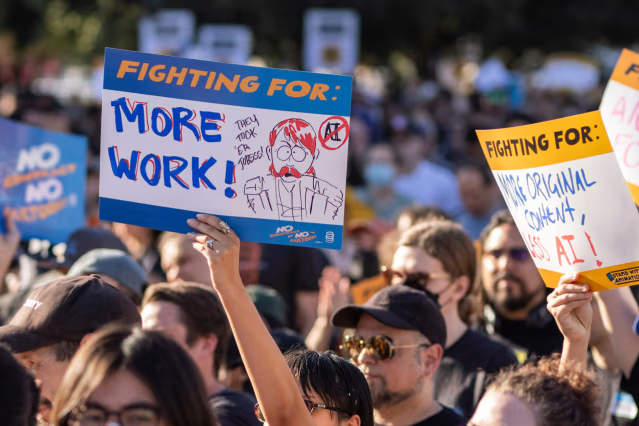
From Factory Floors to Office Cubicles
Automation historically disrupted manual labor first: manufacturing lines, warehouse sorting and industrial processes.
AI changes the equation.
Unlike previous waves of automation, generative AI systems can perform cognitive tasks such as:
- Drafting reports
- Writing marketing copy
- Coding software
- Reviewing legal documents
- Summarizing financial statements
- Responding to customer inquiries
This shifts automation into traditionally white-collar territory.
The psychological impact is profound. College degrees were long seen as insulation against technological replacement. AI challenges that assumption.
Why This Moment Feels Different
Several factors converged to make the “wipeout week” feel real:
1. Public Executive Admissions
Corporate leaders openly cited AI-driven productivity gains as justification for leaner staffing.
2. Visible Automation
Employees witnessed AI tools performing tasks previously handled by coworkers.
3. Concentrated Announcements
Multiple layoff announcements within a short time frame created a sense of acceleration.
4. Rapid AI Improvement
Generative AI capabilities have advanced faster than many experts predicted.
The convergence amplified anxiety.
Which Jobs Are Most Exposed?
AI does not eliminate entire professions overnight. It targets tasks.
Roles heavily composed of repetitive cognitive work face the highest near-term exposure:
- Entry-level analysts
- Customer service representatives
- Administrative assistants
- Junior coders
- Paralegals handling document review
- Basic content creators
However, jobs involving:
- Strategic decision-making
- Emotional intelligence
- Physical dexterity
- Complex interpersonal negotiation
Remain more resilient — at least for now.
Augmentation vs Replacement
A critical distinction often gets lost in headlines.
AI frequently augments rather than replaces.
For example:
- A software engineer may produce twice as much code with AI assistance.
- A lawyer may review contracts faster using automated summarization tools.
- A marketing team may draft campaigns more efficiently.
The question becomes: does increased productivity reduce headcount, or allow companies to expand output?
The answer varies by industry and economic conditions.
The Macroeconomic Wildcard
Labor markets are shaped not only by technology but by:
- Economic growth
- Consumer demand
- Capital investment
- Regulatory environment
If economic expansion continues, AI may complement growth rather than shrink employment.
If growth slows, automation may become a cost-cutting lever.
Technology does not operate in isolation from macroeconomic forces.

The Skills Shift
What is emerging is less a mass extinction of jobs and more a rapid skills reshuffling.
Rising demand areas include:
- Machine learning engineering
- AI oversight and governance
- Cybersecurity
- Data infrastructure
- Prompt engineering
- Human-AI workflow design
Workers who adapt may thrive.
Those without access to retraining may struggle.
The transition speed is what makes this moment feel destabilizing.
Psychological and Cultural Impact
Beyond economics, AI-driven job anxiety reshapes workplace culture.
Employees report:
- Heightened performance pressure
- Fear of redundancy
- Uncertainty about career trajectories
- Hesitation to specialize narrowly
Companies must manage not only automation but morale.
Trust erodes when efficiency gains translate directly into layoffs.
Historical Perspective
Technological revolutions have always disrupted labor markets:
- The Industrial Revolution displaced artisans.
- Automation reduced agricultural employment.
- The internet transformed retail and media.
Each shift eventually created new industries — but often after painful transitions.
AI’s pace may compress that adjustment period.
Is This Just the Beginning?
Many analysts believe we are in the early phase of AI labor impact.
Future developments could include:
- Fully autonomous customer support systems
- AI-managed supply chains
- Automated financial advisory tools
- Self-improving code generation systems
Yet full automation remains technically and economically complex.
Human oversight still plays a crucial role.
Policy Implications
Governments face mounting questions:
- Should there be AI workforce transition funds?
- How should education systems adapt?
- Are new social safety nets required?
- Should AI deployment be regulated to slow labor displacement?
Policymakers must balance innovation incentives with workforce stability.
Frequently Asked Questions (FAQ)
Q: Is AI really causing job losses?
In some sectors, yes. Automation is contributing to workforce reductions, especially in routine cognitive roles.
Q: Is this a temporary wave of layoffs?
Some layoffs may reflect broader economic cycles. Others signal structural changes driven by automation.
Q: Which industries are most affected?
Technology, finance, media, legal services and customer support sectors are experiencing early impact.
Q: Will AI create new jobs?
Yes, particularly in technical and oversight roles — but they may require different skill sets.
Q: Should workers be worried?
Concern is understandable. Adaptability and skill development are increasingly important.
Q: Could governments intervene?
Policy responses may include retraining programs, unemployment protections and AI governance frameworks.
Q: Is this worse than previous automation waves?
It may affect a broader range of white-collar professions, making its psychological impact more widespread.

Conclusion
The week the AI job wipeout felt real marked a turning point — not necessarily because millions of jobs vanished overnight, but because the threat became tangible.
Artificial intelligence is not eliminating work altogether. It is redefining what work looks like, who performs it and which skills hold value.
The real story is not sudden collapse — but accelerated transformation.
Whether this shift leads to widespread displacement or a more productive economy depends on how businesses, workers and policymakers respond.
The future of work is being rewritten in real time.
Sources The Wall Street Journal

