

The gig economy is entering a new phase—and it’s not just about delivering food anymore. DoorDash, one of the world’s largest delivery platforms, is quietly transforming its workforce into something far more futuristic: a distributed network of human trainers for artificial intelligence and robotics systems.
In a surprising shift, the company has begun offering paid “micro-tasks” to its couriers, allowing them to contribute to the development of AI models and autonomous technologies. What was once a job focused purely on logistics is now evolving into a hybrid role that blends physical delivery with digital labor.
This development signals a broader trend across the tech industry: the merging of gig work and AI training, where everyday workers play a crucial role in shaping the intelligence of machines.

The Rise of “AI Training Tasks” in the Gig Economy
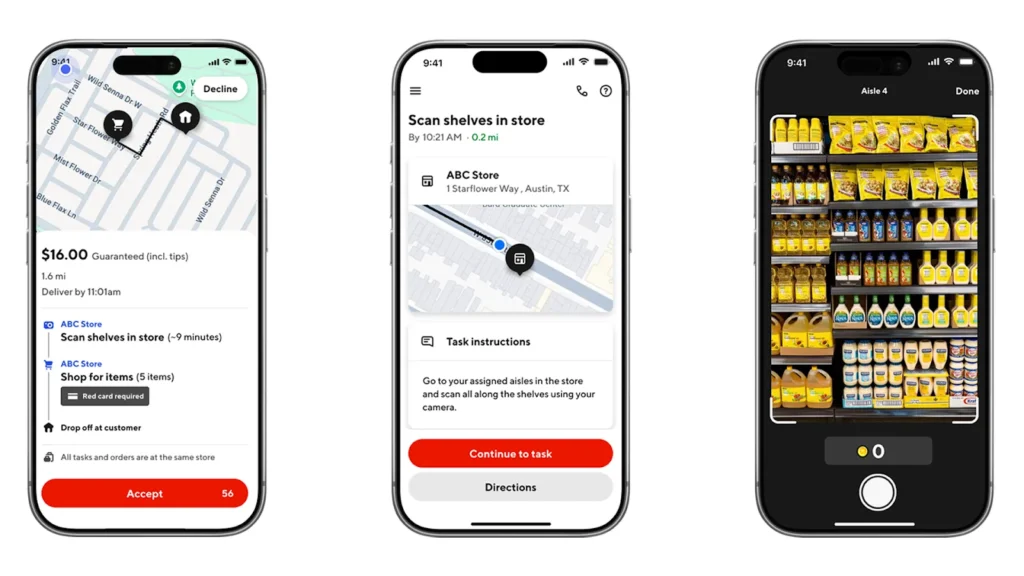
DoorDash’s new initiative introduces optional tasks that couriers can complete alongside or between deliveries.
These tasks may include:
- capturing images of delivery locations or storefronts
- verifying business details and menu accuracy
- labeling or categorizing real-world environments
- providing feedback on navigation or mapping systems
- recording data that can improve robotic or AI systems
While these activities may seem simple, they provide valuable real-world data used to train AI models.
In essence, couriers are helping machines better understand the physical world—one task at a time.
Why Human Data Is Still Essential for AI
Despite rapid advances in artificial intelligence, machines still struggle to fully interpret the complexity of real-world environments.
AI systems require vast amounts of labeled data to learn effectively.
Human workers provide:
- contextual understanding of environments
- judgment in ambiguous situations
- real-world verification of digital data
- corrections for AI errors
For example, a human can easily identify:
- whether a restaurant entrance is accessible
- if a building address is correctly labeled
- how crowded or complex a delivery location is
These insights are difficult for AI systems to generate on their own.
Training the Next Generation of Delivery Robots
DoorDash has been investing in automation technologies, including:
- autonomous delivery robots
- drone delivery systems
- AI-powered route optimization
The data collected by couriers can help improve these systems.
For instance:
- images of sidewalks and entrances can train navigation systems
- feedback on delivery challenges can improve robotic planning
- real-world observations can refine mapping algorithms
By leveraging its existing workforce, DoorDash gains access to a scalable, cost-effective data collection network.
The Economics Behind Micro-Tasking
For DoorDash, integrating AI training tasks into its platform offers several advantages.
Lower Data Collection Costs
Instead of hiring specialized teams, the company can use its existing workforce to gather data.
Scalable Workforce
Thousands of couriers can contribute data across different cities and environments.
Flexible Participation
Workers can choose when and whether to complete tasks, maintaining the gig economy’s flexibility.
For couriers, these tasks provide an opportunity to earn additional income.
However, the pay for micro-tasks is typically small, meaning workers must complete multiple tasks to generate meaningful earnings.
The Blurring Line Between Physical and Digital Labor
This shift highlights a growing trend: the convergence of physical and digital work.
Gig workers are no longer just performing physical tasks—they are also contributing to digital systems that power AI.
Similar trends are emerging in other industries:
- ride-share drivers collecting mapping data
- warehouse workers training robotics systems
- online freelancers labeling data for machine learning models
This hybrid model represents a new category of labor in the AI economy.
Ethical and Labor Concerns
While the concept offers new opportunities, it also raises important questions.
Compensation Fairness
Are workers being paid adequately for the value of the data they provide?
Transparency
Do workers fully understand how their data is being used?
Job Evolution
Will these tasks lead to new career opportunities—or simply more fragmented gig work?
Data Ownership
Who owns the data generated by workers, and how is it monetized?
Labor advocates argue that as companies benefit from AI training data, workers should share more directly in the value created.
The Future of AI Training Work
The use of gig workers for AI training is likely to expand.
As AI systems become more integrated into daily life, the demand for real-world data will increase.
Future roles may include:
- real-time feedback providers for autonomous vehicles
- human supervisors for AI systems in public environments
- hybrid jobs combining physical tasks with digital data collection
- specialized gig roles focused on AI training and validation
This could create new income streams—but also reshape how work is structured.
A New Kind of Workforce
DoorDash’s initiative reflects a broader transformation in the global economy.
Workers are increasingly becoming:
- contributors to AI systems
- sources of real-world data
- participants in machine learning processes
In this model, human labor does not disappear—it evolves.
Rather than being replaced by AI, workers are helping to build and improve the very systems that may one day automate parts of their jobs.
Frequently Asked Questions (FAQs)
1. What are DoorDash’s AI training tasks?
They are optional paid tasks where couriers collect data—such as images or feedback—that helps train AI systems and improve automation.
2. Why does DoorDash need couriers for AI training?
Human workers provide real-world data and context that AI systems cannot easily generate on their own.
3. Are couriers required to complete these tasks?
No. Participation is optional, allowing workers to choose whether to take on additional tasks.
4. How much do these tasks pay?
Payments are typically small per task, meaning workers need to complete multiple tasks to earn significant income.
5. What kind of AI systems benefit from this data?
The data can improve navigation systems, delivery robots, mapping tools and logistics optimization algorithms.
6. Is this trend limited to DoorDash?
No. Many companies are using gig workers and distributed labor to train AI systems.
7. Will this replace human jobs?
Not immediately. Instead, it represents a shift where humans play a role in training and supporting AI systems.

Conclusion
DoorDash’s move to turn couriers into AI trainers marks a significant moment in the evolution of work. It highlights how the gig economy is expanding beyond physical services into the digital infrastructure that powers artificial intelligence.
As companies increasingly rely on real-world data to train AI systems, workers will play a central role in shaping the future of automation. The challenge will be ensuring that this new form of labor is fair, transparent and rewarding for those who contribute.
In the emerging AI economy, the people delivering your food today may also be helping train the intelligent systems of tomorrow.
Sources Bloomberg

