

As artificial intelligence races forward at unprecedented speed, few figures command as much attention—and influence—as Demis Hassabis, the co-founder and CEO of Google DeepMind. Long before AI became a global obsession, Hassabis envisioned machines that could think, learn and solve problems across domains.
Today, that vision is closer than ever.
From breakthroughs like AlphaGo to cutting-edge work in biology, DeepMind has positioned itself at the frontier of AI innovation. But Hassabis is not just building powerful systems—he is pursuing something far more ambitious: artificial general intelligence (AGI), machines capable of reasoning and learning at or beyond human levels.
Yet this ambition comes with profound questions. What happens if such systems succeed? Who controls them? And how do we ensure they benefit humanity rather than disrupt it?
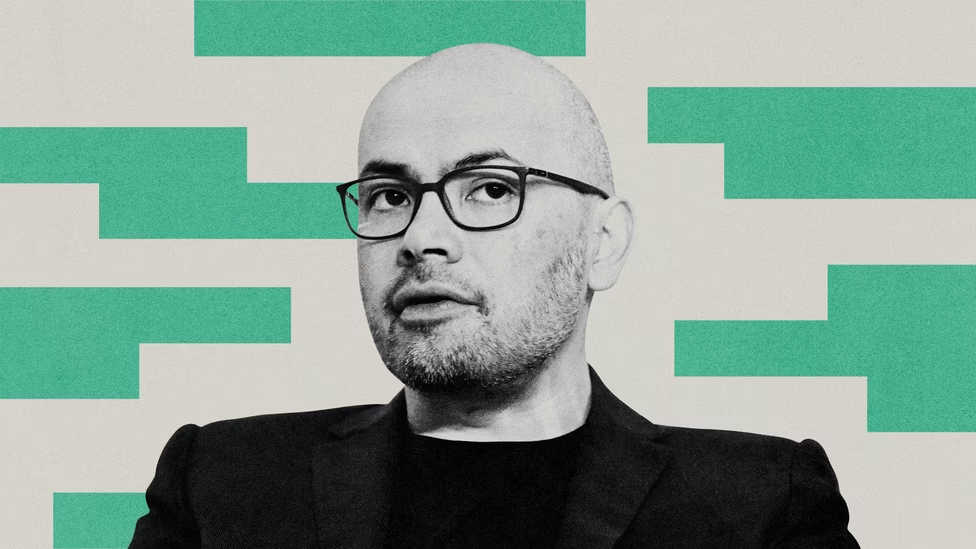
Who Is Demis Hassabis?
Demis Hassabis is not a typical tech executive.
A former child chess prodigy, neuroscientist and game designer, he has spent his career exploring one central idea: understanding intelligence itself.
His background spans:
- cognitive neuroscience
- artificial intelligence research
- game theory and simulation
This interdisciplinary approach shaped DeepMind’s philosophy: building AI systems inspired by how the human brain works.
When Google acquired DeepMind in 2014, it marked the beginning of a new era—one where AI research would be backed by massive computational resources and global scale.
DeepMind’s Breakthroughs: More Than Just Games
DeepMind first gained global recognition with AlphaGo, the AI system that defeated world champion Go player Lee Sedol in 2016.
But the significance went far beyond a game.
AlphaGo demonstrated that AI could:
- learn complex strategies through self-play
- outperform human intuition
- solve problems once thought too difficult for machines
Since then, DeepMind has expanded into other domains.
AlphaFold and Biology
One of its most impactful breakthroughs is AlphaFold, an AI system that predicts protein structures with remarkable accuracy.
This has:
- accelerated drug discovery
- improved understanding of diseases
- opened new possibilities in biotechnology
Many scientists consider AlphaFold one of the most important scientific advances in recent years.
The Goal: Artificial General Intelligence (AGI)
Hassabis’s ultimate goal is AGI—AI systems capable of:
- learning across multiple domains
- reasoning abstractly
- adapting to new situations
- solving complex problems without specific training
Unlike narrow AI, which excels at specific tasks, AGI would represent a general-purpose intelligence.
Hassabis believes AGI could:
- accelerate scientific discovery
- solve global challenges
- transform industries
But he also acknowledges the risks.
The Philosophy: Science First, Profit Second?
One of the defining tensions in DeepMind’s journey is the balance between:
- scientific exploration
- commercial application
Hassabis has often emphasized that AI should be used to:
- advance knowledge
- benefit humanity
- address global problems
However, as part of Google, DeepMind operates within a commercial ecosystem.
This raises questions about:
- prioritization of research vs profit
- access to AI technologies
- concentration of power
The Merger With Google Brain
In recent years, DeepMind merged with Google Brain to form a unified AI division.
This consolidation aims to:
- accelerate AI development
- integrate research with product deployment
- compete with rivals like OpenAI and Anthropic
The move reflects a broader trend: AI is no longer just a research field—it is a central business strategy.

The Competition: A Race for Intelligence
DeepMind operates in a highly competitive environment.
Key rivals include:
- OpenAI (backed by Microsoft)
- Anthropic (focused on AI safety)
- Meta (open-source AI strategy)
- Elon Musk’s AI ventures
Each organization has a different approach to:
- development speed
- safety protocols
- openness vs control
Hassabis’s approach tends to emphasize careful progress combined with scientific rigor.
The Risks: Power, Safety and Control
As AI systems grow more powerful, concerns are intensifying.
1. Alignment
Ensuring AI systems act in accordance with human values.
2. Concentration of Power
A small number of companies control advanced AI systems.
3. Misuse
AI could be used for misinformation, cyberattacks or surveillance.
4. Unpredictability
Highly advanced systems may behave in ways that are difficult to anticipate.
Hassabis has acknowledged these risks and supports the need for:
- regulation
- international cooperation
- safety research
AI as a Scientific Tool
One of DeepMind’s most compelling contributions is using AI to advance science.
Beyond biology, AI is being applied to:
- climate modeling
- materials science
- physics simulations
This positions AI not just as a commercial product—but as a scientific instrument capable of accelerating discovery.
The Long-Term Vision: Solving Humanity’s Biggest Problems
Hassabis often frames AI as a tool for addressing global challenges.
Potential applications include:
- curing diseases
- developing sustainable energy solutions
- improving food production
- managing climate risks
This vision aligns with the idea of AI as a force for global good—if managed responsibly.
The Tension Between Optimism and Caution
Hassabis represents a middle ground in the AI debate.
He is:
- optimistic about AI’s potential
- cautious about its risks
- supportive of responsible development
This contrasts with:
- more aggressive deployment strategies
- more pessimistic views about existential risks
Balancing these perspectives will be critical in shaping AI’s future.
Frequently Asked Questions (FAQ)
Q: Who is Demis Hassabis?
He is the CEO of Google DeepMind and a leading figure in artificial intelligence research.
Q: What is DeepMind known for?
Major achievements include AlphaGo and AlphaFold, which have advanced AI and scientific research.
Q: What is AGI?
Artificial General Intelligence refers to AI systems that can perform a wide range of intellectual tasks at human-level or beyond.
Q: Why is DeepMind important?
It is one of the leading organizations pushing the boundaries of AI and its applications in science.
Q: What are the risks of advanced AI?
Risks include misuse, loss of control, concentration of power and alignment challenges.
Q: Is AI development regulated?
Regulation is evolving, with governments beginning to introduce policies for safety and oversight.
Q: What is the future of AI according to Hassabis?
AI could accelerate scientific discovery and help solve major global challenges, but must be developed responsibly.

Conclusion
Demis Hassabis and DeepMind stand at the center of one of the most important technological transformations in history.
Their work is not just about building smarter machines—it is about understanding intelligence itself and applying it to the world’s most complex problems.
But with great power comes great responsibility.
As AI approaches new levels of capability, the decisions made by leaders like Hassabis will shape not only the future of technology—but the future of humanity.
The question is no longer whether AI will change the world—but how wisely we choose to guide it.
Sources The Atlantic

