

The old career formula used to feel almost immortal:
Get a degree.
Learn professional skills.
Work behind a computer.
Climb the corporate ladder.
Retire comfortably.
According to Mustafa Suleyman, that era may be ending far faster than most people expect.
The CEO of Microsoft AI recently warned that most computer-based professional tasks could become fully automated within the next 12 to 18 months. He specifically pointed to professions like:
- accounting
- law
- marketing
- project management
- administrative work
- software-related tasks
His prediction sent shockwaves through the technology and business world because it came not from a fringe futurist…
…but from one of the people actively building the future of AI itself.
And the deeper implication is even more unsettling:
The AI revolution may not arrive gradually. It may arrive all at once.
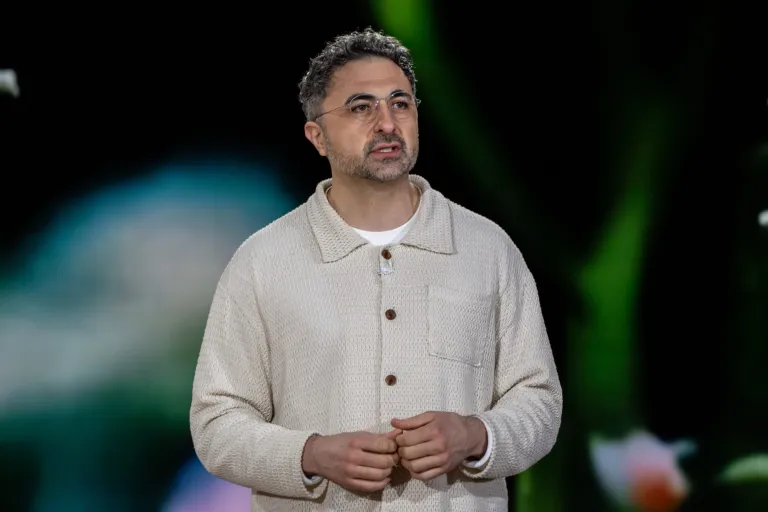
🧠 Why Mustafa Suleyman’s Warning Matters More Than Typical AI Hype
Silicon Valley makes bold predictions constantly.
Most fade away.
But Suleyman carries unusual credibility because he helped build modern AI infrastructure itself.
Before leading Microsoft AI, he:
- co-founded DeepMind
- helped pioneer applied AI systems
- later founded Inflection AI
- eventually became CEO of Microsoft’s AI division
This means his warnings are not coming from outside observers.
They are coming from inside the engine room.
And many investors, executives, and researchers are increasingly taking such timelines seriously.
⚡ Why White-Collar Jobs Suddenly Look Vulnerable
For decades, automation mainly targeted physical labor:
- factory work
- manufacturing
- repetitive industrial tasks
AI changes the equation because it automates cognition.
Modern generative AI systems can now:
- write legal drafts
- summarize meetings
- generate code
- analyze spreadsheets
- automate research
- create marketing campaigns
- answer customer inquiries
- process documentation
- coordinate workflows
In many cases:
the AI is already “good enough” for large portions of professional work.
And companies increasingly care about “good enough” more than perfection if costs drop dramatically.
💻 “Sitting at a Computer” Is Becoming a Risk Category
One reason Suleyman’s quote spread so widely is because it reframed automation in brutally simple terms.
Historically, office work felt safer than manual labor.
Now the danger zone increasingly looks like this:
jobs heavily dependent on digital information processing.
If your work mainly involves:
- documents
- spreadsheets
- emails
- reports
- structured communication
- repetitive decision-making
AI pressure is rising rapidly.
That does not necessarily mean jobs disappear overnight.
But it may mean:
- fewer hires
- smaller teams
- lower salaries
- compressed organizational structures
- reduced demand for junior workers
📉 The Real Threat Is Task Automation, Not Instant Job Elimination
One nuance often missing from AI discussions is important:
AI rarely replaces entire professions immediately.
Instead, it automates chunks of work.
For example:
- lawyers still exist
- but AI reduces time spent reviewing contracts
- marketers still exist
- but AI generates first drafts instantly
- programmers still exist
- but AI handles routine coding increasingly well
This creates what economists call:
“labor compression”
The same output requires fewer people.
And over time, that changes hiring dramatically.
🏢 Corporations Are Already Quietly Reorganizing Around AI
The transformation is not theoretical anymore.
Companies worldwide are already:
- reducing administrative hiring
- experimenting with AI agents
- flattening management layers
- increasing productivity targets
- automating workflows
Some executives now openly ask:
“Why hire five analysts if one analyst with AI can do the work?”
That logic is spreading rapidly across:
- finance
- consulting
- law
- media
- customer service
- software development
- enterprise operations
And once one competitor cuts costs using AI, others face pressure to follow.
🤖 AI Agents Could Accelerate the Disruption Even Faster
Large language models were only the beginning.
The next wave involves:
autonomous AI agents
These systems can:
- plan tasks
- use software tools
- interact with websites
- coordinate workflows
- complete multi-step operations
Suleyman reportedly suggested that within several years, AI agents may run large portions of institutional workflows more efficiently than humans.
That possibility changes the scale of disruption dramatically.
Because now AI is no longer just assisting workers.
It may begin replacing operational structures themselves.
⚠️ Why Experts Disagree on the Timeline
Not everyone agrees with the 18-month prediction.
Critics argue:
- businesses adopt technology slowly
- regulations create friction
- humans resist organizational change
- AI still makes serious errors
- trust remains a major issue
Even many AI researchers believe full occupational automation will take far longer.
But here’s the uncomfortable part:
Even if Suleyman is early…
the direction may still be correct.
And economically, direction matters more than perfect timing.
🧩 The Entry-Level Crisis Could Become the Biggest Problem
One of the most dangerous consequences involves junior workers.
AI is especially strong at:
- basic coding
- first drafts
- routine analysis
- summarization
- document preparation
But those are exactly the tasks younger employees traditionally performed while learning.
If AI removes beginner work:
- how do people gain experience?
- how do companies train future experts?
- how do career ladders survive?
This may become one of the defining labor challenges of the AI era.
🌍 The Global Economy Could Be Reshaped
The implications extend far beyond Silicon Valley.
Entire economies rely heavily on:
- outsourced office work
- call centers
- digital services
- administrative labor
- software support
Countries built around white-collar outsourcing may face enormous pressure if AI reduces labor demand globally.
This could reshape:
- international labor markets
- migration patterns
- education systems
- economic development strategies
🧠 AI May Change What Society Values
For decades, modern economies rewarded:
- information processing
- academic credentials
- office productivity
- administrative expertise
AI potentially commoditizes all four.
Ironically, some physical-world professions may become relatively more valuable:
- electricians
- mechanics
- plumbers
- logistics operators
- infrastructure technicians
Why?
Because the real world remains stubbornly difficult to automate fully.
🔥 The Psychological Impact May Be Massive
Work is not only about money.
It provides:
- status
- identity
- structure
- social belonging
- meaning
And many white-collar professionals increasingly feel existential anxiety about AI.
Especially because the systems threatening disruption improve continuously.
Unlike earlier automation:
AI evolves while workers sleep.
That creates a uniquely destabilizing psychological environment.
📊 The AI Economy May Create Extreme Winners and Losers
One possibility increasingly discussed by economists:
AI may create extraordinary productivity growth while simultaneously reducing labor demand.
That could lead to:
- enormous corporate profits
- concentrated wealth
- weaker worker bargaining power
- shrinking middle-class stability
Some analysts now compare AI to:
- the Industrial Revolution
- electrification
- the internet
Except potentially faster.
Much faster.
🔮 What Happens Next?
Three major scenarios are emerging:
1. AI augmentation economy
Humans remain central but become massively AI-assisted.
2. Workforce compression
Companies operate with far fewer employees.
3. Structural labor disruption
Entire white-collar sectors shrink permanently.
The reality may include elements of all three simultaneously.
❓ Frequently Asked Questions (FAQ)
Who is Mustafa Suleyman?
Mustafa Suleyman is a British AI entrepreneur who co-founded DeepMind and later became CEO of Microsoft AI.
What did Suleyman predict?
He predicted that most computer-based professional tasks could be automated by AI within 12 to 18 months.
Which jobs are most vulnerable?
Jobs involving repetitive cognitive work, including:
- accounting
- marketing
- legal analysis
- administrative work
- project management
- routine software tasks
Will AI replace all office jobs?
Probably not entirely. But it may significantly reduce the number of workers needed for many tasks.
Why is AI automation moving so fast?
Because software scales globally almost instantly, and AI models improve rapidly through increased compute power and training.
Are experts unanimous about this timeline?
No. Many researchers believe the transition will take longer due to economic, legal, and social friction.
What are AI agents?
Autonomous systems capable of planning and executing complex workflows with minimal human supervision.
What skills may become more valuable in the AI era?
Likely:
- creativity
- strategic thinking
- emotional intelligence
- systems design
- leadership
- physical-world technical skills
- AI oversight and orchestration

🧠 Final Thought
The most unsettling part of Mustafa Suleyman’s warning is not the timeline itself.
It is the realization that many of the people building advanced AI systems increasingly speak less like optimistic technologists…
…and more like witnesses describing an approaching economic storm.
Maybe the predictions are exaggerated.
Maybe businesses adapt more slowly.
Maybe society finds new forms of work.
But one thing is becoming difficult to deny:
The age where “working at a computer” guaranteed long-term economic security is beginning to crack.
And once AI starts performing cognitive labor at scale, the definition of work itself may never look the same again.
Sources Fortune

