
Artificial intelligence has become the biggest investment theme of the decade, creating enormous wealth for technology companies that build AI models, manufacture advanced chips, provide cloud infrastructure, or connect billions of users to AI-powered services.
Just as previous generations of investors followed groups like the Nifty Fifty, the Four Horsemen, FAANG, and the Magnificent Seven, a new market acronym has emerged: MANGOS.
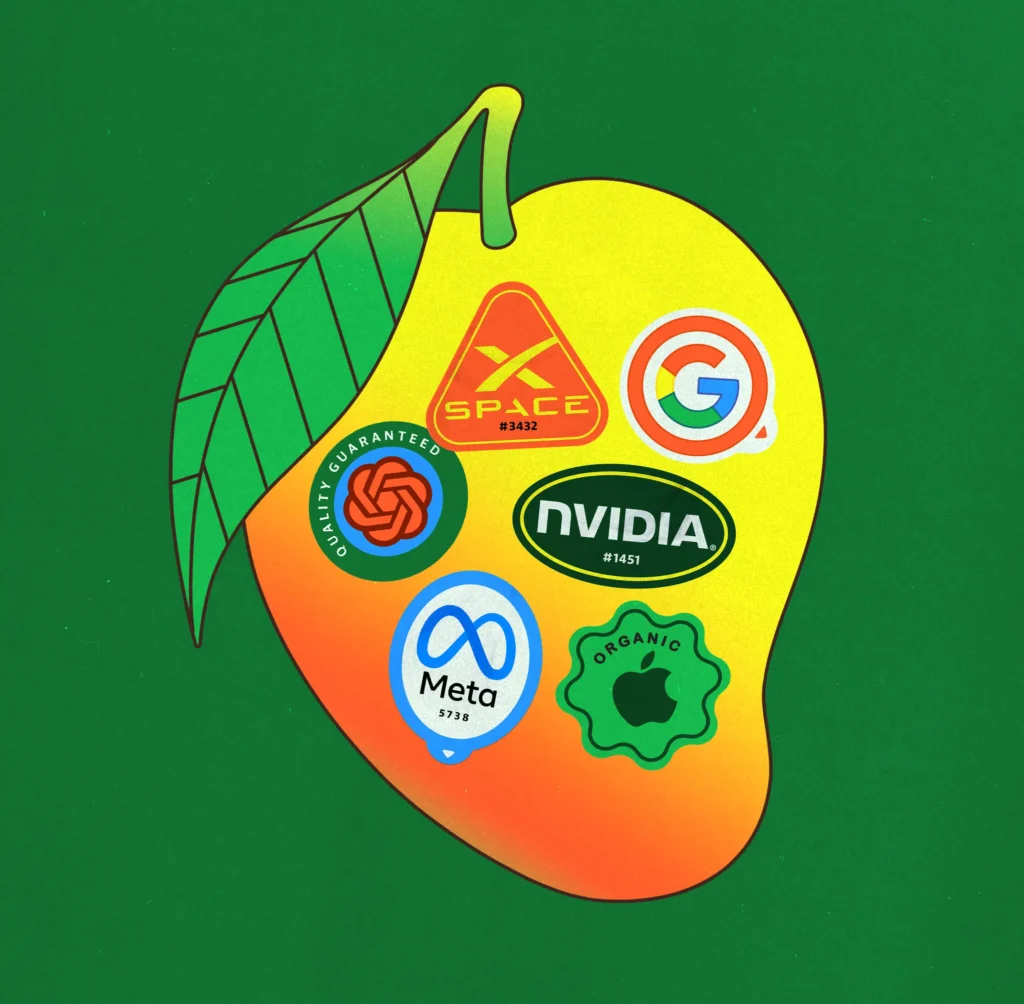
MANGOS refers to six companies widely viewed as the core of today’s AI ecosystem:
- Meta
- Anthropic
- Nvidia
- OpenAI
- SpaceX
Unlike earlier technology stock groupings, MANGOS combines both publicly traded companies and privately held AI leaders, reflecting how today’s AI revolution spans public markets, venture capital, cloud infrastructure, and space-based connectivity. The term has gained traction as investors search for the next generation of AI market leaders.
However, as enthusiasm reaches new highs, an important question is emerging:
Has the AI trade become too expensive, or is this only the beginning of a much larger technological transformation?
What Are the MANGOS Stocks?
The MANGOS acronym highlights companies occupying different strategic positions within the AI value chain.
Meta
Operates AI-powered social platforms, develops open-weight AI models, and invests heavily in AI infrastructure.
Anthropic
Focuses on enterprise AI models with an emphasis on safety, reliability, and constitutional AI.
Nvidia
Designs the GPUs and AI accelerators that power most large-scale AI training and inference.
Combines AI research, cloud computing, search, advertising, and custom AI hardware into one of the world’s largest AI ecosystems.
OpenAI
Popularized generative AI through conversational assistants and multimodal foundation models.
SpaceX
Provides satellite communications infrastructure through Starlink while increasingly being viewed as part of the broader AI infrastructure ecosystem because global connectivity is becoming essential for AI-enabled services.
Each company controls a different “bottleneck” within the AI economy, making the group more diversified than earlier technology stock clusters.
Why Investors Created Another Stock Acronym
Financial markets have always favored memorable labels.
Examples include:
- Seven Sisters
- Nifty Fifty
- FAANG
- Magnificent Seven
These names help describe periods when a relatively small group of companies drives an outsized share of market performance.
The MANGOS label reflects the belief that AI—not social media or smartphones—is now the dominant force shaping the technology sector.
History also provides a cautionary lesson: many once-dominant market groups eventually lost their leadership as technology and competitive dynamics changed.
Why AI Stocks Rose So Quickly
Several factors fueled extraordinary investor enthusiasm.
Explosive AI Adoption
Businesses across nearly every industry are integrating AI into customer service, software development, healthcare, finance, manufacturing, education, and logistics.
Massive Capital Investment
Technology companies are spending hundreds of billions of dollars building:
- AI data centers
- GPU clusters
- networking infrastructure
- cloud platforms
- custom AI chips
These investments are expected to continue for years, although rising capital expenditures are also becoming a key concern for investors.
Strong Revenue Growth
AI-related services continue generating rapid increases in cloud computing demand, enterprise software spending, and semiconductor sales.
Investor Optimism
Many investors believe AI represents a technological shift comparable to the internet, smartphones, or electricity.
Such expectations naturally lead to higher company valuations.
Why Some Investors Are Becoming More Cautious
Despite strong fundamentals, several risks are emerging.
Extremely High Valuations
High expectations leave little room for disappointment.
Even excellent financial results may fail to satisfy investors if growth slows.
Rising Infrastructure Costs
Building AI requires enormous spending on:
- advanced chips
- electricity
- cooling systems
- networking
- real estate
- engineering talent
Several AI leaders are dramatically increasing capital expenditures, raising questions about when those investments will translate into higher profits.
Growing Competition
The AI market is becoming increasingly crowded.
Companies now compete across:
- foundation models
- AI assistants
- enterprise software
- cloud platforms
- robotics
- autonomous systems
Greater competition may reduce pricing power over time.
Investor Rotation
As AI leaders become larger, some investors are rotating toward AI infrastructure companies, semiconductor suppliers, and other sectors that may benefit from AI spending. Recent research suggests AI infrastructure firms have begun outperforming some hyperscale technology companies.

The AI Investment Cycle Is Entering a New Phase
The first stage of the AI boom focused on excitement.
The next stage will likely focus on execution.
Investors increasingly want answers to questions such as:
- Can AI generate sustainable profits?
- Will enterprise customers continue increasing spending?
- Can companies recover enormous infrastructure investments?
- Will AI products become indispensable?
Future stock performance may depend less on AI announcements and more on measurable business results.
Capital Expenditure Is Becoming the New Battleground
One of the defining characteristics of today’s AI race is infrastructure spending.
Technology companies are investing unprecedented amounts in:
- hyperscale data centers
- AI chips
- fiber networks
- energy infrastructure
- specialized cooling systems
These investments create long-term competitive advantages but also place pressure on near-term earnings and free cash flow.
Companies must demonstrate that today’s spending produces tomorrow’s revenue growth.
Public vs. Private AI Companies
Unlike earlier market leaders, the MANGOS group includes both public and private firms.
Public companies provide quarterly financial reports, allowing investors to evaluate performance regularly.
Private companies such as Anthropic and OpenAI depend on venture capital and private funding rounds, making valuation more difficult and often more speculative.
This mix highlights how AI innovation increasingly spans both public equity markets and private investment.
Could Another AI Leader Emerge?
Technology history suggests leadership rarely remains fixed.
Future AI winners could emerge from areas including:
- robotics
- AI healthcare
- autonomous transportation
- industrial automation
- cybersecurity
- AI infrastructure
- semiconductor manufacturing
- edge computing
Some of tomorrow’s largest AI companies may not yet exist.
Lessons From Previous Technology Booms
Market history offers valuable perspective.
The internet boom created extraordinary long-term winners.
However, many early leaders disappeared through:
- acquisitions
- bankruptcies
- technological disruption
- changing consumer preferences
The same pattern could occur in AI.
While the technology itself appears transformational, individual company leadership is never guaranteed.
Diversification Still Matters
One of the biggest risks during periods of market enthusiasm is concentration.
When a small number of companies dominate market indices, portfolios become more vulnerable if sentiment changes. Some investment managers have warned that the growing weight of mega-cap U.S. technology companies reduces diversification and increases concentration risk.
Many financial professionals therefore recommend balancing exposure across:
- AI leaders
- infrastructure companies
- software firms
- healthcare
- industrials
- energy
- international markets
Diversification remains one of the most effective ways to manage long-term investment risk.
The Future of AI Investing
Artificial intelligence is unlikely to disappear as an investment theme.
Instead, the market may shift toward evaluating companies based on:
- recurring revenue
- profitability
- infrastructure efficiency
- customer adoption
- AI differentiation
- long-term competitive advantages
Companies that successfully convert AI innovation into sustainable earnings are likely to remain leaders regardless of changing market acronyms.
The Bottom Line
The emergence of the MANGOS stocks reflects the extraordinary influence artificial intelligence now has on global financial markets. These companies occupy some of the most important positions in the AI ecosystem, from chips and cloud infrastructure to foundation models, consumer platforms, and global connectivity.
Yet history suggests that every major technology boom eventually transitions from excitement to execution. Investors will increasingly judge AI leaders not by ambitious announcements but by their ability to generate durable revenue, manage massive infrastructure investments, and maintain competitive advantages in an increasingly crowded marketplace.
Whether the MANGOS group becomes the next enduring chapter in market history or simply another memorable Wall Street acronym remains uncertain. What is clear is that AI itself is likely to remain a defining force in technology and investing for many years to come.
Frequently Asked Questions (FAQ)
1. What are the MANGOS stocks?
MANGOS is a market acronym referring to six companies considered central to the AI revolution: Meta, Anthropic, Nvidia, Google, OpenAI, and SpaceX. Unlike earlier technology groupings, it includes both public and private companies.
2. Why are investors concerned about AI stock valuations?
Many AI companies trade at high valuations because investors expect rapid future growth. If revenue growth slows or infrastructure investments fail to generate expected returns, stock prices could become more volatile.
3. Why are AI companies spending so much money?
Developing advanced AI requires massive investments in GPUs, cloud infrastructure, data centers, networking, electricity, and specialized engineering talent. These capital expenditures are intended to support long-term AI growth.
4. Could another group replace the MANGOS stocks?
Yes. Technology leadership changes over time. Future AI leaders could emerge in robotics, healthcare, semiconductor manufacturing, cybersecurity, edge computing, or entirely new industries that have yet to mature.

5. What should long-term investors watch?
Key indicators include AI adoption rates, recurring revenue, profitability, infrastructure efficiency, competitive positioning, capital expenditure returns, and the ability to convert technological leadership into sustainable earnings growth.
Sources The New York Times

