
For decades, Intel was synonymous with computing. Its processors powered the vast majority of personal computers, its engineering breakthroughs helped define the semiconductor industry, and its manufacturing leadership made it one of the world’s most influential technology companies.
Today, however, Intel faces one of the greatest challenges in its history.
The explosive rise of artificial intelligence has fundamentally changed the semiconductor market. Instead of traditional CPUs dominating computing workloads, AI training and inference increasingly rely on specialized accelerators, high-performance GPUs, advanced networking, and enormous data center infrastructure.
While competitors have rapidly expanded their presence in AI computing, Intel has struggled to establish the same level of leadership. The company now finds itself at a critical turning point—one that will determine whether it can regain momentum in one of the fastest-growing technology markets in the world.
The situation extends beyond a single company. Intel’s journey reflects how quickly technological leadership can shift when an industry experiences a major platform transition.

How Intel Became a Semiconductor Giant
Founded in 1968, Intel played a central role in the personal computer revolution.
Its innovations included:
- x86 processor architecture
- High-performance desktop CPUs
- Laptop processors
- Server chips
- Semiconductor manufacturing
- Chip packaging technologies
For decades, the famous “Intel Inside” campaign symbolized reliability and performance for consumers worldwide.
The company’s processors became standard components in personal computers, enterprise servers, and business infrastructure.
Why Artificial Intelligence Changed Everything
Traditional computing workloads differ significantly from AI.
Conventional software often performs sequential calculations.
AI models require:
- Massive parallel computation
- Matrix operations
- High-bandwidth memory
- Extremely fast interconnects
- Specialized AI accelerators
Graphics processing units (GPUs), originally developed for computer graphics, proved exceptionally effective for these tasks.
This unexpected shift dramatically changed the semiconductor industry’s competitive landscape.
CPUs Still Matter—But Their Role Is Changing
Artificial intelligence has not made CPUs obsolete.
Instead, CPUs now work alongside specialized hardware.
Modern AI systems typically combine:
- CPUs for general computing
- GPUs for model training
- AI accelerators for inference
- High-speed networking
- Large-scale storage
Rather than replacing CPUs, AI has created increasingly heterogeneous computing environments.
Intel remains a major supplier of server CPUs, but the fastest-growing AI workloads increasingly involve specialized processors.
The Rise of AI Accelerators
Today’s AI infrastructure depends on chips specifically optimized for machine learning.
These include:
- GPUs
- Tensor processors
- Neural processing units (NPUs)
- Custom AI accelerators
- Edge AI processors
Unlike traditional processors, these chips are designed to execute thousands of mathematical operations simultaneously.
This architecture dramatically improves AI performance.
Competition Has Intensified
The AI boom has created fierce competition among semiconductor companies.
Major players include:
- NVIDIA
- AMD
- Intel
- Qualcomm
- Broadcom
- Cerebras
- Groq
- Tenstorrent
- Google (TPUs)
- Amazon (Trainium and Inferentia)
- Microsoft (Maia)
Each company focuses on different aspects of AI infrastructure, ranging from cloud computing to edge devices and enterprise data centers.
Manufacturing Has Become a Strategic Advantage
Building advanced semiconductors requires enormous investment.
Modern fabrication plants cost tens of billions of dollars.
Successful manufacturing depends upon:
- Extreme ultraviolet (EUV) lithography
- Advanced packaging
- Yield optimization
- Supply chain coordination
- Materials engineering
Intel has invested heavily in modernizing its manufacturing capabilities while expanding foundry services that produce chips for external customers.
This strategy aims to diversify revenue beyond Intel’s own processor designs.
The AI Opportunity Is Larger Than GPUs
Although GPUs receive much attention, AI infrastructure involves many additional technologies.
Examples include:
Networking
High-speed communication between thousands of AI processors.
Memory
Large language models require enormous memory bandwidth.
Storage
Training datasets occupy petabytes of information.
Cooling
AI clusters generate significant heat requiring sophisticated cooling systems.
Power Management
Large AI data centers consume substantial electricity.
Intel participates in several of these markets, offering opportunities beyond traditional processors.
Software Matters as Much as Hardware
Hardware alone does not determine AI success.
Developers need:
- Programming tools
- Optimized libraries
- AI frameworks
- Driver software
- Model optimization tools
A strong software ecosystem encourages organizations to deploy applications on specific hardware platforms.
This is one reason why AI software platforms have become increasingly important in semiconductor competition.
Intel’s AI Strategy
Intel has pursued multiple AI initiatives.
These include:
- Xeon processors optimized for AI inference
- Gaudi AI accelerators
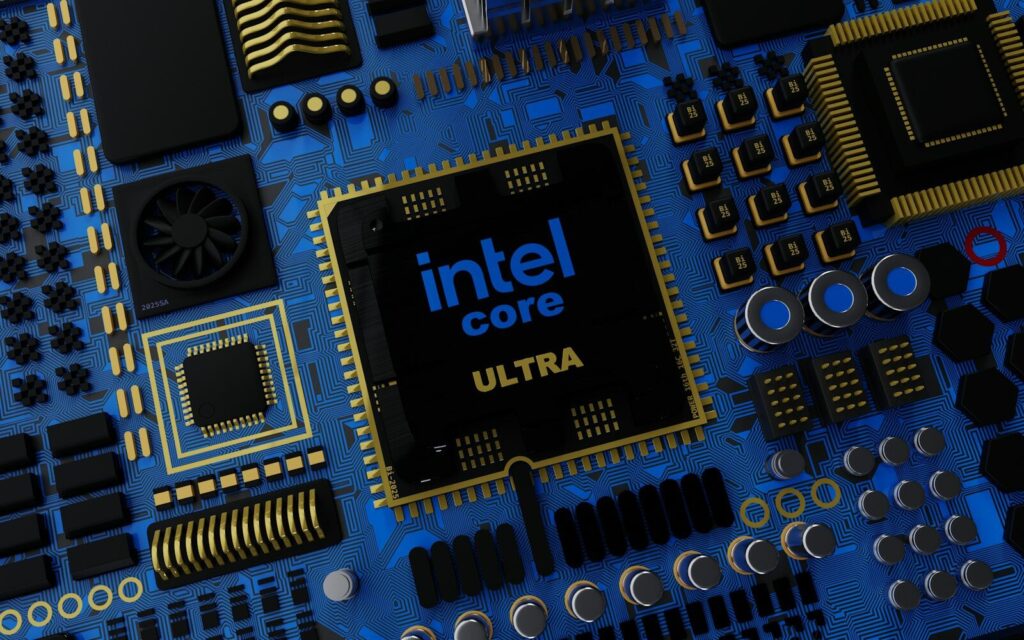
- AI-enabled Core Ultra processors
- Neural processing units for laptops
- Open software development tools
- Enterprise AI solutions
Rather than competing in only one market, Intel is attempting to build an end-to-end AI ecosystem spanning personal computers, enterprise servers, cloud infrastructure, and edge computing.
Edge AI Represents a Major Growth Opportunity
Not all AI runs inside massive data centers.
Increasingly, AI executes directly on:
- Laptops
- Smartphones
- Industrial equipment
- Medical devices
- Vehicles
- Smart cameras
- Manufacturing systems
This trend—known as Edge AI—reduces latency, improves privacy, and lowers cloud computing costs.
Intel’s long history in PC processors positions it to compete in this growing market.
Why Semiconductor Leadership Matters
Advanced semiconductors influence far more than consumer electronics.
They support:
- Scientific research
- Healthcare
- Financial services
- National security
- Telecommunications
- Autonomous vehicles
- Manufacturing
- Robotics
As AI adoption accelerates, semiconductor leadership increasingly affects economic competitiveness and geopolitical strategy.
Challenges Facing Intel
Despite its strengths, Intel faces several significant obstacles.
Market Competition
Rivals have gained strong momentum in AI accelerators.
Manufacturing Execution
Producing cutting-edge chips consistently remains technically demanding.
Software Ecosystem
Developers often prefer mature AI software platforms with broad community support.
Capital Investment
Semiconductor manufacturing requires continuous multibillion-dollar investments.
Rapid Innovation
AI hardware evolves much faster than traditional processor markets.
Why Reinvention Is Possible
Technology history includes many examples of companies successfully adapting to major industry shifts.
Success often depends on:
- Strong engineering talent
- Long-term investment
- Product innovation
- Manufacturing excellence
- Strategic partnerships
- Customer trust
Intel continues to possess substantial expertise in each of these areas.
Whether that translates into renewed AI leadership will depend on execution over the coming years.
The Future of AI Computing
Artificial intelligence is driving demand for increasingly diverse computing architectures.
Future systems will likely combine:
- CPUs
- GPUs
- NPUs
- Custom AI chips
- Photonic networking
- Advanced memory
- Specialized inference processors
No single processor type is expected to dominate every workload.
Instead, optimized combinations of different computing technologies will become increasingly common.
The Bigger Picture
Intel’s transformation reflects a broader truth about technological innovation.
Leadership in one computing era does not automatically guarantee leadership in the next.
Artificial intelligence has created new markets, new competitors, and new technical requirements that are reshaping the semiconductor industry at unprecedented speed.
Whether Intel fully regains its position as an AI leader remains uncertain.
However, its future will likely depend less on replicating past successes and more on adapting to a world where computing is increasingly driven by artificial intelligence, specialized hardware, software ecosystems, and integrated platforms.
The AI revolution is not simply changing how computers think—it is redefining which companies will power the next generation of global technology.
Frequently Asked Questions (FAQs)
1. Why has artificial intelligence changed the semiconductor industry?
AI workloads require massive parallel processing, high-bandwidth memory, and specialized accelerators that differ significantly from the CPUs traditionally used for general-purpose computing.
2. Does AI mean CPUs are becoming obsolete?
No. CPUs remain essential for general computing, operating systems, orchestration, and many enterprise workloads. They increasingly work alongside GPUs, NPUs, and other specialized AI processors rather than replacing them.
3. What is Edge AI?
Edge AI refers to running artificial intelligence directly on local devices—such as laptops, smartphones, vehicles, industrial equipment, or medical devices—instead of relying entirely on cloud data centers. This can improve response times, reduce bandwidth usage, and enhance privacy.
4. Why is semiconductor manufacturing strategically important?
Advanced chip manufacturing underpins artificial intelligence, cloud computing, telecommunications, scientific research, defense technologies, and many other industries. It has become a key factor in both economic competitiveness and national security.
5. Can Intel still compete successfully in the AI era?
Yes, although the competition is intense. Intel continues to possess strong engineering expertise, manufacturing capabilities, AI-focused processors, and enterprise relationships. Its long-term success will depend on executing its AI strategy, expanding its software ecosystem, and delivering competitive products across cloud, enterprise, and edge computing markets.
Sources The Wall Street Journal

