

When Nvidia executives took the stage at CES to unveil what comes next for the company, it wasn’t just another product announcement. It was a statement of intent.
Nvidia is no longer just a chipmaker riding the AI boom — it is positioning itself as the backbone of the global AI economy, from data centers and supercomputers to robotics, cars, and everyday devices.
The technologies Nvidia outlined point to a future where AI is not a feature layered onto products, but the core operating system of the modern world.
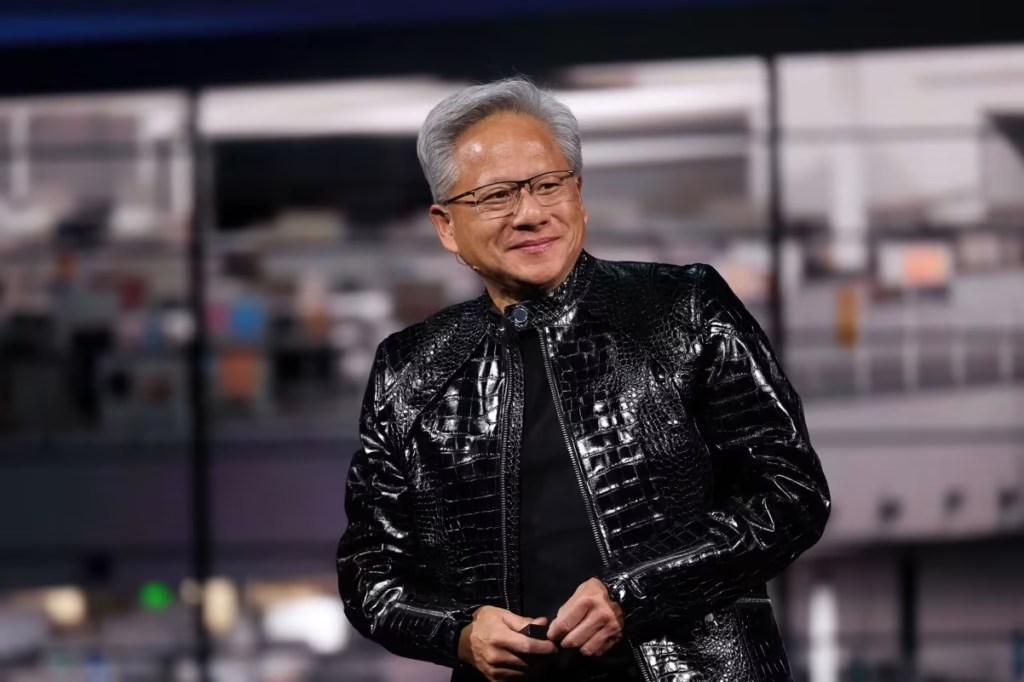
How Nvidia Became the World’s Most Valuable Tech Company
Nvidia’s rise has been driven by one central fact: modern AI runs on its hardware.
The company’s GPUs (graphics processing units) proved uniquely suited for training and running large AI models. As generative AI exploded, demand for Nvidia chips surged across:
- Cloud providers
- AI labs
- Enterprises
- Governments
But Nvidia’s dominance is no accident. It spent years building a tightly integrated ecosystem of hardware, software, and developer tools — making it extremely hard for competitors to catch up.
What Nvidia Announced — And Why It Matters
1. The Next Generation of AI Chips
Nvidia revealed details about its upcoming AI platforms, designed to dramatically increase performance while improving energy efficiency.
These new chips aim to:
- Train larger models faster
- Reduce power consumption per computation
- Support real-time inference at scale
The goal isn’t just faster AI — it’s AI everywhere, from massive data centers to edge devices.
2. AI as Infrastructure, Not a Feature
Nvidia is reframing AI as core infrastructure — similar to electricity or the internet.
This includes:
- AI “factories” (massive GPU clusters)
- Integrated networking and memory systems
- End-to-end software stacks that manage AI workloads
Instead of selling standalone chips, Nvidia is selling complete AI systems.
3. Expansion Beyond Data Centers
Nvidia outlined plans to push AI deeper into:
- Autonomous vehicles
- Robotics and humanoid systems
- Industrial automation
- Healthcare imaging
- Consumer PCs and devices
This diversification reduces reliance on any single market while embedding Nvidia technology into everyday life.
4. Software Is the Secret Weapon
While chips grab headlines, Nvidia’s software ecosystem is just as important.
Its platforms allow developers to:
- Optimize AI models for Nvidia hardware
- Deploy models across cloud and edge systems
- Build simulations and digital twins
This software lock-in makes switching away from Nvidia costly — reinforcing its competitive moat.

Why the Vera Rubin Platform Matters
Named after the astronomer who helped prove the existence of dark matter, Nvidia’s Vera Rubin platform represents a leap in AI computing architecture.
It combines:
- Advanced GPUs
- High-speed interconnects
- Memory optimized for massive models
The platform is designed to handle:
- Trillion-parameter AI models
- Complex simulations
- Multi-modal AI systems
In effect, Nvidia is preparing for a future where today’s “large” models look small.
What This Means for the Tech Industry
Cloud Computing
Cloud providers are racing to secure Nvidia’s latest hardware to meet AI demand. This reinforces Nvidia’s pricing power and strategic importance.
AI Startups
Startups benefit from Nvidia’s tools — but also become dependent on its ecosystem, raising long-term cost and competition concerns.
Competitors
Rivals like AMD, Intel, and custom AI chipmakers are pushing alternatives, but Nvidia’s integrated stack gives it a significant head start.
Governments
AI infrastructure is increasingly seen as a national strategic asset. Nvidia’s technology now sits at the intersection of economics, security, and geopolitics.
Risks Nvidia Still Faces
Despite its dominance, Nvidia’s future isn’t risk-free.
1. Regulation and Geopolitics
Export controls and geopolitical tensions could limit where Nvidia can sell its most advanced chips.
2. Energy and Sustainability
AI infrastructure consumes vast amounts of electricity. Energy efficiency and environmental impact are growing concerns.
3. Customer Concentration
A handful of large buyers account for a significant portion of revenue, making Nvidia sensitive to changes in spending cycles.
4. Competition Over Time
History shows that dominant tech platforms eventually face disruption — even if not immediately.
Why Nvidia’s Strategy Is About the Long Term
Nvidia is betting that:
- AI workloads will grow for decades
- Models will become larger and more capable
- AI will move from the cloud to the physical world
By controlling both hardware and software, Nvidia aims to become the default platform for intelligent computing, much as Windows once was for PCs.
Frequently Asked Questions
What is the Vera Rubin platform?
It’s Nvidia’s next-generation AI computing platform designed to support extremely large and complex AI models with higher efficiency and speed.
Why are Nvidia chips so important for AI?
GPUs excel at parallel processing, which is essential for training and running modern AI models.
Is Nvidia just an AI chip company?
No. Nvidia increasingly sells full AI systems, software platforms, and infrastructure solutions.
Who are Nvidia’s biggest competitors?
AMD, Intel, custom chips from cloud providers, and emerging AI accelerators — though Nvidia currently leads.
Could Nvidia’s growth slow down?
Yes. AI spending could cool, regulation could tighten, or competitors could catch up — but Nvidia’s ecosystem gives it strong momentum.
How does this affect everyday consumers?
AI-powered features in cars, healthcare, devices, and services are increasingly built on Nvidia technology.
The Bottom Line
Nvidia’s CES announcements make one thing clear: the company is planning for a future where AI is not optional — it is foundational.
By expanding beyond chips into full-stack AI infrastructure, Nvidia is shaping how intelligence is built, deployed, and scaled across the global economy.
The technology that made Nvidia the world’s most valuable company may only be at the beginning of its influence — and the next phase could redefine computing itself.
Sources CNN

