

For decades, cybersecurity had a clear enemy: human hackers.
They were clever, creative, and dangerous — but limited by time, fatigue, and scale.
That era is ending.
Today, AI-powered hackers are coming dangerously close to matching human attackers, and in some cases outperforming them. What once required years of skill can now be automated, copied, and deployed at machine speed. The result is a cybersecurity landscape that looks nothing like the one we’ve known.
This isn’t a warning about the future. It’s a description of the present.
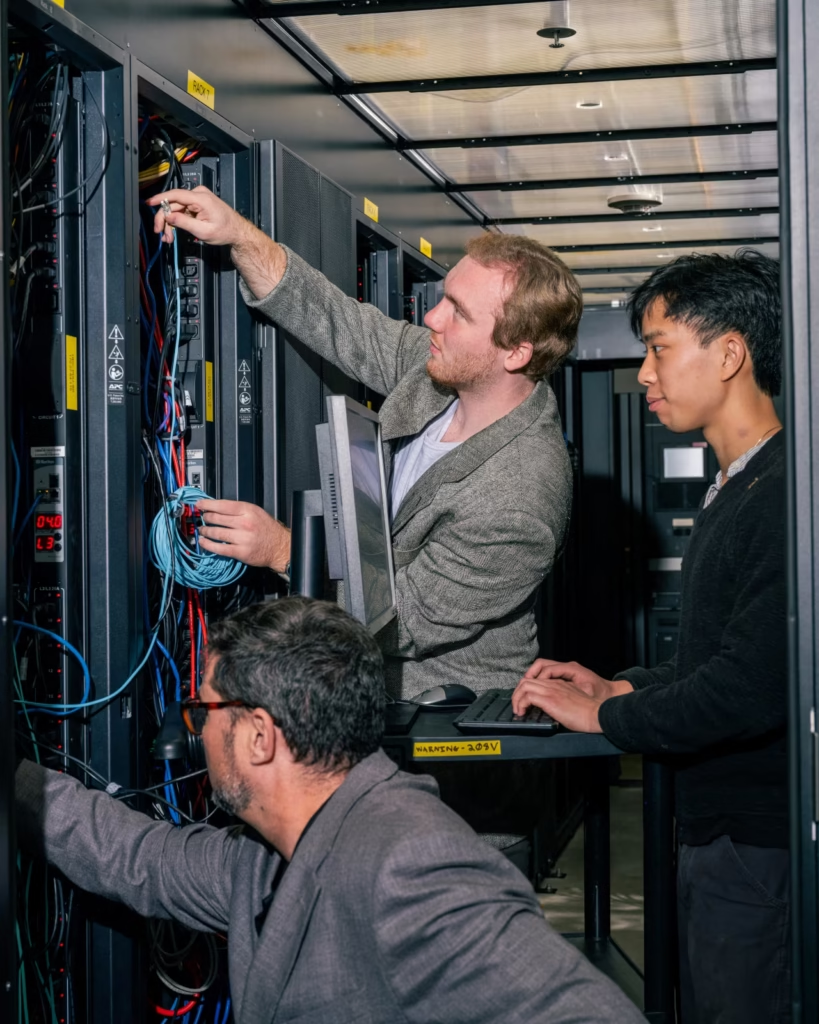
What “AI Hackers” Really Means
AI hackers aren’t robots breaking into systems on their own.
They are AI-driven tools that assist or automate cyberattacks, handling tasks that humans once did manually.
These systems can:
- scan massive codebases for weaknesses
- identify misconfigurations in cloud environments
- generate exploit ideas
- craft realistic phishing messages
- automate attack chains across thousands of targets
In controlled tests, AI systems already rival — and sometimes beat — junior human hackers at vulnerability discovery and exploitation.
Why AI Is So Good at Cyberattacks
1. AI Never Gets Tired
Humans work in bursts.
AI works endlessly.
An AI system can probe networks, test credentials, and analyze logs 24/7 without fatigue — a massive advantage in cybersecurity.
2. AI Learns From the Entire History of Hacking
Modern models are trained on:
- vulnerability databases
- security research
- exploit write-ups
- malware samples
- open-source code
This gives AI a pattern-recognition advantage humans can’t match alone.
3. AI Automates Repetition at Scale
Tasks like:
- port scanning
- brute-force testing
- exploit variation
- reconnaissance
are perfect for AI. What took teams of humans now takes a single system.
4. AI Lowers the Barrier to Entry
Perhaps the most dangerous change:
You no longer need deep expertise to launch serious attacks.
With AI assistance, even low-skill actors can generate convincing phishing campaigns or basic malware.
Where Humans Still Have the Edge — For Now
AI is powerful, but not unbeatable.
Humans still outperform machines at:
- creative attack design
- strategic planning
- adapting to novel defenses
- understanding organizational psychology
- exploiting human trust and confusion
But this gap is shrinking quickly.

What Most Coverage Misses
This Is an Arms Race, Not a Collapse
Defenders are using AI too.
AI-powered security tools now:
- detect anomalies in real time
- analyze massive data streams
- automate incident response
- simulate attacks before they happen
The future isn’t AI vs. humans — it’s AI vs. AI, with humans overseeing both sides.
AI Makes Attacks Harder to Detect
AI-driven attacks can be:
- slower
- stealthier
- adaptive
- more precise
This increases the risk of long-running breaches that stay hidden for months.
Infrastructure Is the New Battlefield
Attackers increasingly target:
- cloud configurations
- APIs
- identity systems
- AI pipelines
- supply-chain software
Modern systems are complex — and complexity breeds vulnerability.
Why This Matters to Everyone
AI-driven hacking means:
- more frequent breaches
- larger attack surfaces
- higher cybersecurity costs
- increased insurance premiums
- stricter compliance requirements
Small businesses and individuals are especially vulnerable, widening the digital security gap.
How Organizations Should Respond
1. Assume Attackers Are Using AI
Threat models must evolve.
Manual defense is no longer enough.
2. Use AI for Defense
Automation is now essential for detection and response.
3. Fix the Basics
Most attacks still exploit:
- weak passwords
- unpatched systems
- misconfigured cloud services
AI just finds these weaknesses faster.
4. Train People
AI-generated phishing is highly convincing.
Human awareness remains critical.
5. Prepare for Continuous Attacks
AI attackers don’t give up.
They adapt instantly.
The Turning Point in Cybersecurity
Cybersecurity has crossed a line.
Machines are no longer just tools — they’re becoming adversaries.
Humans still matter. Strategy still matters. Judgment still matters.
But speed and scale now belong to AI.
The organizations that survive will be those that treat AI as a core security force — not an optional upgrade.

Frequently Asked Questions
Q1. Are AI hackers better than humans?
In repetitive, large-scale tasks, yes. In creativity and strategy, humans still lead.
Q2. Who is using AI hacking tools?
Criminal groups, security researchers, and nation-state actors.
Q3. Will hacking increase?
Almost certainly — especially automated, low-skill attacks.
Q4. Can AI defend against AI hackers?
Yes, but only if adopted aggressively.
Q5. Are small businesses at risk?
Extremely — they often lack advanced defenses.
Q6. Is AI-generated malware common?
It’s growing rapidly, especially in customized variants.
Q7. Will regulation stop this?
Regulation may help, but technology moves faster.
Q8. What’s the biggest risk right now?
Stealthy, long-term breaches that go undetected.
Q9. Can AI understand human behavior?
Only partially — but it’s improving quickly.
Q10. What’s the future of cybersecurity?
Human strategy paired with AI automation — anything less will fail.
Sources The Wall Street Journal

