

Artificial intelligence is no longer just another technology sector—it has become the central battlefield for what may be the most valuable industry ever created. At the center of this struggle are three powerful and highly visible figures: Sam Altman of OpenAI, Dario Amodei of Anthropic, and Elon Musk of xAI.
Each is racing to build the most powerful AI systems in the world. Each believes their approach will define the future of intelligence, business, and global power. And each is competing not only with technology companies but with governments, regulators, and the broader forces shaping the global economy.
The stakes are extraordinary. Artificial intelligence could transform nearly every sector—from healthcare and finance to defense and education. Whoever builds the dominant AI platforms may control a market potentially worth trillions of dollars.
But the race is not just technological. It is also political, philosophical, and deeply personal.
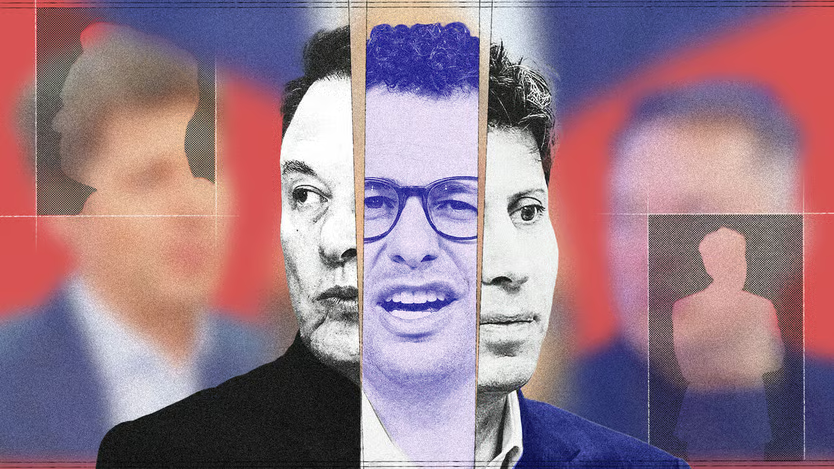
The Three Titans of the AI Race
Sam Altman – The Platform Builder
Sam Altman, CEO of OpenAI, is arguably the most influential figure in the current AI boom. Under his leadership, OpenAI released ChatGPT and a series of powerful language models that pushed generative AI into mainstream awareness.
Altman’s strategy focuses on building AI systems that serve as universal digital assistants capable of performing tasks across industries.
OpenAI’s key goals include:
- developing increasingly capable AI models
- integrating AI into everyday digital tools
- building a global ecosystem of AI applications
With deep financial backing from Microsoft, OpenAI has access to vast computing resources through Microsoft’s Azure cloud infrastructure.
Altman has also positioned himself as both an AI entrepreneur and a policy advocate, frequently engaging with governments about AI regulation and safety.
Dario Amodei – The Safety Architect
Dario Amodei, co-founder and CEO of Anthropic, represents a different vision for artificial intelligence.
Formerly a senior researcher at OpenAI, Amodei left to create Anthropic with a strong emphasis on AI safety and alignment—ensuring that increasingly powerful AI systems behave in ways that benefit humanity.
Anthropic’s flagship AI system, Claude, has gained attention for its ability to handle complex reasoning tasks and long-form interactions.
The company’s approach includes:
- extensive safety research
- rigorous testing of AI behavior
- transparency about AI capabilities
Anthropic has attracted major investments from companies including Google and Amazon, which see the startup as a key competitor in the AI race.
Elon Musk – The Disruptor
Elon Musk, one of the earliest investors in OpenAI before later becoming a critic, has reentered the AI race with his company xAI.
Musk has frequently warned about the dangers of artificial intelligence while simultaneously developing AI systems himself.
His strategy focuses on building models that challenge existing AI platforms and emphasize transparency and open research.
xAI aims to:
- compete with leading language models
- integrate AI into Musk’s broader technology ecosystem
- leverage data from platforms such as X (formerly Twitter)
Musk’s companies also control enormous computing resources through Tesla’s AI infrastructure and data centers.
The Economic Prize: Trillions of Dollars
The scale of investment flowing into artificial intelligence reflects its perceived economic potential.
Major technology companies are investing billions in:
- AI data centers
- specialized AI chips
- large language models
- robotics and automation systems
The value of the AI industry could eventually rival or exceed previous technological revolutions such as:
- the internet
- mobile computing
- cloud computing
Whoever controls the dominant AI platforms could shape the global economy for decades.
The Infrastructure Arms Race
Behind the public competition between AI companies lies an enormous infrastructure battle.
Training modern AI models requires massive computing power.
Companies are investing heavily in:
- GPU clusters
- specialized AI processors
- hyperscale data centers
- global fiber networks
Some AI training runs require tens of thousands of GPUs operating simultaneously.
Access to computing power may become one of the most important factors determining which company wins the AI race.
The Political Dimension
The AI competition is not just corporate—it is geopolitical.
Governments are increasingly involved in shaping AI development.
Concerns include:
- national security risks
- economic competitiveness
- misinformation and social stability
- labor market disruptions
The United States, China and the European Union are all developing policies aimed at regulating or guiding AI technologies.
Companies like OpenAI and Anthropic frequently interact with policymakers to shape these regulations.

Ethical and Philosophical Divides
Despite competing in the same industry, Altman, Amodei and Musk hold different views about AI’s long-term impact.
Altman’s Vision
Altman believes AI will become a powerful tool that dramatically increases human productivity.
He has spoken about the possibility of artificial general intelligence (AGI) transforming society and potentially creating unprecedented economic abundance.
Amodei’s Perspective
Amodei focuses on the risks of uncontrolled AI development.
Anthropic invests heavily in research aimed at ensuring that AI systems remain aligned with human values.
Musk’s Warnings
Musk has repeatedly warned that AI could become dangerous if developed without adequate safeguards.
At the same time, his companies are actively building competing systems.
These philosophical differences shape how each company approaches AI development.
Dirty Tactics and Fierce Competition
As competition intensifies, the AI race has become increasingly aggressive.
Companies are competing for:
- top AI researchers
- access to advanced chips
- massive data sets
- partnerships with cloud providers
Recruiting wars for elite AI talent have driven salaries to extraordinary levels.
Some engineers are reportedly offered compensation packages worth millions of dollars annually.
At the same time, companies carefully guard their models and training techniques as proprietary secrets.
The Risk of an AI Bubble
The enormous enthusiasm surrounding artificial intelligence has led some economists to warn about the possibility of an AI investment bubble.
Indicators include:
- massive capital expenditures
- soaring valuations for AI startups
- aggressive predictions about future profits
However, even if some companies fail, the underlying technological progress may still reshape industries.
Previous technology bubbles—such as the dot-com boom—ultimately left behind transformative infrastructure.
What Happens Next?
The outcome of the AI race remains uncertain.
Possible future scenarios include:
- one dominant AI platform controlling global markets
- several competing ecosystems across regions
- heavy government regulation shaping AI development
What is certain is that artificial intelligence will play a central role in shaping the 21st century economy.
The rivalry between Altman, Amodei and Musk is only the beginning of a much larger transformation.
Frequently Asked Questions (FAQ)
Q: Who are the main leaders in the AI race?
Key figures include Sam Altman (OpenAI), Dario Amodei (Anthropic), and Elon Musk (xAI).
Q: Why is artificial intelligence so valuable?
AI has the potential to automate complex tasks across nearly every industry, creating enormous economic value.
Q: What is artificial general intelligence (AGI)?
AGI refers to AI systems capable of performing intellectual tasks at or beyond human-level ability across many domains.
Q: Why are companies spending billions on AI infrastructure?
Training advanced AI models requires enormous computing power, data centers and specialized hardware.
Q: Is there a risk of an AI bubble?
Some economists believe investment enthusiasm could exceed short-term economic returns, though the long-term impact of AI may still be transformative.
Q: Why is AI development controversial?
Concerns include job displacement, misinformation, national security risks and the potential for uncontrolled AI systems.
Q: Could one company dominate AI?
It is possible, but the industry may also evolve into a competitive ecosystem with multiple major players.

Conclusion
The battle for artificial intelligence supremacy is shaping up to be the most consequential technology rivalry of our time.
Sam Altman, Dario Amodei and Elon Musk represent three powerful visions for the future of intelligent machines. Their competition reflects not only the enormous economic potential of AI but also the uncertainty surrounding its long-term impact.
As the race intensifies, the companies building the most powerful AI systems may determine how knowledge, productivity and innovation evolve for generations.
The ultimate prize is not just technological leadership—it is influence over the future of intelligence itself.
Sources The Economist

