
Elon Musk’s vision for the future has always extended beyond cars and rockets—and now it is becoming increasingly clear that humanoid robots powered by “physical AI” may be his most ambitious project yet. Tesla’s Optimus robot is no longer just a concept; it represents a serious attempt to bring artificial intelligence out of the digital world and into the physical one.
While AI chatbots and software systems dominate headlines, Musk is betting on something bigger: machines that can see, move, think and act in the real world. If successful, Optimus could redefine labor, reshape industries and fundamentally change how humans interact with technology.
But despite the excitement, the path to a fully capable humanoid robot is filled with technical, economic and ethical challenges.
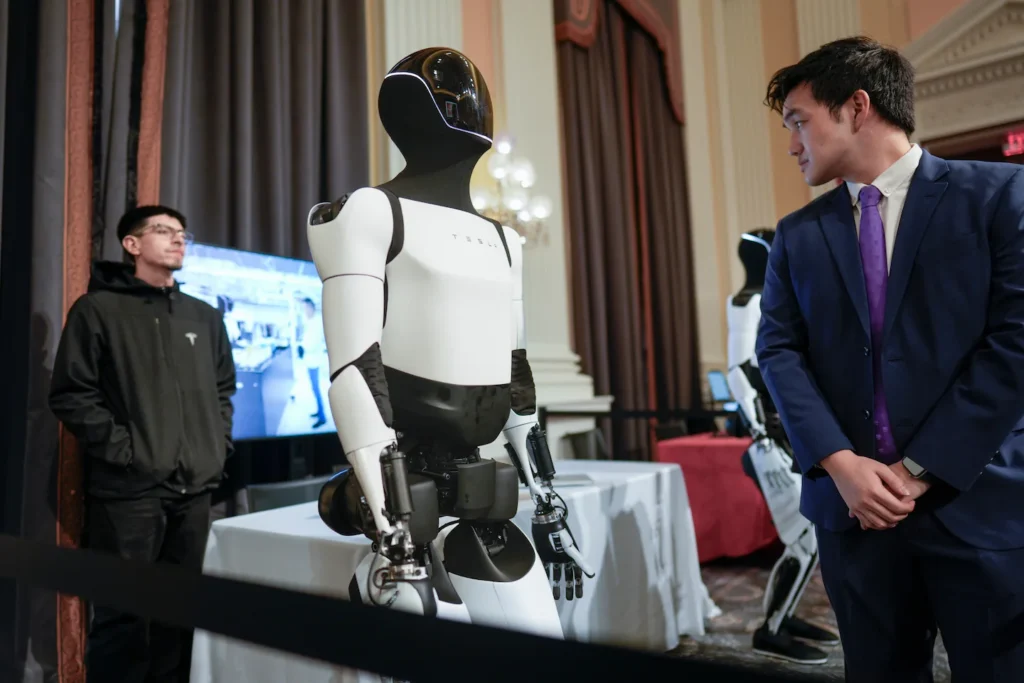
What Is Tesla Optimus?
Optimus is Tesla’s humanoid robot designed to perform physical tasks in environments built for humans.
Unlike industrial robots that operate in controlled settings, Optimus is intended to:
- walk and navigate human spaces
- manipulate objects with hands
- perform repetitive or dangerous tasks
- assist in factories, warehouses and potentially homes
The robot leverages Tesla’s existing expertise in:
- computer vision
- AI decision-making
- hardware engineering
- battery systems
In many ways, Optimus is an extension of Tesla’s autonomous driving technology—applied to the human body.
What Is “Physical AI”?
“Physical AI” refers to artificial intelligence systems that interact directly with the physical world.
While traditional AI operates in digital environments, physical AI combines:
- perception (seeing and sensing)
- reasoning (decision-making)
- action (movement and manipulation)
This requires integrating multiple technologies:
Computer Vision
Allows robots to understand their surroundings through cameras and sensors.
Robotics Engineering
Enables movement, balance and object handling.
Machine Learning
Helps systems learn from experience and adapt to new situations.
Real-Time Processing
Allows instant responses to dynamic environments.
Physical AI is significantly more complex than software-based AI because it must deal with unpredictable real-world conditions.
Why Tesla Is Building Robots
Tesla’s interest in robotics is closely tied to its long-term strategy.
Labor Shortages
Many industries face shortages of workers for repetitive or physically demanding jobs.
Cost Efficiency
Robots could reduce long-term labor costs in manufacturing and logistics.
Scalability
Machines can be deployed at scale without the constraints of human labor.
Vertical Integration
Tesla can use robots in its own factories, improving efficiency and reducing reliance on external labor.
Musk has suggested that humanoid robots could eventually become more significant than Tesla’s car business.
What Optimus Can Do Today
Current versions of Optimus are still in development but have demonstrated capabilities such as:
- walking and balancing
- picking up and moving objects
- performing basic assembly tasks
- navigating structured environments
Tesla has showcased prototypes performing simple factory tasks, such as sorting items or handling components.
However, these demonstrations are far from the versatility of human workers.
The Hard Problem: Dexterity and Adaptability
One of the biggest challenges in robotics is dexterity—the ability to handle objects with precision.
Humans perform complex tasks effortlessly, such as:
- folding clothes
- cooking
- assembling small components
For robots, these tasks are extremely difficult due to:
- variations in object shapes and textures
- unpredictable environments
- the need for fine motor control
Achieving human-level dexterity remains one of the biggest hurdles for physical AI.
The Data Advantage
Tesla’s unique advantage lies in data.
Its vehicles collect vast amounts of visual and spatial data from real-world environments.
This data can be used to train AI systems for:
- object recognition
- navigation
- decision-making
While driving and robotics are different challenges, the underlying AI systems share similarities.
This gives Tesla a potential edge in developing physical AI at scale.
Competition in Humanoid Robotics
Tesla is not alone in pursuing humanoid robots.
Other major players include:
- Boston Dynamics (advanced robotics systems)
- Figure AI (general-purpose humanoid robots)
- Agility Robotics (warehouse-focused robots)
- Chinese robotics companies investing heavily in humanoid designs
Each company is exploring different approaches to mobility, control and AI integration.
The race to build practical humanoid robots is becoming increasingly competitive.
The Economic Impact of Robot Labor
If humanoid robots become viable, the economic implications could be enormous.
Productivity Gains
Robots could operate continuously without fatigue.
Industry Transformation
Manufacturing, logistics and service sectors could be reshaped.
Labor Market Disruption
Certain jobs may be automated, particularly repetitive or manual roles.
New Job Creation
New roles may emerge in robotics engineering, maintenance and AI supervision.
The transition could be both transformative and disruptive.
Ethical and Social Questions
The rise of physical AI raises important concerns.
Job Displacement
How will societies adapt if large numbers of jobs are automated?
Safety
How can robots operate safely around humans?
Privacy
Robots equipped with cameras and sensors may collect sensitive data.
Human Interaction
How will relationships between humans and machines evolve?
These questions will become more urgent as robots move into everyday environments.
The Timeline: How Close Are We?
Despite rapid progress, fully capable humanoid robots are still years away from widespread adoption.
Key challenges include:
- improving reliability
- reducing costs
- scaling production
- ensuring safety
Experts suggest that initial deployments will likely occur in:
- factories
- warehouses
- industrial settings
Consumer use may take longer.
The Bigger Picture: From Digital AI to Physical Intelligence
The development of Optimus represents a broader shift in artificial intelligence.
AI is moving from:
- software systems (chatbots, algorithms)
to - embodied systems (robots, autonomous machines)
This transition could be as significant as the rise of the internet or smartphones.
Physical AI has the potential to transform not just how we work—but how we live.
Frequently Asked Questions (FAQ)
Q: What is Tesla Optimus?
Optimus is a humanoid robot developed by Tesla to perform physical tasks in human environments.
Q: What is physical AI?
Physical AI refers to artificial intelligence systems that interact with and operate in the real world.
Q: Can Optimus replace human workers?
Not yet. It can assist with simple tasks, but human-level capability is still far away.
Q: Why is Tesla building robots?
Tesla aims to address labor shortages, improve efficiency and expand its technology ecosystem.
Q: Are humanoid robots safe?
Safety is a major focus, but ensuring reliable operation around humans remains a challenge.
Q: How soon will robots like Optimus be widely available?
Widespread adoption may take several years, especially for consumer use.
Q: Will robots become part of everyday life?
Possibly. If technology improves and costs decrease, humanoid robots could become common in the future.
Conclusion
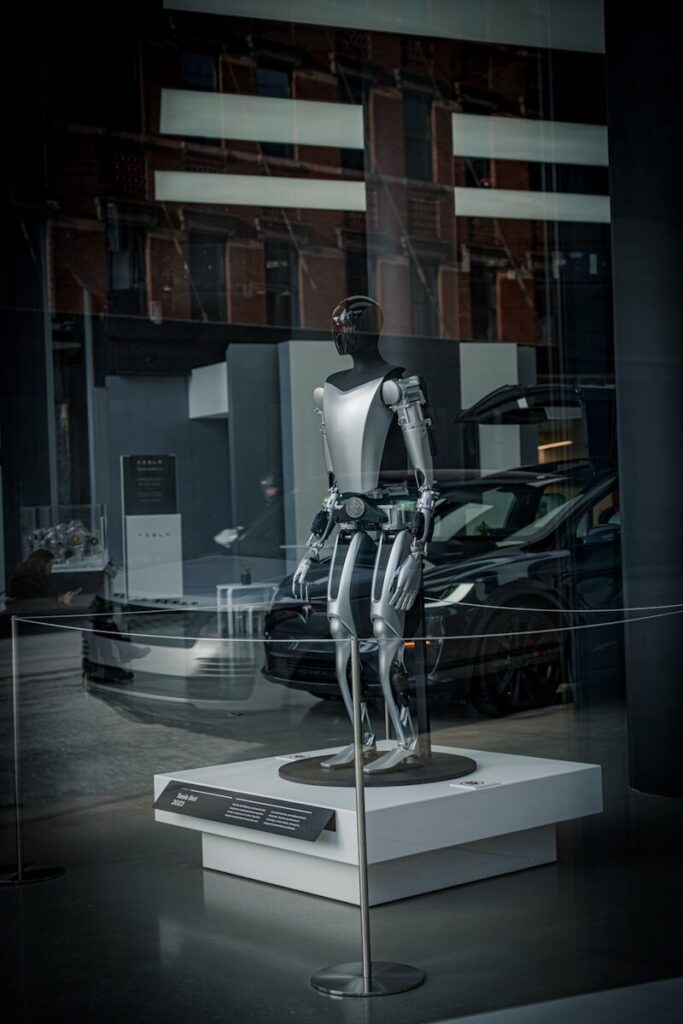
Tesla’s Optimus project represents a bold step toward a future where artificial intelligence is no longer confined to screens and software—but embodied in machines that move and act in the real world.
While the technology is still in its early stages, the potential impact is enormous. From transforming industries to redefining labor, physical AI could become one of the most important technological shifts of the 21st century.
But as with any powerful innovation, the challenge will not just be building these systems—it will be ensuring they are safe, beneficial and aligned with human needs.
Because when AI gains a body, the future stops being theoretical—and starts becoming real.
Sources The Washington Post

