
The rise of humanoid robots has long been a vision of the future—machines that can walk, grasp, assist and even collaborate with humans in real-world environments. But behind this technological leap lies an unexpected and rapidly growing reality:
Humans are now being hired to train robots how to be human.
From warehouses to labs, a new category of jobs is emerging—workers who spend hours performing physical tasks, recording movements and guiding AI systems so that robots can learn how to interact with the world. This process is reshaping both the robotics industry and the labor market, creating opportunities while raising complex ethical and economic questions.
The Hidden Workforce Behind Humanoid Robots
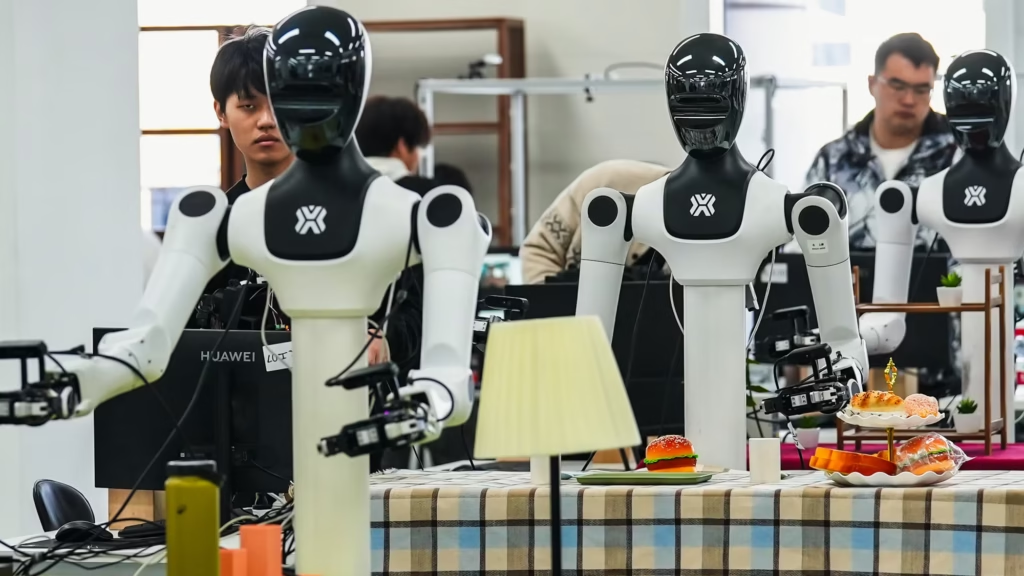
While headlines often focus on advanced robotics companies, the real progress depends on a less visible group: robot trainers.
These workers are responsible for:
- demonstrating physical tasks (e.g., picking up objects, walking, assembling items)
- wearing motion-capture suits or using sensors
- annotating data for machine learning systems
- correcting robot behavior during training
In essence, they provide the real-world data that robots need to function effectively.
Why Robots Need Human Training
Unlike traditional software, humanoid robots must operate in unpredictable environments.
They need to understand:
- balance and movement
- object manipulation
- spatial awareness
- human interaction cues
AI alone cannot fully learn these skills from simulations.
The Reality Gap
Simulations often fail to capture:
- real-world physics variations
- unexpected obstacles
- human behavior nuances
Human training helps bridge this “reality gap,” enabling robots to function outside controlled environments.
How the Training Process Works
1. Demonstration
Humans perform tasks while sensors capture:
- movement patterns
- force and pressure
- timing and coordination
2. Data Processing
This data is converted into training inputs for AI models.
3. Robot Learning
Robots use machine learning techniques to:
- replicate actions
- optimize performance
- adapt to variations
4. Iteration
Humans provide feedback and corrections, refining the robot’s behavior.
This cycle may be repeated thousands of times for a single task.
A New Kind of Job Market
The demand for robot training is creating new employment opportunities.
Types of Roles
- motion capture operators
- robotics trainers
- data annotators for physical tasks
- simulation testers
- human-robot interaction specialists
Who Is Being Hired?
- factory workers transitioning into tech roles
- gig workers performing repetitive demonstrations
- specialists with robotics or biomechanics knowledge
This creates a hybrid workforce combining physical labor and digital training.

The Economic Trade-Off
There is a paradox at the heart of this trend:
Humans are training machines that may eventually replace human labor.
Short-Term Benefits
- job creation in emerging fields
- new income opportunities
- skill development
Long-Term Risks
- automation of the same tasks being taught
- job displacement in industries like logistics, manufacturing and retail
This raises questions about sustainability and fairness.
What the Original Discussion Often Misses
Training Is Labor-Intensive
Despite advanced AI, training robots still requires significant human effort.
Global Labor Dynamics
Much of this work may be outsourced to regions with lower labor costs, creating:
- uneven economic benefits
- potential labor exploitation concerns
Data Ownership Issues
Who owns the movement data generated by human workers?
Skill Stratification
Higher-skilled roles (robotics engineers) benefit more than low-paid trainers.
The Ethical Questions
As humanoid robotics advances, ethical concerns are growing.
Is This Work Fairly Compensated?
Some training roles resemble gig work, with:
- low pay
- repetitive tasks
- limited job security
Are Workers Being Replaced by Their Own Data?
Workers may contribute to systems that eventually eliminate their roles.
Transparency and Consent
Do workers fully understand how their data is used?
These questions are becoming central to the future of robotics.
The Technological Payoff
Despite challenges, the benefits of humanoid robots are significant.
Increased Productivity
Robots can work continuously without fatigue.
Safety Improvements
Robots can handle dangerous tasks.
Labor Shortage Solutions
In aging populations, robots can fill workforce gaps.
New Industries
Robotics development creates new economic sectors.
The Future of Human-Robot Collaboration
Rather than full replacement, many experts envision a hybrid future:
- humans and robots working side by side
- robots handling repetitive tasks
- humans focusing on complex, creative or interpersonal work
However, the balance between collaboration and replacement remains uncertain.
A Turning Point in Labor and Technology
The rise of humanoid robot training represents a unique moment:
- humans teaching machines
- machines learning to replace humans
- new jobs emerging alongside future risks
It is both an opportunity and a warning.
Frequently Asked Questions (FAQ)
Q: What is a humanoid robot trainer?
A worker who helps teach robots how to perform physical tasks using demonstrations and data.
Q: Why can’t robots learn everything on their own?
Real-world environments are too complex for simulations alone.
Q: Are these jobs well paid?
It varies widely. Some roles are technical and well-paid, while others resemble gig work.
Q: Will these jobs disappear in the future?
Some may, as robots become more capable.
Q: What industries will be affected?
Manufacturing, logistics, healthcare and service industries.
Q: Is this trend global?
Yes. Robot training work is emerging worldwide.
Q: What skills are needed for these jobs?
Basic physical coordination, attention to detail and, for advanced roles, technical knowledge.
Conclusion
The development of humanoid robots is not just a technological story—it is a human one.
Behind every intelligent machine is a network of people teaching it how to move, think and interact. This new workforce is shaping the future of robotics, even as it faces uncertainty about its own role in that future.
As robots become more capable, society must confront a fundamental question:
How do we ensure that the people building the future are not left behind by it?
Because in the race to create machines that can do everything, the real challenge is ensuring that progress benefits everyone—not just the technology itself.
Sources CNN

