

In the rapidly intensifying global artificial intelligence race, Chinese technology companies are deploying an unusual strategy: they are paying users to adopt their AI services.
Major Chinese tech firms—including Baidu, Alibaba, Tencent and emerging AI startups—are offering cash rewards, free credits, subsidies and generous incentives to attract users to their AI platforms. The approach reflects a fierce competition not only between companies but also between nations seeking dominance in the next generation of digital infrastructure.
As artificial intelligence becomes a foundational technology for the global economy, China’s tech giants are racing to build massive user bases—even if it means losing money in the short term.
The logic is simple: the AI platform with the most users and data today could control the digital economy tomorrow.
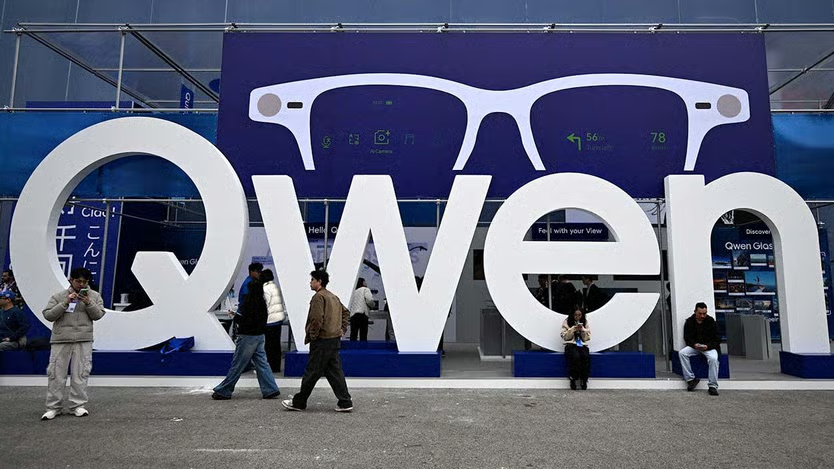
Why Chinese AI Companies Are Paying Users
The incentive programs are designed to accelerate adoption of AI services such as:
- chatbot platforms
- AI-powered productivity tools
- content generation systems
- coding assistants
- AI-driven search engines
Companies are offering benefits including:
- cash bonuses for new users
- free computing credits
- referral rewards
- discounts on AI services
- promotional subsidies for developers
These incentives encourage individuals and businesses to experiment with AI tools and integrate them into their daily workflows.
In a market where many users are still exploring how to use artificial intelligence effectively, lowering the barrier to entry is critical.
The Data Advantage
Artificial intelligence systems improve through training data and user interaction.
The more people use a platform, the more feedback and behavioral information companies can collect to improve their models.
This creates a powerful feedback loop:
- More users generate more data.
- More data improves AI performance.
- Better performance attracts more users.
By subsidizing user growth early, companies hope to dominate the long-term AI ecosystem.
In many ways, the strategy resembles the early days of ride-hailing apps or food delivery services, where companies heavily subsidized usage to capture market share.
China’s Major AI Players
China’s technology sector includes several major players competing in the AI race.
Baidu
Often called China’s equivalent of Google, Baidu has heavily invested in large language models and AI-powered search systems. Its ERNIE model is among the country’s leading generative AI platforms.
Alibaba
Alibaba is integrating AI into e-commerce, cloud computing and enterprise services. Its Tongyi Qianwen model is used in applications ranging from business analytics to content generation.
Tencent
Tencent is incorporating AI into its massive ecosystem of messaging, gaming and digital services.
Emerging AI Startups
Numerous startups are also competing aggressively, often backed by venture capital and government investment.
These companies are experimenting with new AI products and competing for attention in an increasingly crowded market.
Government Support and National Strategy
China’s AI expansion is not purely market-driven. The government views artificial intelligence as a strategic technology critical to economic growth and national security.
Policies supporting AI development include:
- government funding for AI research
- support for domestic semiconductor development
- incentives for AI startups
- large-scale digital infrastructure investments
China has set ambitious goals to become a global leader in artificial intelligence by the end of the decade.
Encouraging mass adoption of AI tools helps accelerate this ambition.
The Economic Gamble
Subsidizing AI adoption can be expensive.
Developing and operating large AI models requires enormous computational resources, including:
- high-performance chips
- massive data centers
- specialized engineering talent
Offering free or subsidized services adds additional costs.
However, companies are betting that early dominance will eventually translate into profitable ecosystems.
Revenue could eventually come from:
- enterprise AI services
- cloud computing subscriptions
- advertising and digital commerce integration
- premium AI tools for businesses
In other words, today’s subsidies may be tomorrow’s platform monopolies.

Global Implications
China’s aggressive AI expansion has implications far beyond its domestic market.
The competition between Chinese and Western AI companies is shaping the global technology landscape.
Key areas of rivalry include:
- AI software platforms
- semiconductor supply chains
- cloud computing infrastructure
- digital services ecosystems
If Chinese companies succeed in attracting millions of users globally, they could become major competitors to American AI platforms.
The outcome of this technological competition may influence economic power for decades.
Risks and Challenges
Despite rapid progress, China’s AI sector faces several challenges.
Chip Restrictions
U.S. export controls have limited China’s access to some advanced AI chips, forcing companies to develop domestic alternatives.
Profitability Concerns
Subsidizing users may help growth but can strain company finances if revenue models take too long to develop.
Market Saturation
With many companies launching AI platforms simultaneously, competition within China itself is intense.
Regulation
Chinese authorities maintain strict oversight of internet platforms and AI-generated content.
Companies must ensure their systems comply with national regulations.
The Future of the AI Platform Wars
The strategy of paying users to adopt AI tools reflects a broader reality: the AI industry is still in its early stages.
Companies are experimenting with business models, pricing strategies and product design.
In the coming years, the competition may evolve into several possible scenarios:
- a few dominant global AI platforms
- regionally divided AI ecosystems
- specialized AI services for specific industries
What is clear is that the fight for users—and data—is only beginning.
Frequently Asked Questions (FAQ)
Q: Why are Chinese AI companies paying users?
To rapidly grow their user base, collect valuable data and establish dominance in the AI platform market.
Q: Which companies are leading China’s AI race?
Major players include Baidu, Alibaba, Tencent and several emerging startups.
Q: Is this strategy profitable?
Not immediately. Many companies are investing heavily now with the expectation of future revenue.
Q: How does this affect global AI competition?
It intensifies the rivalry between Chinese and Western tech companies for leadership in artificial intelligence.
Q: Why is user data important for AI systems?
User interactions help train and refine AI models, improving accuracy and usefulness.
Q: Are governments involved in AI development?
Yes. Many governments, including China’s, view AI as a strategic industry and provide support through funding and policies.
Q: Will this price war continue?
Likely yes, at least until dominant platforms emerge and companies begin focusing more on profitability.

Conclusion
China’s AI giants are treating the artificial intelligence boom like a modern gold rush.
Instead of digging for minerals, they are mining something even more valuable: users and data.
By subsidizing adoption and aggressively expanding their platforms, these companies hope to secure leadership in one of the most important technological revolutions of the 21st century.
The battle for AI dominance is no longer just about algorithms—it is about who can build the largest ecosystem first.
Sources The Economist

