
Why the biggest transformation in computing infrastructure since the internet is happening right now
Once hidden behind the scenes, data centers are now at the center of the AI revolution—literally. As artificial intelligence models grow larger, hungrier, and more demanding, the humble data center is undergoing a radical reinvention. What’s emerging is an entirely new generation of high-density, high-powered, AI-optimized infrastructure—and it’s about to reshape not just how tech companies operate, but where and how the digital world is built.
From cooling systems that sound like something out of a sci-fi movie to power demands rivaling small cities, the AI era is remaking the internet’s physical backbone at breakneck speed.
⚡ Why AI Is Forcing a Data Center Overhaul
🔌 More power. Way more.
Traditional data centers weren’t built to handle racks pulling 100–200 kilowatts each. But training massive AI models—like GPTs or image generators—demands intense computing power and tons of electricity. These AI workloads aren’t just increasing—they’re exploding.
❄️ Goodbye fans. Hello liquid cooling.
Your average server room fan won’t cut it anymore. We’re now talking about liquid-cooled servers, immersion tanks, and highly pressurized cooling systems just to keep those ultra-hot GPUs running. Older data centers? Most can’t be retrofitted. Entirely new campuses are being built from scratch.
🏗️ Build faster or fall behind.
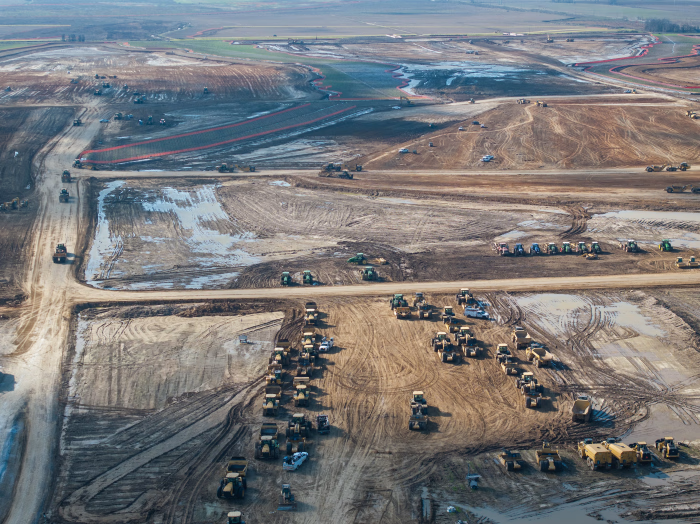
The tech giants can’t afford to wait. Construction timelines are being slashed using modular data center units that can be deployed in months, not years. The locations? Not just Silicon Valley anymore—think Scandinavia, the American Midwest, and even remote power-rich zones in Asia.
🌍 Water, energy, land—there’s a catch.
These monster data centers use enormous amounts of power and water. Local governments and communities are already pushing back, especially where grids are weak or water is scarce. It’s creating a new kind of geopolitical tug-of-war: AI expansion vs. environmental impact.
💡 What Everyone’s Missing About This Boom
Most headlines focus on how big tech is pouring billions into AI. But here’s what’s not being talked about enough:
- Some existing data centers could soon be obsolete if they can’t handle high-density AI workloads.
- Water stress is real. Many data centers are competing with towns for clean water just to stay cool.
- Grid pressure is growing. These facilities draw so much power that some cities may need energy infrastructure upgrades.
- Cyber threats are scaling, too. With AI data centers becoming crown jewels, they’re a magnet for hackers and nation-state actors.
- The cloud isn’t just in the cloud. Physical infrastructure—location, hardware, cooling—is now a massive differentiator.
🧩 What This Means for Tech, Business, and You
For Cloud Users and Enterprises:
- Ask your cloud provider: “Is this AI-ready infrastructure?”
- Sustainability now matters—not just because it’s ethical, but because it affects cost and uptime.
- Performance isn’t just about GPUs—it’s about where and how they’re hosted.
For Data Center Operators:
- Liquid cooling, power scalability, and modular builds are no longer optional—they’re the future.
- Building close to clean, abundant energy sources is becoming a strategic advantage.
- Sustainability efforts aren’t PR—they’re regulatory survival tactics.
For Governments and Regulators:
- Striking the right balance between innovation and environmental responsibility is key.
- Expect future zoning laws, energy caps, and water usage permits to affect data center placement.
- Local economies may benefit—but only with thoughtful, inclusive planning.
🔍 Frequently Asked Questions
Q: Why are AI data centers so different from regular ones?
A: Because the demands of AI are orders of magnitude higher. It’s not just storage—it’s massive real-time compute, training on trillions of data points, and cooling tech that makes traditional fans look like toys.
Q: Where are these new data centers being built?
A: Anywhere with cheap, stable power, room to grow, and political support. Places like Norway, Iowa, Oregon, and Singapore are booming—while some legacy hubs are hitting grid and zoning limits.
Q: Are these builds sustainable?
A: Not yet. They can be—but it takes serious investment in renewables, water recycling, and grid coordination. Some firms are better at this than others.
Q: Will older data centers survive the AI era?
A: Many won’t. Some will be repurposed, others retrofitted—but if they can’t handle AI power and cooling demands, they risk becoming digital dead zones.
Q: How does this affect my business or my tech stack?
A: If you’re investing in AI tools or infrastructure, the quality of the data center matters more than ever. Look under the hood—cheap compute in outdated facilities can mean lower performance, more downtime, and higher long-term costs.
🔮 Final Take
AI may live in the cloud—but it breathes through data centers. As the world barrels into the AI era, the biggest innovations may not be in flashy consumer tools, but in the high-voltage, liquid-cooled, power-hungry buildings making it all possible.
This is the biggest physical infrastructure shift since the invention of the internet.
And it’s only just begun.
Sources The Wall Street Journal

