

The setup: What’s fueling the AI race
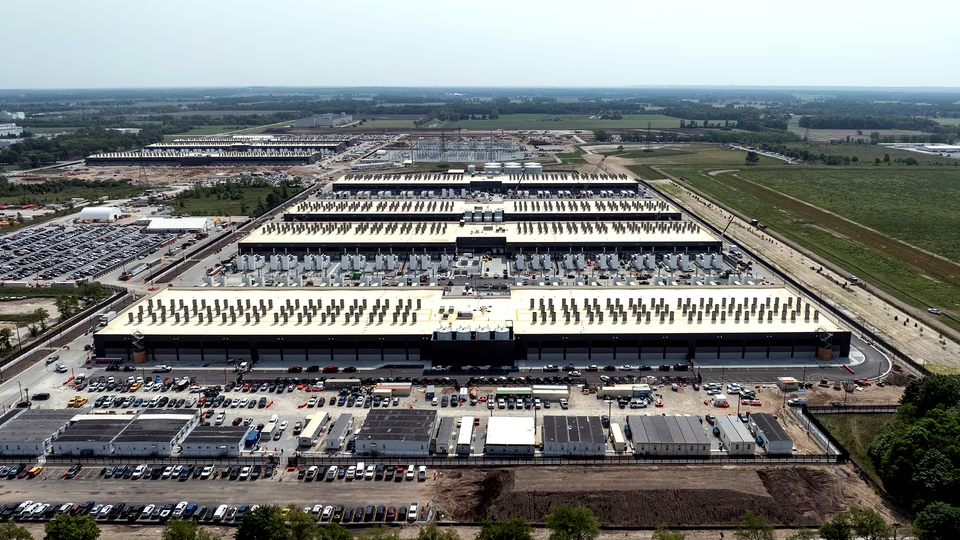
In recent years, generative AI—large‑language models, image/video generation, autonomous agents—has surged in popularity and investment. Companies worldwide are building gigantic fleets of computing power, custom chips, data centres, and cloud infrastructure to support the explosion of AI usage.
- Vast data centres are being constructed at breakneck pace to power training and inference of models.
- Data‑centre construction, hardware (GPUs/TPUs), cooling, power supply—all have become huge capital‑intensive bets.
- The infrastructure investment is no longer a side effect—it’s central to the business model for many AI companies.
- The promise of AI is high: automating tasks, creating new services, reshaping entire industries.
So far this sounds like a technological revolution—but beneath the surface, cracks are forming.
The crash scenario: Four interlocking fault lines
Here are the main channels through which an AI crash could materialize, often working together.
1. Infrastructure overbuild & demand miss
- Data‑centres take years to plan, permit, build, equip—so decisions made now are based on future demand.
- If AI usage (especially inference/agent usage) grows more slowly than projected, facilities could remain under‑utilised, wasting billions in capex.
- Leads and lags in hardware production, cooling/power supply constraints, and supply‑chain tailwinds all amplify risks.
- Example: If you build for “agents everywhere” scenario but adoption plateaus, much of the infrastructure might sit idle or deliver low returns.
2. Diminishing returns & tech‑scaling limits
- Early AI model gains came from “bigger models + more data + more compute”. But many researchers argue that such scaling is hitting diminishing returns.
- Energy/compute per improvement is rising; performance gains per watt are flattening in some hardware.
- If the next leap fails to materialise (e.g., no obvious artificial general intelligence breakthrough), the investor narrative might falter.
- In short: hype may outrun technical progress.
3. Business model & profitability mismatch
- Training and running AI models at scale is extremely expensive (power, hardware, cooling, maintenance).
- Many AI companies are still burning cash, not yet proving robust business models with predictable margins.
- If AI features don’t convert into large‑scale revenue quickly, valuations may collapse, reducing funding for infrastructure.
- The “cost per query” for some inference tasks is high; if users aren’t paying, you have a crisis of cost vs return.
4. Systemic economic and regulatory pressures
- Infrastructure investments aren’t happening in isolation: power grids, water/cooling resources, real‑estate zoning, and environmental regulation all matter.
- If utilities resist rate hikes or power supply becomes constrained, data‑centre operations may face bottlenecks or public push‑back.
- Financial markets may become skittish if bubble signals (overvalued assets, speculative construction, shadow lending) proliferate.
- A crash in one segment (e.g., a large data‑centre REIT default) could ripple outward.
Why the analogy to past “bubbles” matters
Observers frequently compare the current AI/data‑centre boom to prior infrastructure/speculation episodes:
- Dot‑com bubble (late 1990s): massive investment in internet infrastructure and companies with weak business models, many failed.
- Telecom/build‑out crash (early 2000s): over‑capacity in fibre networks versus slower demand growth.
- Housing/sub‑prime (mid‑2000s): speculative lending, unregulated finance, asset over‐hang.
In the AI case: huge spending on data centres + high expectations of usage + unclear profit timelines = ingredients similar to those past bubbles. But it’s not identical: for example, the demand curves, technology vintage, and global scale differ.

What the original article missed (or under‑emphasised)
Here are some deeper angles worth highlighting:
- Global demand vs local bottlenecks: Data‑centre booms are concentrated in certain geographies (e.g., U.S. mid‑Atlantic, Texas, western Europe). Local power, cooling, land and grid infrastructure may constrain expansion or raise costs.
- Human‑data supply limitation: Models need high‑quality data, not just compute. If “usable” data sources saturate, model performance improvements may slow further.
- Eco‑sustainability & externalities: The environmental footprint of large data centres (power consumption, cooling water, land use) is rarely addressed fully in coverage of the crash risk.
- Financial plumbing & shadow lending: Many data‑centre build‐outs are financed with creative or lightly regulated structures. If financing collapses, the operational risk grows.
- Technology disruption risk: A breakthrough in more efficient AI hardware or training paradigm (e.g., neuromorphic computing) could render current infrastructure partially obsolete—creating write‑downs.
- Interdependency risk with other sectors: If one major player cuts back (cloud provider reduces AI spending), the broader ecosystem (hardware, real‑estate, cooling, power) will feel the knock‑on effect.
- Time‐horizon mismatch: Build‑now for a future use‑case that may not mature for several years; meanwhile investors may demand returns sooner.
What this means for companies, investors and society
- For companies: Be cautious about committing to massive infrastructure unless usage demand is finely projected. Consider modular/scalable build‑outs rather than “everything at once”.
- For investors: Assess not just hype and growth potential, but unit economics, capex burn, utilisation rates, contract terms (e.g., data‑centre leases), financing risk, tech refresh risk.
- For policymakers & regulators: Monitor energy grid stress, land/water/zoning impact, financial risk in data‑centre real‐estate, ensure transparency in lending and building related to this boom.
- For society: The hope of AI is large—but the risk of a crash means job markets, regional economies, and infrastructure may face stress if the boom falters.
Frequently Asked Questions (FAQ)
Q1: Is an “AI crash” the same as “AI fails to deliver”?
A1: Not exactly. A crash can happen even if AI continues to make progress. It’s more about infrastructure, financing and business model mismatches—overinvestment, under‑utilisation, or financial stress—not only about technology stagnation.
Q2: Which signals would suggest we’re headed toward a crash?
A2: Key red flags include: large new data‑centre capacity going unused; major AI firms failing to convert users into paying customers; financing defaults in data‑centre real estate; slowing improvements in model performance despite heavy investment; power grid or regulatory bottlenecks causing cost spikes.
Q3: Which stakeholders are most at risk?
A3: Real‑estate developers who’ve built large data‑centres expecting high utilisation; lenders or credit funds backing speculative data‑centre builds; hardware manufacturers reliant on sustained growth; regions whose infrastructure is stressed by boom build‑out; investors in AI companies with high valuations and weak profit models.
Q4: Does this mean AI is a bad investment?
A4: Not at all. AI remains transformative. The caution is about timing, business model viability, and capacity risk. Investing with awareness of these risks is key—successful outcomes may still emerge, but they may take longer or look different than the hype implies.
Q5: What can companies do to mitigate their risk?
A5: Build flexibly: deploy infrastructure incrementally; seek contracts or leases that ensure utilisation; stress‑test business models for slower adoption; diversify revenue streams; monitor power and cooling costs; closely track unit economics of AI workloads (cost per query, cost per token, etc.).
Q6: How might this affect the broader economy?
A6: If a crash happens: data‑centre real‑estate prices could fall; companies might write down infrastructure; job markets in regions reliant on build‑out may soften; energy/utilities near data‑centre clusters may face disruptions or cost pressures; investor losses could reduce capital for adjacent sectors.
Q7: Is there a safe way to benefit from the AI boom while avoiding crash risk?
A7: Yes—by focusing on domains with clear revenue models (e.g., enterprise AI services with paying customers), by investing in companies with proven economics, by avoiding speculative “build‑for‑everything” scenarios, and by keeping an eye on how usage, cost and infrastructure align.

Final Thought
The story of the AI boom is still being written—and it may well deliver major breakthroughs and economic gains. But the infrastructure, finance and scale of that boom create fault lines. An AI crash wouldn’t mean AI dies—it could instead mean a sharp correction, slower growth, and painful losses for those who bet hardest on the wrong assumptions.
Sources The Atlantic

