
Amazon has quietly pulled the plug on one of its experimental warehouse robots, reportedly known internally as “Blue Jay.” The decision underscores a reality often lost in automation hype: not every robot survives contact with the real world.
For a company synonymous with logistics innovation and robotic fulfillment centers, shelving a high-profile robotics initiative raises important questions. Why did the project stall? What does it reveal about the limits of warehouse automation? And does this signal a slowdown in Amazon’s broader robotics ambitions — or simply a strategic reset?
This article explores what the cancellation suggests about automation economics, technical hurdles in robotics, labor implications, and the future of AI-powered fulfillment.
Amazon’s Long Bet on Robotics
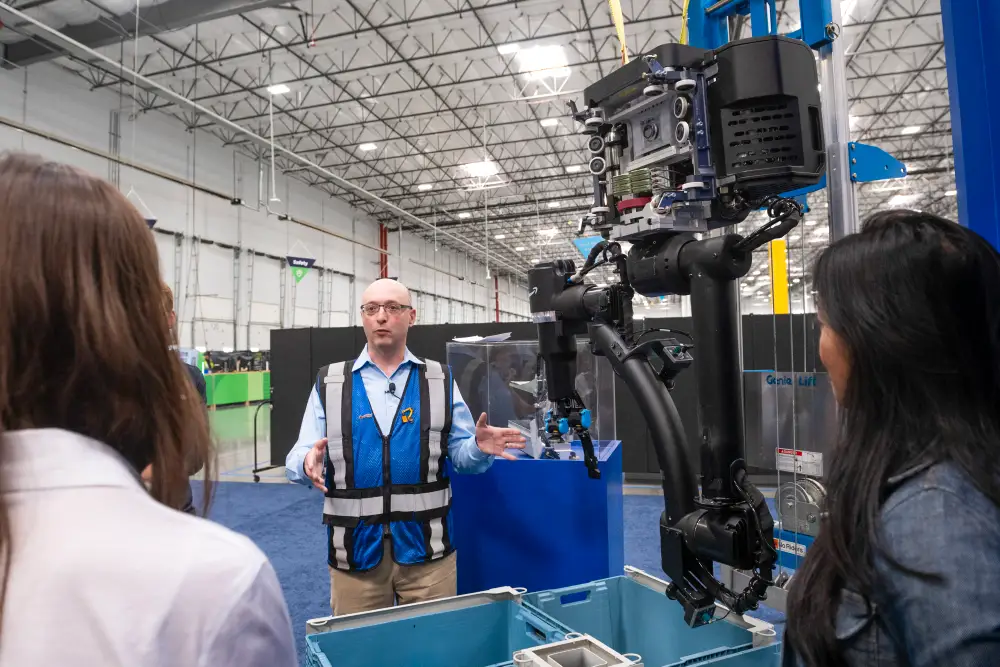
Amazon has invested heavily in warehouse automation for over a decade. Its fulfillment centers already rely on:
- Autonomous mobile robots that move shelves
- Robotic arms for sorting and packaging
- AI-powered inventory management
- Computer vision systems for quality control
These technologies aim to:
- Increase speed
- Reduce operational costs
- Improve safety
- Scale during peak demand
Against this backdrop, Blue Jay represented another step toward deeper automation.
Why Experimental Robots Fail
Warehouse robotics is uniquely challenging. Unlike structured factory environments, fulfillment centers involve:
- Irregularly shaped items
- Rapidly changing layouts
- High throughput expectations
- Mixed human-robot collaboration
Even advanced robots struggle with:
- Object recognition across varied packaging
- Fine motor manipulation
- Error recovery
- Unexpected obstacles
A prototype that works in a controlled test environment may falter at full industrial scale.
The Economics of Automation
Automation is not just a technical challenge — it’s a financial one.
Robotic systems must justify:
- High upfront capital costs
- Maintenance and repair expenses
- Software updates
- Integration with existing workflows
If a robot:
- Slows operations
- Requires frequent recalibration
- Fails to outperform human workers
it may not deliver sufficient return on investment.
In high-margin tech sectors, experimentation is tolerated. In logistics, margins are tight.
What This Means for Amazon’s Workforce
Whenever automation projects are scaled back, observers ask: Does this mean jobs are safer?
The answer is nuanced.
Amazon continues expanding robotic integration in other areas. However, shelving one system suggests:
- Full automation remains technically difficult
- Human labor remains essential
- Hybrid systems are more practical
Rather than replacing workers wholesale, robotics often reshapes roles — shifting employees toward oversight, maintenance, and quality assurance.
The Hidden Complexity of Warehouse Robotics
Unlike software automation, physical robotics must deal with:
- Gravity
- Friction
- Wear and tear
- Sensor calibration
- Real-world unpredictability
Small mechanical failures can cascade into large operational disruptions.
This makes reliability paramount.
What Often Goes Unsaid
Failure Is Built Into Innovation
Large tech firms routinely abandon internal projects.
The cancellation of Blue Jay may reflect:
- Iterative experimentation
- Reallocation of capital
- Shifting strategic priorities
Stopping a project does not necessarily signal retreat — it may indicate refinement.
AI Alone Is Not Enough
Even with advanced AI vision systems, robotic manipulation remains one of the hardest engineering challenges.
Grasping diverse items with precision and speed is far more complex than generating text.
Public Expectations May Outpace Reality
The narrative of fully automated warehouses can create unrealistic expectations.
In practice, robotics deployment tends to be gradual and uneven.
The Broader Industry Context
Amazon is not alone in facing robotic setbacks.
Across logistics and manufacturing:
- Some automation pilots stall
- Certain robots underperform
- Companies reassess timelines
Warehouse automation is advancing, but not linearly.
What Comes Next for Amazon
Amazon is likely to:
- Continue investing in robotics
- Refine successful systems
- Integrate AI more deeply
- Focus on high-impact use cases
Rather than pursuing full automation, the emphasis may remain on targeted efficiency gains.
Frequently Asked Questions
Why did Amazon shut down the Blue Jay robot?
While specific internal reasons may vary, likely factors include cost, performance limitations, and integration challenges.
Does this mean warehouse automation is slowing?
Not necessarily. It reflects recalibration rather than abandonment.
Are warehouse jobs safe?
Automation continues to evolve, but full replacement remains unlikely in the near term due to technical complexity.
Is robotics in logistics overhyped?
Some expectations have been overly optimistic, but steady progress continues.
Will Amazon try again?
Almost certainly. Major tech firms rarely abandon strategic domains after a single setback.
Final Thoughts
The shelving of Blue Jay serves as a reminder that automation is not a straight line from innovation to domination.
Robotics, especially in messy, dynamic environments like warehouses, requires not only AI intelligence but also mechanical reliability, economic feasibility, and seamless integration.
Amazon’s decision may signal caution — but it also reflects maturity. Not every experiment must succeed to drive progress.
In the race toward automated logistics, setbacks are not signs of defeat.
They are part of the engineering reality behind the promise of intelligent machines.
Sources Business Insider

