
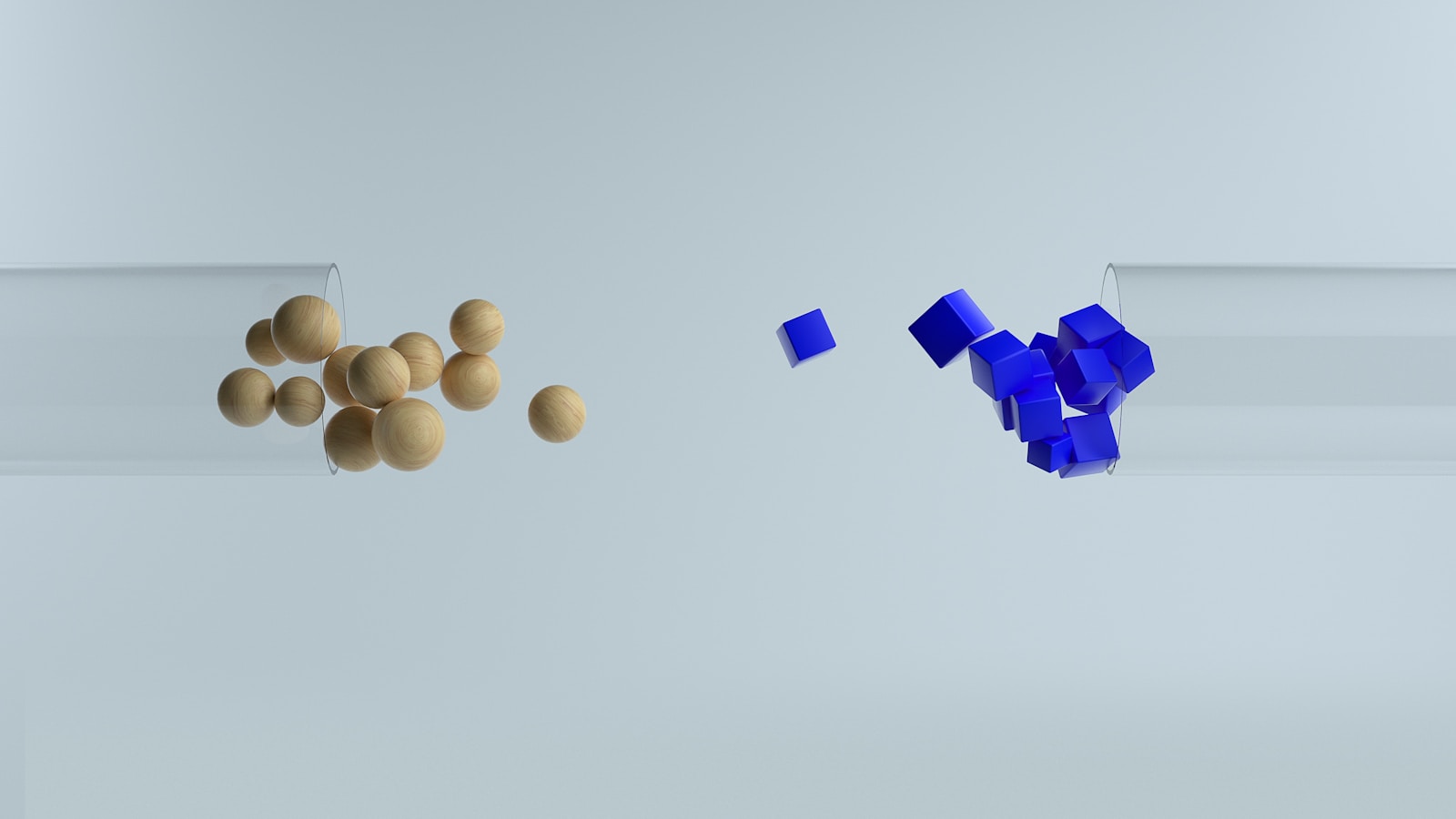
Imagine an AI that can propose new crystals, compounds, or alloys far faster than humans ever could. That’s precisely what several labs and companies are now doing: training generative or predictive models to suggest millions of new material candidates. But the real question is: how many of them are credible, stable, synthesizable, or useful?

What the Nature Article Reports
- A few years ago, DeepMind (Google) reported it had generated 2.2 million new crystalline materials via a deep learning method.
- That announcement inspired excitement, but also skepticism from chemists and materials scientists: how many of those “new” materials are physically valid or synthesizable?
- Critics have argued that the announcements resemble hype more than substance.
- Nevertheless, there is real progress: some AI-discovered materials have already moved toward experimental validation or have promising simulated behavior (e.g. high strength, desirable bandgaps, novel atomic arrangements).
- The article cites several efforts and examples where ML / AI accelerate parts of the materials discovery pipeline (screening, optimizing, multi-parameter search).
That is a solid foundation — but it leaves many crucial layers underexplored.
What the Broader Landscape Looks Like (Beyond the Article)
Here’s what the mainstream coverage often omits or underemphasizes — both opportunities and challenges.
The Pipeline: From AI Suggestion → Experimental Reality
The journey from a candidate material suggestion to a validated real-world material is long and fraught with steps:
- Model Proposal / Ranking
The AI proposes thousands to millions of candidate structures, often ranking them on computed metrics (e.g. energy stability, bandgap, mechanical strength). - Simulation & Screening
Using quantum chemistry (DFT), molecular dynamics, or finite element methods, researchers test which candidates are thermodynamically stable, metastable, or viable under real conditions (temperature, pressure, defects). - Synthesis Attempt
Lab chemists or materials engineers try to create the candidate in real life — dealing with constraints (availability of precursor chemicals, reaction paths, kinetics, impurities). - Characterization & Testing
If synthesis succeeds, the material is characterized (X-ray diffraction, electron microscopy, spectroscopy) and tested for properties (electrical, mechanical, thermal, optical). - Scale, Integration & Stability
Even if a material works in small samples, scaling it, integrating it into devices or systems, and ensuring long-term stability under real conditions is hard.
Many AI-suggested candidates fail along one of these steps, often in synthesis or stability.
Hype, Hallucination, and Overclaim Risk
- Some AI models may hallucinate physically impossible structures — free-floating atoms, inconsistent bonding, non-realizable symmetries.
- Because AI can extrapolate beyond known data, it sometimes proposes “novel” structures that violate chemical constraints or stability principles.
- Press releases and headlines may promote massive numbers (“millions”) without clarifying how many survive downstream validation.
Bias, Data Limitations & Domain Gaps
- Training data is skewed toward known materials — many chemical spaces (combinations of rare metals, complex heterostructures) are underrepresented, so AI will struggle to generalize well.
- Models often assume ideal conditions (no defects, perfect crystal lattices, no impurities), which diverge from real-world messy materials.
- Transferability is tricky: a material that looks good in simulation may fail under real-world thermal, mechanical, or environmental stress.
Model Interpretability & Trust
- Materials scientists often ask: Why does the model pick one structure over another? Explainable AI is still immature in many domains.
- Without interpretability, AI suggestions may appear as black box magic — hindering trust, insight, or further human-guided refinement.
Cost of Failure & Resource Constraints
- Running large-scale DFT or quantum simulations is computationally expensive. If you propose millions of candidates, screening them demands huge compute budgets.
- Many labs lack access to such compute, making democratization difficult.
- Failed synthesis attempts waste lab time, $$, chemicals, and effort.
Promising Approaches and Hybrid Models
Despite the challenges, several strategies help bridge the gap:
- Active Learning / Closed-Loop Discovery: AI suggests candidates, experiments test them, feedback flows back to the model to refine search.
- Multifidelity Modeling: Use cheap approximate models (coarse simulations) first, then refine promising ones with high-fidelity computation, then lab tests.
- Constraint-Based Design: Encode chemical, physical, thermodynamic, or mechanistic constraints into the AI model to avoid unrealistic suggestions.
- Transfer Learning / Domain Adaptation: Models pretrained on broad chemical spaces then fine-tuned to narrow domains (e.g. battery materials, thermoelectrics).
- Collaboration Networks: Companies or consortia share computational and experimental facilities to test AI-proposed structures.
Real-World Examples (Beyond the Article)
- Some AI-assisted materials have made it into experimental labs: for example, predicted alloys or metal–organic frameworks (MOFs) with target pore sizes or conductivity have been synthesized and show promising properties.
- Startup efforts combining AI + materials (e.g. for better battery cathodes, catalysts, thermoelectrics) are starting to raise funding.
- Governments and consortia (e.g. U.S. Materials Genome Initiative, EU materials programs) are investing in infrastructure to support AI-driven materials discovery.
What’s Coming — Where We Could Be in 5–10 Years
If the field matures, here’s what might become realistic:
- “Just-in-time” materials design: designers or engineers propose desired properties (strength, conductivity, light absorption) and AI returns candidate materials ready for near-term fabrication.
- Customized materials for niche use: everything from aerospace alloys, medical implants with precise biocompatibility, novel photonic crystals, 2D semiconductors, and more.
- Material-as-code platforms: software ecosystems where materials properties, models, simulation tools, factory parameters are codified and iterated like software development.
- Sustainable materials and “green design”: AI-suggested materials optimized for low carbon footprint, recycling, minimal rare elements usage, or degradability.
- Democratization: as computational resources get cheaper and open materials databases proliferate, more labs globally can participate in AI-driven discovery.
But we should also brace for stalls, overpromises, failures, hype cycles, and the need for stronger standards and validation protocols.
Frequently Asked Questions (FAQs)
| Question | Answer |
|---|---|
| 1. How many AI-proposed materials actually survive to practical use? | Very few — the funnel is steep. Millions may be proposed, thousands simulated, hundreds synthesized, and only a handful end up viable for real applications. |
| 2. Can AI replace human materials scientists? | No — AI helps accelerate search, but human insight, intuition, mechanistic understanding, experimental skill, and judgment remain essential. |
| 3. What properties can AI optimize for? | Many: stability, bandgaps, catalytic activity, conductivity, strength, thermal properties, optical response, etc. The choice depends on domain and constraints. |
| 4. Are these materials always better than existing ones? | Not necessarily. Sometimes they offer incremental improvements; sometimes novel trade-offs (e.g. better in one metric, worse in others). |
| 5. How do we validate AI predictions? | Via simulations of increasing fidelity (DFT, molecular dynamics), lab synthesis, characterization (XRD, SEM, spectroscopy), and performance testing. |
| 6. What’s the biggest technical barrier? | Synthesizability and stability under real conditions, plus bridging simulation-to-experiment gaps and managing computational costs. |
| 7. Can open data and open models help? | Yes — open chemical and materials databases, shared models and datasets, collaborative platforms can accelerate progress and democratize access. |
| 8. What if AI suggests unsafe or toxic materials? | That’s a risk. Safety screening, toxicity modeling, chemical hazard constraints must be part of the pipeline to prevent dangerous or environmentally harmful suggestions. |
Final Thoughts
AI dreaming up millions of new materials is not science fiction — it’s an emerging frontier with real momentum. But the headline-grabbing numbers must be tempered by reality: only a few candidates survive the gauntlet of physics, chemistry, and manufacturing.
If the field navigates its gaps — interpretability, synthesizability, simulation fidelity, cost barriers, safety constraints — AI-driven materials discovery could reshape energy, electronics, medicine, sustainability, and beyond.
The key is not just how many materials AI can imagine, but which ones are real, useful, and trustworthy. The future of materials science may lie in the collaboration of human scientists and AI systems, each doing what they do best.

Sources nature

