

Artificial intelligence has become the biggest investment story of the decade. Governments, tech giants, venture capitalists, and financial markets are pouring trillions of dollars into data centers, chips, power infrastructure, talent, and AI startups.
The promise is transformative: faster growth, higher productivity, and a technological edge that could define global power for generations.
The risk is equally historic: there is no certainty that these investments will ever deliver returns large enough to justify their cost.
As the AI boom accelerates, a growing number of economists, technologists, and investors are asking a sobering question — what if the rewards never match the spending?
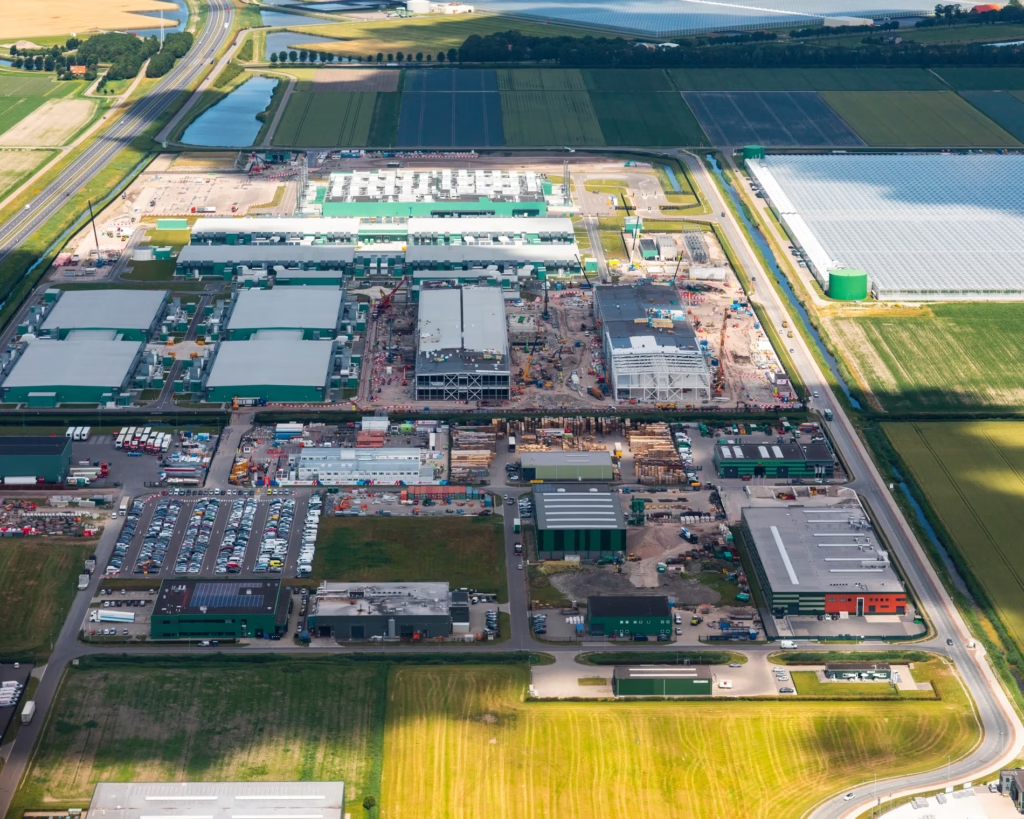
Why the AI Investment Wave Is So Massive
AI isn’t just another software trend. It demands enormous physical and financial infrastructure.
Major investments include:
- Data centers costing tens of billions of dollars
- Advanced chips with limited global supply
- Vast electricity and water resources
- Highly paid researchers and engineers
- Ongoing model training and maintenance
Unlike earlier tech revolutions, AI scales costs alongside usage, meaning success often increases spending rather than reducing it.
The Productivity Promise — Still Unproven
AI advocates argue that:
- Automation will boost efficiency
- Knowledge work will accelerate
- Economic growth will surge
But productivity gains at the macro level have so far been modest.
History shows that:
- New technologies often take decades to deliver broad productivity growth
- Benefits concentrate in a few firms and sectors
- Costs arrive immediately, while gains arrive slowly
AI may follow the same pattern — or fail to exceed it.
Why Investors Keep Spending Anyway
Despite uncertainty, investment continues because:
- No one wants to miss the next general-purpose technology
- Early leaders may gain insurmountable advantages
- Governments see AI as a strategic asset
- Markets reward growth narratives
In short, the fear of being left behind is stronger than the fear of overpaying.
The Arms Race Problem
AI investment is increasingly shaped by competition rather than economics.
Countries and companies feel pressured to:
- Build ever-larger models
- Secure chip supply chains
- Expand data center capacity
- Move faster than rivals
This arms-race dynamic can lead to overinvestment — where everyone spends more just to avoid losing ground, not because returns justify the cost.

The Energy and Infrastructure Constraint
AI’s appetite for energy is becoming a bottleneck.
Challenges include:
- Rising electricity costs
- Grid strain and delays
- Environmental backlash
- Local resistance to data centers
Infrastructure limits could slow AI deployment long before technological limits do.
What Happens If AI Revenues Don’t Scale
The financial risks are significant.
If AI fails to generate sufficient revenue:
- Valuations could collapse
- Capital markets could tighten
- Smaller firms could disappear
- Investment could concentrate further in Big Tech
The result wouldn’t be the end of AI — but a painful correction.
Who Bears the Risk If the Bet Fails
The costs of AI investment are not evenly distributed.
Potential losers include:
- Workers displaced faster than productivity grows
- Communities hosting data centers without long-term benefits
- Consumers facing higher energy costs
- Taxpayers subsidizing infrastructure
Meanwhile, the upside remains concentrated among a small group of firms and investors.
What the Original Discussion Didn’t Fully Explore
Historical Parallels
Railroads, dot-coms, and telecom booms all saw massive overinvestment before consolidation.
Opportunity Cost
Money spent on AI is money not spent on healthcare, education, or climate adaptation.
Distributional Effects
Even if AI succeeds, gains may not be shared broadly.
Governance Gaps
Few safeguards exist to manage systemic risk from AI overinvestment.
Could AI Still Pay Off? Absolutely — But Not Guaranteed
AI may yet:
- Deliver breakthroughs in science and medicine
- Dramatically improve productivity
- Create entirely new industries
But success at a societal level doesn’t automatically mean financial success for today’s investors.
Timing, regulation, and distribution matter.
Frequently Asked Questions
Why is so much money flowing into AI right now?
Because AI is viewed as a foundational technology with strategic and economic importance.
Has AI already proven its value?
In some areas, yes — but economy-wide productivity gains remain uncertain.
Is this an AI bubble?
Possibly. Or it may be a long build-up followed by consolidation rather than collapse.
Who benefits most from current AI investment?
Large tech firms, chipmakers, and early infrastructure providers.
What happens if returns disappoint?
Expect market corrections, reduced funding, and industry concentration.
Can governments reduce the risk?
Yes — through regulation, transparency, and ensuring public benefits from AI investment.

The Bottom Line
The world is making a historic bet on artificial intelligence.
Trillions of dollars are being spent on the assumption that AI will reshape economies, boost productivity, and justify unprecedented investment.
It might.
But history warns us that transformative technologies rarely deliver rewards evenly — or on the timelines investors expect.
AI could change everything.
It could also leave behind a trail of stranded assets, inflated expectations, and hard lessons.
The real risk isn’t betting on AI.
It’s assuming that technological potential automatically guarantees economic payoff.
Sources The Guardian

