If you want to see what the future of a robot-assisted society looks like—not in a lab, not in a sci-fi movie, but in real suburban streets—there’s a quiet English town you need to visit: Milton Keynes.
Here, delivery robots zip across pedestrian crossings. Autonomous pods navigate traffic islands. Machines glide through parks, apartment complexes, and shopping centres as casually as cyclists or joggers. What was once a quirky, experimental new town has become the closest thing the world has to a fully integrated robotic ecosystem.
And what’s happening in Milton Keynes is bigger than novelty. It’s a preview of how robotics may blend into daily life worldwide.
🤖 Why Milton Keynes Became the Robot Capital of Europe
While many cities talk about embracing robotics, Milton Keynes actually did it. Several factors uniquely positioned the town to become a living robotics laboratory:
1. A Purpose-Built Grid Layout
Designed in the 1960s as a planned “new city,” Milton Keynes has:
- wide pathways
- consistent block layouts
- suburban spacing
- plentiful pedestrian routes
These features make it ideal for autonomous navigation—robots can move freely without constant conflict with dense foot traffic.
2. Strong Local Government Support
Local councils embraced automation early, issuing testing permissions long before other British cities were willing to take the risk.
3. A Growing Tech Ecosystem
Robotics companies like Starship Technologies picked Milton Keynes because:
- it’s close to London
- it’s cost-efficient
- it has a diverse residential population
- it offers predictable infrastructure and regulations
This creates a stable testing ground for commercial robots.
4. An Eager Population
Residents—many of them young families and commuters—have generally shown curiosity and enthusiasm toward robotic deliveries and automation trials.
It’s one of the rare cities where robots aren’t a novelty—they’re normal.
📦 The Robots Already Roaming Milton Keynes
1. Delivery Robots (Starship Technologies)
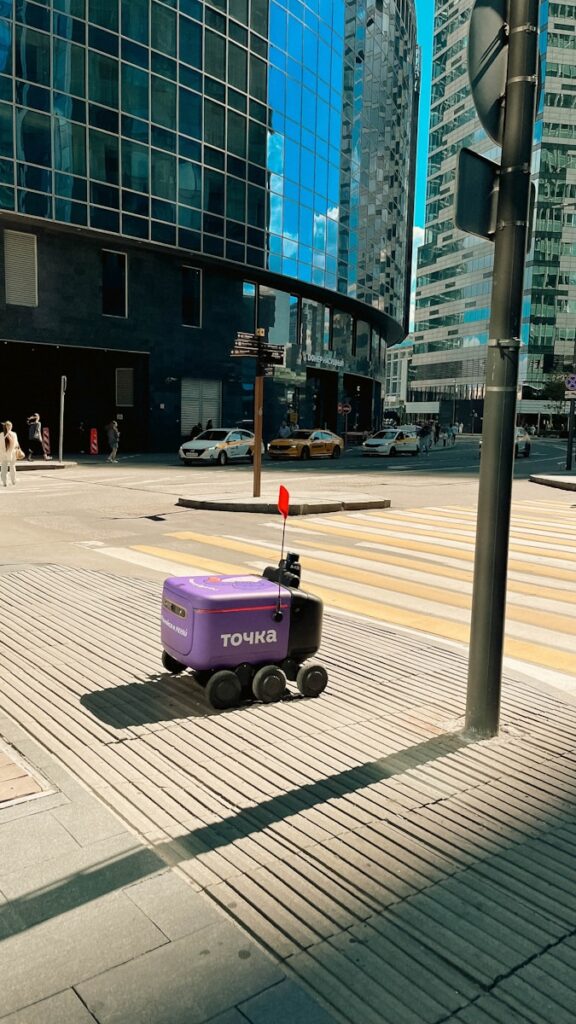
These white, six-wheeled, cooler-sized robots deliver:
- groceries
- takeaways
- parcel shipments
- pharmacy items
They operate autonomously, navigating sidewalks and crossings using:
- computer vision
- ultrasonic sensors
- GPS
- onboard machine-learning algorithms
Residents track them via an app, unlock their cargo with a code, and send them back.
2. Autonomous Pods & Shuttles
Pilot programs have tested:
- self-driving people-movers
- small autonomous buses
- neighborhood transport pods
These could become a backbone of future micro-transit services.
3. Robotic Street Monitoring Systems
Some robots conduct surveys or map city infrastructure for local authorities. They support:
- pothole detection
- pathway mapping
- environmental monitoring
4. Warehouse & Logistics Robots
Milton Keynes is surrounded by distribution hubs, many of which use robotic sorting, picking, and packing systems. This ecosystem supports faster deliveries—and feeds the robotic delivery fleet.
🌍 What This Means for the Future of Cities
Milton Keynes isn’t just showing the future—it’s testing it.
A. Cities May Need to Be Designed for Robots
Walkways, crossings, signage, and parking spaces all affect how well autonomous systems work. MK’s early success suggests city planners worldwide may need to update designs.
B. Human-Robot Interaction Will Define Daily Life
Will pedestrians trust robots crossing roads beside them?
Will drivers accept them in traffic?
So far—yes, mostly.
C. Automation Will Become “Invisible Infrastructure”
Just like Wi-Fi and smartphones quietly changed daily life, robots may soon become background actors in everything from:
- grocery delivery
- food takeout
- waste management
- city inspections
- public transportation
D. Ethical and Labour Considerations Will Rise
As robots assume more logistical tasks, governments will face questions about:
- job displacement
- data privacy
- accident liability
- robot-caused traffic issues
- accessibility for vulnerable populations
E. Other Towns Will Imitate Milton Keynes
Cities in the U.K., Europe, Asia, and the U.S. are already studying MK’s model to replicate it at scale.
🔍 What the Original Coverage Didn’t Fully Explore
1. Economic Impact on Local Businesses
Robot deliveries have actually helped smaller shops compete with big platforms by lowering delivery costs.
2. Environmental Benefits
Starship robots emit almost no carbon and replace short vehicle trips—the dirtiest category of urban transportation.
3. Challenges Behind the Scenes
Robots still:
- get stuck on uneven paths
- require remote human supervision
- are occasionally vandalised
- struggle in extreme weather
The public rarely sees these flaws.
4. The Labour Question
While automation reduces need for some delivery drivers, it increases need for:
- remote robot operators
- software engineers
- field technicians
- logistics managers
The job landscape shifts, but doesn’t disappear.
5. Security Risks
As robots carry goods and operate on public pathways, cybersecurity becomes crucial.
Could someone hack a delivery robot?
Could a swarm be misused?
Authorities take this seriously, but answers aren’t fully clear.
❓ Frequently Asked Questions (FAQs)
Q1: Are robots replacing human delivery workers in Milton Keynes?
Partially, but not completely. Robots handle small, short-range deliveries; humans still handle complex, heavy, or long-distance ones.
Q2: Are these robots fully autonomous?
Mostly — but they have human supervisors who can intervene remotely when needed.
Q3: Do people trust the robots?
Yes. Surveys show high acceptance, but occasional complaints exist about path obstructions or novelty fatigue.
Q4: Have there been accidents?
Minor ones — mostly robots getting stuck or bumped by pedestrians or cyclists. Serious incidents are extremely rare.
Q5: Do robots reduce carbon emissions?
Significantly. They replace car trips, cut fuel consumption, and run on rechargeable electric batteries.
Q6: Will more U.K. cities adopt delivery robots?
Yes. Trials are already happening in Cambridge, Northampton, Leeds, and other towns, inspired by Milton Keynes’ success.
Q7: How are robots protected from theft or tampering?
Onboard cameras, alarms, GPS tracking, secure cargo locks, and automatic shutdown systems deter most tampering.
Q8: Do robots take jobs away?
They shift the job market rather than eliminate it. New robotics-related roles are growing rapidly in maintenance, engineering, and fleet operations.
✅ Final Thoughts
Milton Keynes is no longer just a planned town — it’s a testing ground for the near future.
Robots delivering groceries, navigating sidewalks, and blending into daily life once sounded like science fiction. Now, it’s just another Tuesday in Buckinghamshire.
If the world wants a preview of tomorrow’s automated cities, it won’t find it in Silicon Valley or Tokyo.
It will find it on the peaceful pathways of Milton Keynes, where humans and robots already move side by side.
Sources New York Intelligencer