
Colin Kaepernick’s influence has long extended beyond sports, reshaping conversations about power, justice, and who gets heard. Now, that influence is moving into classrooms—specifically into AI education for public school students who have historically been left out of the technology revolution.
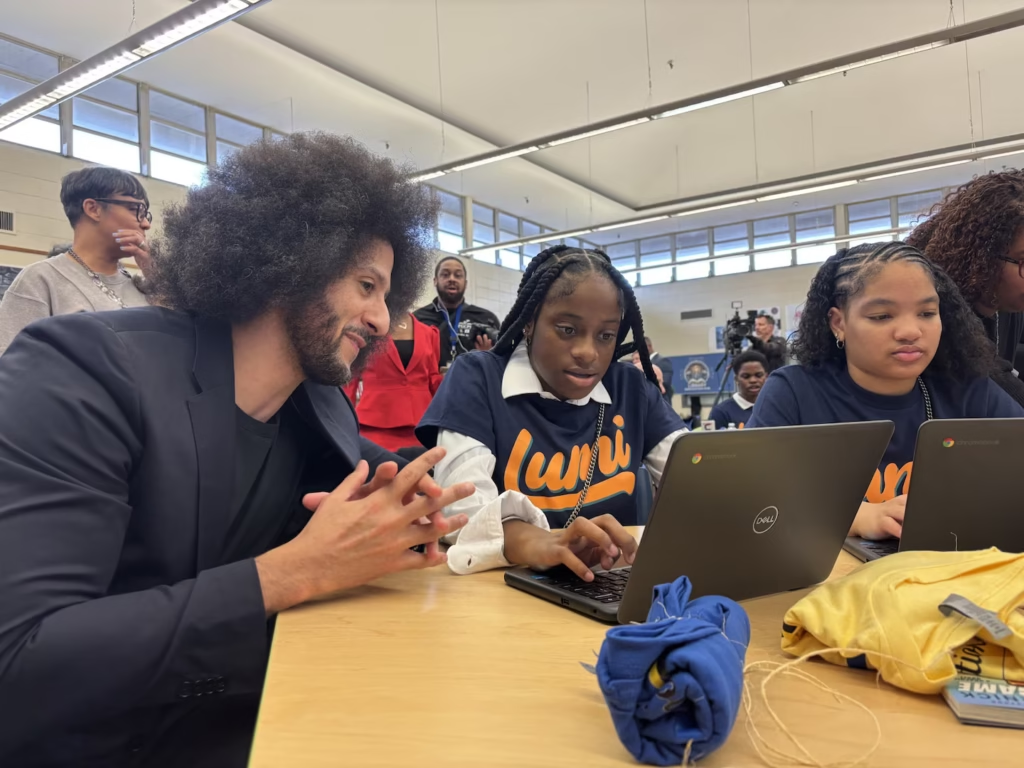
In Prince George’s County, Maryland, Kaepernick-backed initiatives are introducing artificial intelligence education not as a luxury or an elite skillset, but as a core form of modern literacy. While headlines often focus on the celebrity connection, the deeper story is about access, agency, and whether the next generation will merely live under algorithmic systems—or help design them.
Why AI Education Has Become a Civil Rights Issue
Artificial intelligence now plays a role in:
- Hiring and job screening
- Credit scoring and lending
- Policing and surveillance
- Education assessment
- Healthcare access
When communities lack AI literacy, they don’t just miss career opportunities—they lose the ability to question, challenge, and influence systems that affect their lives.
Historically, advanced technology education has been concentrated in affluent districts and elite institutions. Kaepernick’s involvement highlights a growing consensus: AI literacy should be a public good, not a private advantage.
What’s Actually Being Taught in Prince George’s County
More Than Just Coding
The program goes far beyond teaching students how to write code. Core lessons include:
- How AI systems make decisions
- What data bias looks like in real life
- Where algorithms fail or hallucinate
- Ethical risks in automated systems
- Real-world applications of machine learning
Students learn not just how to use AI—but how to interrogate it.
Investing in Teachers, Not Just Technology
A critical element often overlooked in AI education is educator preparedness. These initiatives emphasize:
- Professional development for teachers
- Curriculum design support
- Ongoing mentorship and collaboration
Technology without trained educators doesn’t scale. This program understands that.
What Makes Kaepernick’s Approach Different
Equity Comes Before Innovation
Many AI programs focus narrowly on workforce readiness. This initiative places equal emphasis on:
- Historical inequality
- Community context
- Ethical responsibility
- Student empowerment
AI is presented as both a tool and a system of power—something to understand critically, not accept passively.
From Protest to Institution-Building
This effort represents a shift from symbolic protest to structural change. Education becomes a long-term strategy for equity, helping students gain future-facing agency rather than short-term awareness.

What Coverage Often Misses
AI Literacy Is Civic Literacy
Understanding AI isn’t just about jobs—it’s about citizenship. Students learn:
- When automated systems affect their rights
- How to demand transparency
- Why accountability matters
In an AI-shaped society, this knowledge is foundational.
Early Exposure Changes Outcomes
Introducing AI concepts in middle and high school:
- Builds confidence
- Reduces intimidation around STEM
- Expands career imagination
- Normalizes advanced technical learning
Waiting until college excludes too many students.
Community Trust Is Essential
In communities historically impacted by biased surveillance and automation, AI education must be transparent and participatory. Trust determines success.
Challenges That Remain
- Scaling beyond pilot programs
- Securing long-term funding and policy support
- Balancing ethical critique with employable skills
- Keeping curriculum current as AI evolves rapidly
Celebrity backing opens doors—but systems change requires sustained institutional commitment.
Why This Matters Beyond One School District
Prince George’s County is a test case for a national question:
Can public schools deliver rigorous, ethical, and inclusive AI education at scale?
If successful, this model could:
- Influence national curriculum standards
- Inspire similar programs across the country
- Help marginalized communities shape AI’s future—not just experience it
Frequently Asked Questions (FAQ)
Why is Colin Kaepernick involved in AI education?
He views AI literacy as an equity issue that will define future opportunity and power.
Is this just about teaching coding skills?
No. It focuses on AI concepts, ethics, bias, and real-world impact.
Why start in public schools?
Because early access determines who feels ownership over technology later in life.
Does this help with future jobs?
Yes—but more importantly, it helps students become informed participants in an AI-driven society.
Can this model scale nationally?
With funding, policy support, and teacher training, similar programs could expand nationwide.

Final Thoughts
Colin Kaepernick’s move into AI education isn’t a departure from his activism—it’s its next chapter.
As algorithms increasingly shape opportunity, access to understanding those systems will determine who holds power and who doesn’t. Bringing AI education into public schools isn’t about chasing trends—it’s about ensuring the future is built by many, not controlled by a few.
In the age of artificial intelligence, literacy is leverage—and education is the front line.
Sources The Washington Post