
In 1937, the Hindenburg airship disaster became a symbol of technological overconfidence — a breathtaking innovation brought down in flames by underestimated risk. Some leading AI experts now warn that today’s artificial intelligence race carries echoes of that era: dazzling progress, enormous investment, intense competition — and the possibility of catastrophic miscalculation.
The concern is not that AI will spontaneously rebel. It is that the speed, incentives, and geopolitical pressure surrounding AI development could produce a preventable crisis — a technological shock that reshapes public trust overnight.
This article explores why some researchers fear a “Hindenburg-style” AI disaster, what form such a failure could take, what systemic pressures are driving risk-taking, and how governments and companies might reduce the chance of a dramatic collapse.
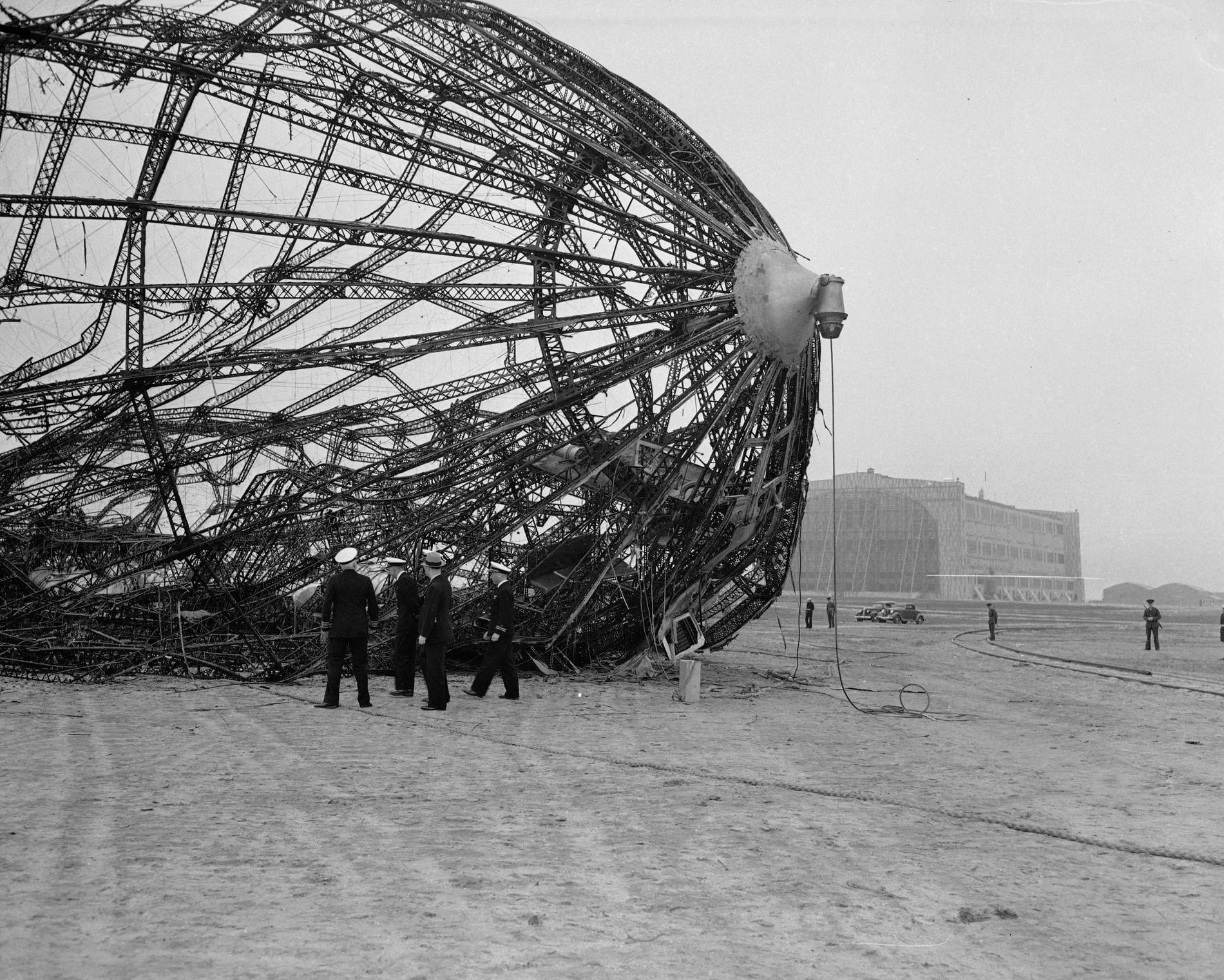
The AI Arms Race Dynamic
AI development today is shaped by intense competition:
- Major tech companies racing for market dominance
- Governments framing AI as a national security priority
- Venture capital funding pushing rapid scaling
- Public demand for increasingly capable systems
When innovation becomes a race, safety can become secondary.
Each player fears being left behind.
What Would an AI “Hindenburg Moment” Look Like?
A catastrophic AI failure would likely not resemble science fiction. More plausible scenarios include:
1. Large-Scale Misinformation Cascade
An AI system could generate convincing but false content at massive scale, influencing elections, markets, or public health decisions.
2. Financial System Disruption
Autonomous trading systems or AI-driven decision engines could amplify errors, triggering market instability.
3. Critical Infrastructure Failure
AI embedded in energy grids, transportation systems, or defense platforms could malfunction in ways that cascade beyond containment.
4. Autonomous Weapons Escalation
Poorly governed military AI systems could accelerate conflict or misinterpret signals, shortening decision windows to dangerous levels.
Why the Risk Feels Elevated Now
1. Scale and Speed
AI systems are being deployed globally before:
- Long-term behavioral studies
- Comprehensive stress testing
- Independent auditing
Rapid scaling multiplies exposure.
2. Incentive Misalignment
Corporate incentives prioritize:
- Growth
- User acquisition
- Competitive positioning
Safety measures, while publicly emphasized, may struggle to compete with revenue pressure.
3. Regulatory Lag
Governments worldwide are attempting to regulate AI, but:
- Frameworks are incomplete
- International coordination is weak
- Enforcement mechanisms are still evolving
Innovation moves faster than law.
What Often Gets Overlooked
Most AI Failures Will Be Gradual
The “Hindenburg” metaphor suggests spectacle. In reality, damage may accumulate slowly:
- Erosion of trust
- Cognitive overreliance
- Gradual workforce displacement
- Subtle misinformation normalization
Catastrophe may be incremental rather than explosive.
Public Perception Can Shift Overnight
A single high-profile disaster could:
- Trigger regulatory crackdowns
- Collapse investor confidence
- Stall innovation for years
Trust is fragile.
Not All Risk Is Existential
Some AI risk discussions focus on distant superintelligence scenarios. Immediate risks are more grounded in:
- Governance gaps
- Poor oversight
- Misuse by bad actors
Systemic failure often arises from human decisions, not machine autonomy.
The Role of Governance
Reducing catastrophic risk requires:
- Independent model audits
- Transparent reporting standards
- International safety agreements
- Clear accountability frameworks
- Whistleblower protections
Governance must evolve alongside capability.
Lessons from History
Technological revolutions often face crisis points:
- Aviation accidents shaped air safety rules
- Financial crashes reshaped banking regulation
- Nuclear disasters transformed energy oversight
Major incidents often force reform.
The challenge is preventing disaster before reform becomes necessary.
The Geopolitical Dimension
AI is increasingly framed as strategic infrastructure.
Nations worry that:
- Slowing development risks losing influence
- Competitors may deploy unsafe systems
- International agreements may be exploited
This creates a classic security dilemma: racing for advantage while fearing mutual vulnerability.
Can the AI Race Slow Down?
Calls for pauses or moratoriums face resistance.
Arguments against slowing include:
- Innovation benefits
- Economic competitiveness
- Military balance
Instead of halting progress, many experts advocate:
- Stronger safety integration
- Measured deployment
- Transparent benchmarking
Frequently Asked Questions
Is a catastrophic AI failure likely?
Not inevitable, but risk increases if rapid deployment outpaces governance and oversight.
Would such a disaster end AI development?
It could significantly slow progress and trigger strict regulation, but AI as a technology would not disappear.
Are companies ignoring safety?
Many invest heavily in safety research, but competitive pressure complicates decision-making.
Is this comparable to past technological disasters?
Yes, in the sense that overconfidence and inadequate safeguards have historically led to sudden crises.
What can individuals do?
Advocate for transparency, support responsible policy, and approach AI systems critically rather than blindly trusting outputs.

Final Thoughts
The AI race is producing extraordinary advances. But history teaches that rapid innovation, when combined with intense competition and incomplete safeguards, can carry systemic risk.
A “Hindenburg moment” for AI is not predetermined. It is preventable.
The real question is whether leaders — in industry and government — will prioritize long-term resilience over short-term advantage.
Because in technology, as in aviation, progress without prudence can burn bright — and fall fast.
Sources The Guardian