Can AI outperform doctors?
It’s one of the most provocative questions in healthcare today—and one that’s no longer hypothetical.
With companies like Insilico Medicine pushing AI into drug discovery, and global healthcare leaders weighing in, the conversation is shifting fast from possibility to reality.
But here’s the truth:
AI isn’t replacing doctors—it’s redefining what being a doctor means.
The Rise of AI in Medicine
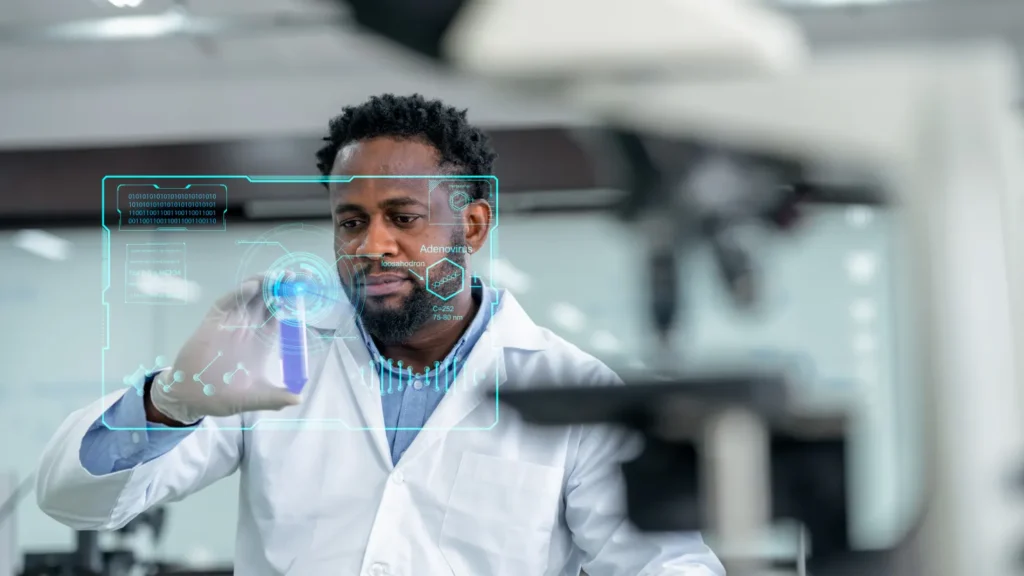
Artificial intelligence is already transforming healthcare in ways most people don’t fully see.
AI is now used to:
- Analyze medical images (X-rays, MRIs)
- Predict disease risk
- Assist in diagnosis
- Accelerate drug discovery
- Personalize treatment plans
And in some areas, AI is performing at—or even above—human level.
Where AI Is Already Beating Humans
1. Medical Imaging
AI systems can detect:
- Tumors
- Fractures
- Early-stage diseases
Often faster and sometimes more accurately than radiologists.
Why?
Because AI can:
- Process millions of images
- Spot patterns invisible to the human eye
- Work without fatigue
2. Drug Discovery
Companies like Insilico Medicine are using AI to:
- Identify drug targets
- Design molecules
- Shorten development timelines
What used to take:
- 10+ years
Can now be reduced significantly.
3. Data Analysis at Scale
AI can process:
- Patient records
- Clinical studies
- Genomic data
At a scale no human can match.
Where Doctors Still Win (And Will for a Long Time)
Despite the hype, AI has clear limitations.
1. Human Judgment
Medicine isn’t just data.
Doctors must:
- Weigh uncertainties
- Make complex decisions
- Adapt to unique cases
2. Empathy and Communication
Patients need:
- Trust
- Reassurance
- Emotional understanding
AI can simulate empathy—but not truly feel it.
3. Ethical Responsibility
Doctors are accountable for:
- Life-and-death decisions
- Ethical considerations
AI cannot take responsibility.
4. Handling the Unexpected
Real-world medicine is messy.
Doctors deal with:
- Incomplete information
- Unpredictable conditions
AI performs best in structured environments—not chaos.
The Real Future: Collaboration, Not Competition
The most realistic outcome isn’t:
AI vs Doctors
It’s:
AI + Doctors
This combination creates a powerful model:
- AI handles data and pattern recognition
- Doctors handle judgment and care
Together, they can:
- Improve accuracy
- Reduce errors
- Enhance patient outcomes
What Healthcare Leaders Are Saying
Industry leaders increasingly agree on one thing:
AI will augment, not replace, medical professionals.
Their focus is on:
- Increasing efficiency
- Reducing workload
- Improving access to care
The Benefits for Patients
If implemented correctly, AI could lead to:
1. Faster Diagnoses
Reduced waiting times and earlier detection.
2. More Accurate Treatment
Better analysis leads to more personalized care.
3. Lower Costs
Automation can reduce:
- Administrative expenses
- Development costs for drugs
4. Increased Access
AI tools can bring healthcare to:
- Remote areas
- Underserved populations
The Risks and Concerns
This transformation isn’t without challenges.
1. Over-Reliance on AI
Doctors may:
- Trust AI too much
- Miss errors
2. Data Privacy Issues
AI requires:
- Large amounts of patient data
This raises concerns about:
- Security
- Misuse
3. Bias in Algorithms
If trained on biased data, AI can:
- Produce unequal outcomes
- Reinforce existing disparities
4. Regulatory Challenges
Healthcare is heavily regulated.
AI must:
- Meet safety standards
- Gain approval
- Prove reliability
Will AI Replace Doctors?
The short answer:
No.
But it will replace:
- Certain tasks
- Some workflows
- Parts of decision-making
Doctors who use AI will outperform those who don’t.
The Changing Role of Doctors
The future doctor will be:
- More data-driven
- More tech-enabled
- More focused on patient interaction
Less time on:
- Paperwork
- Routine analysis
More time on:
- Care
- Strategy
- Complex decisions
What This Means for Medical Students
Future healthcare professionals should focus on:
- AI literacy
- Data interpretation
- Communication skills
- Ethical reasoning
The goal isn’t to compete with AI—
It’s to work alongside it effectively.
The Bigger Picture: A New Healthcare System
AI could reshape healthcare into a system that is:
- More proactive (preventing disease)
- More personalized
- More efficient
- More accessible
But only if implemented responsibly.
Frequently Asked Questions (FAQ)
1. Can AI diagnose diseases better than doctors?
In some areas like imaging, yes. But overall diagnosis still requires human judgment.
2. Will AI replace doctors in the future?
No. It will assist and enhance their capabilities, not fully replace them.
3. What are AI’s biggest strengths in healthcare?
- Speed
- Data processing
- Pattern recognition
4. What are AI’s biggest weaknesses?
- Lack of empathy
- Limited judgment
- Dependence on data quality
5. Is AI safe to use in medicine?
It can be—but requires strict regulation, testing, and oversight.
6. How will AI affect healthcare costs?
It has the potential to reduce costs, especially in diagnostics and drug development.
7. What’s the biggest takeaway?
AI isn’t here to replace doctors.
It’s here to change how medicine is practiced forever.

Final Thoughts
The idea of AI outperforming doctors makes headlines.
But the real story is more nuanced—and more powerful.
Because the future of medicine won’t be decided by who wins—
Human or machine.
It will be shaped by how well they work together.
Sources CNBC