
Artificial intelligence is no longer knocking on the classroom door.
It’s already sitting at the desk.
From Estonia and Iceland to schools across the United States, educators are rapidly adopting AI tools like ChatGPT to assist with tutoring, writing, lesson planning, and personalized learning. Supporters say AI could revolutionize education. Skeptics warn it could quietly erode the very skills schools exist to teach.
As AI becomes embedded in education systems worldwide, one question dominates the debate:
Is AI making students smarter — or simply more dependent?
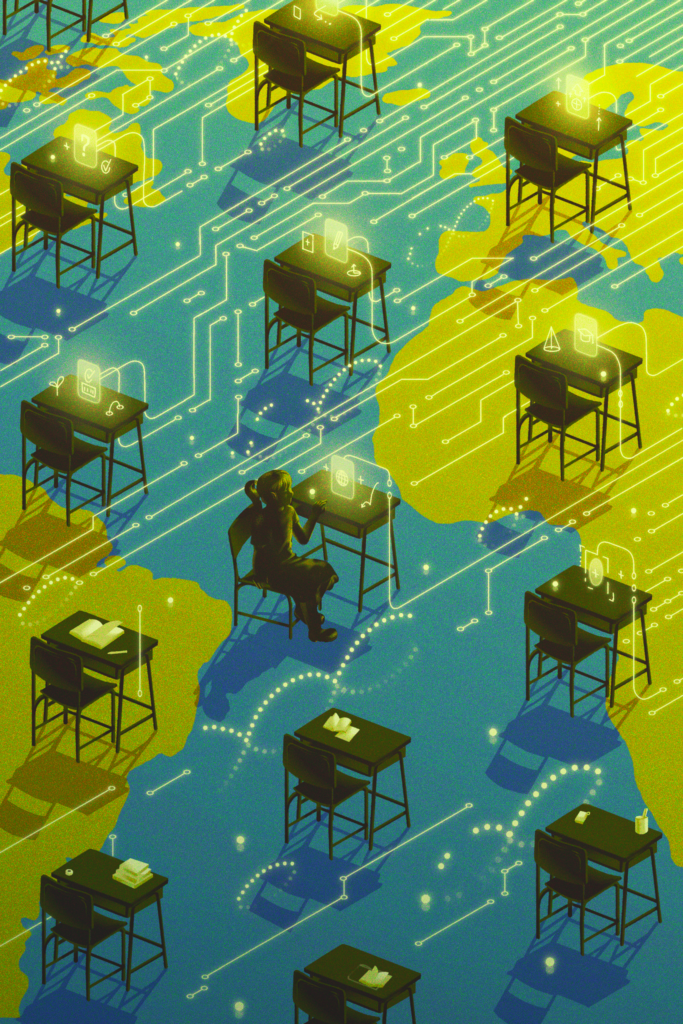
Why Schools Are Turning to AI
Schools face mounting pressure: overcrowded classrooms, teacher shortages, rising administrative workloads, and widening learning gaps. AI promises relief.
1. Personalized Learning at Scale
AI can adjust explanations, examples, and practice problems to match individual student needs. Advocates argue this is especially powerful for:
- Students who struggle to keep up
- Learners who need extra language support
- Advanced students seeking deeper challenges
For systems stretched thin, AI appears to offer customization that human teachers alone can’t always provide.
2. 24/7 Academic Support
Students increasingly use AI tools for homework help, clarification, and study support outside school hours. In countries like Estonia and Iceland, schools are experimenting with official AI integration rather than leaving students to navigate these tools alone.
The goal: guide usage instead of pretending it doesn’t exist.
3. Reducing Teacher Burnout
AI can help teachers with time-consuming tasks such as:
- Drafting lesson plans
- Creating quizzes and worksheets
- Providing feedback on assignments
- Summarizing student progress
Supporters believe this frees educators to focus on mentoring, creativity, and meaningful interaction — the parts of teaching machines can’t replicate.

Why Critics Are Alarmed
Despite the promise, educators and researchers warn that careless adoption could come at a cost.
1. Cheating and Academic Integrity
AI can generate essays, solve math problems, and write code in seconds. Teachers report growing difficulty distinguishing student work from AI-generated content — even when students claim they used AI “only for help.”
This blurs the line between assistance and substitution.
2. The Risk of Skill Atrophy
If students rely on AI for writing, analysis, and problem-solving, critics worry they may never fully develop those skills themselves. Learning is often uncomfortable — and AI can remove the struggle that leads to mastery.
Convenience may come at the expense of thinking.
3. Inequality and Access Gaps
Not all students have equal access to devices, internet connectivity, or AI-enabled platforms. Without careful policy, AI could deepen existing educational divides rather than close them.
4. Data Privacy Concerns
AI tools collect data about how students learn, think, and struggle. Without strong protections, this information could be misused, exposed, or commercialized — raising serious ethical questions.
5. Bias and Accuracy Issues
AI systems are trained on vast amounts of online data, which includes bias and misinformation. In subjects like history, literature, and social studies, AI may oversimplify complex topics or reinforce harmful assumptions.
How Different Countries Are Handling AI in Schools
Estonia: Teach AI — Don’t Hide It
Estonia is integrating AI while emphasizing AI literacy. Students learn how AI works, its limitations, and how to question its outputs — treating AI as a subject of study, not just a shortcut.
Iceland: Teacher-Guided Use
Icelandic schools are piloting supervised AI use, where educators actively guide when and how students use AI tools. The focus is on support, not replacement.
United States: A Patchwork Approach
U.S. schools vary widely:
- Some ban AI outright
- Others allow it for brainstorming and revision
- A growing number are redesigning assessments to adapt to AI-rich environments
The lack of national consensus reflects both opportunity and uncertainty.
What Education Experts Actually Agree On
Despite heated debate, most experts share a key conclusion:
AI should not replace learning — it should reveal how learning works.
Rather than banning AI, researchers recommend:
- Teaching students how to evaluate AI outputs critically
- Redesigning assessments to value reasoning and process
- Making expectations around AI use explicit
- Training teachers to integrate AI responsibly
In this view, AI becomes a tool for learning about thinking — not outsourcing it.
Frequently Asked Questions
Should students be allowed to use AI for homework?
Yes — but with boundaries. Most educators support AI for brainstorming, feedback, and clarification, not for producing final answers.
Does AI actually improve learning outcomes?
Results vary. AI can boost engagement and provide quick feedback, but benefits depend heavily on how tools are implemented and supervised.
Is banning AI in schools effective?
Generally no. Students often use AI anyway. Bans can push usage underground and prevent students from learning responsible practices.
Can AI widen educational inequality?
Yes. Without equitable access and thoughtful policy, AI could benefit already-advantaged students more than others.
What is AI literacy?
AI literacy means understanding how AI works, where it fails, how bias occurs, and how to verify information. It’s increasingly viewed as an essential life skill.
Will AI replace teachers?
Experts overwhelmingly say no. Teaching relies on empathy, judgment, and human connection — areas where AI cannot replace educators.
The Bottom Line
AI is neither the savior nor the villain of modern education.
Handled thoughtfully, it can personalize learning, support teachers, and prepare students for a future shaped by technology. Handled poorly, it risks weakening critical thinking, widening inequality, and undermining trust in education.
The real challenge isn’t whether schools should use AI —
it’s whether they can do so without losing what makes learning human.
Because education isn’t just about answers.
It’s about how students learn to think.
Sources The New York Times