
For nearly fifteen years, Tim Cook has guided Apple through one of the most successful periods in corporate history. Under his leadership, Apple became the world’s most valuable technology company, expanded its ecosystem, launched new product categories, and transformed services into a major revenue engine.
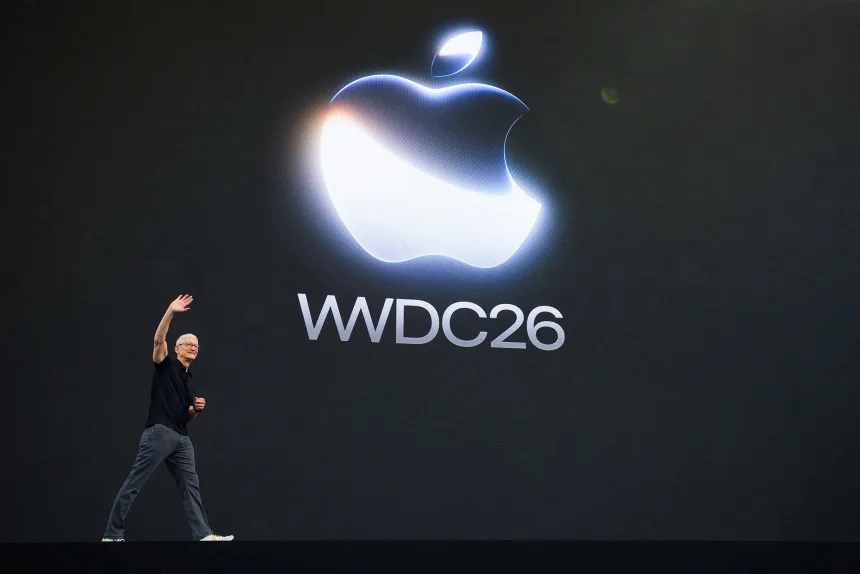
Now, at the 2026 edition of the annual Worldwide Developers Conference (WWDC), Cook delivered what is widely expected to be his final keynote as CEO before handing leadership to John Ternus later this year. The event was more than a software showcase—it represented a turning point for Apple as it attempts to redefine its role in the rapidly evolving artificial intelligence landscape.
While previous WWDC events focused heavily on operating system updates, developer tools, and hardware innovations, WWDC 2026 revolved around one central theme: Apple’s effort to catch up in the AI race and establish a credible long-term strategy for intelligent computing.
Why WWDC 2026 Was So Important
For years, Apple approached artificial intelligence differently than many competitors.
Rather than launching highly visible AI chatbots or cloud-first AI services, Apple prioritized:
- On-device processing
- User privacy
- Hardware optimization
- Incremental AI integration
This approach initially differentiated Apple from competitors.
However, the explosive rise of generative AI platforms such as ChatGPT and rival ecosystems from companies like Google and Microsoft created pressure for Apple to move faster. Many analysts argued that Apple had fallen behind in the AI race.
WWDC 2026 became Apple’s opportunity to demonstrate that it still intends to play a leading role in the next generation of computing.
Siri’s Biggest Transformation Since Launch
The centerpiece of WWDC 2026 was the introduction of a dramatically redesigned AI-powered Siri.
The new system, often referred to as “Siri AI,” represents Apple’s most ambitious attempt yet to modernize its digital assistant. According to presentations during the event, Siri is evolving from a command-based assistant into a conversational AI capable of understanding context, managing complex requests, and interacting more deeply across Apple’s ecosystem.
New capabilities reportedly include:
- Multi-step task execution
- More natural conversations
- Improved contextual awareness
- Personal content retrieval
- Workflow automation
- Enhanced writing assistance
- Image-related tasks and editing functions
The goal is to make Siri less of a voice-command utility and more of a true digital assistant.
Apple’s AI Catch-Up Strategy
One of the most notable aspects of Apple’s new direction is its willingness to collaborate with outside AI providers.
Reports indicate that Apple’s next-generation AI architecture incorporates technology connected to Google’s Gemini models while still combining it with Apple’s own systems and privacy-focused infrastructure. This represents a significant shift from Apple’s historically self-contained approach.
The strategy reflects a broader industry trend.
Instead of attempting to build every component internally, major technology companies are increasingly combining:
- Proprietary AI models
- Third-party foundation models
- Cloud infrastructure
- Specialized hardware
- On-device processing
For Apple, the challenge is balancing cutting-edge AI capabilities with its long-standing commitment to privacy and user control.
The Privacy Challenge
Apple’s brand has long been built around privacy.
Unlike many competitors, Apple frequently emphasizes:
- On-device processing
- Data minimization
- User consent
- Secure hardware integration
The expansion of AI introduces new tensions.
More powerful AI systems often require access to greater amounts of information, contextual understanding, and cloud-based computation.
Apple’s success may depend on convincing consumers that advanced AI can coexist with strong privacy protections.
This balance could become one of the company’s most important competitive advantages.

Beyond Siri: The Expansion of Apple Intelligence
WWDC 2026 demonstrated that AI is becoming deeply integrated across Apple’s ecosystem.
Reported enhancements include AI-powered features in:
- Safari
- Photos
- Messages
- Productivity tools
- System-level workflows
Apple Intelligence is increasingly being positioned as a foundational layer across iPhone, iPad, Mac, and other Apple products rather than as a standalone feature.
This ecosystem-wide approach may prove more valuable than individual AI applications because it allows intelligence to function consistently across devices.
The End of the Tim Cook Era
Perhaps the most emotional aspect of WWDC 2026 was its significance for Tim Cook’s leadership legacy.
When Cook succeeded Steve Jobs in 2011, many observers questioned whether anyone could successfully follow one of the most influential leaders in technology history.
Over the following decade and a half, Cook oversaw:
- Massive revenue growth
- Expansion of Apple’s services business
- Development of Apple Silicon
- Growth of wearables
- Increased healthcare initiatives
- Global supply chain transformation
- Strong environmental commitments
By many financial measures, Apple became even larger and more profitable during Cook’s tenure.
Yet AI may ultimately become the most important unfinished chapter of his leadership.
John Ternus and Apple’s Next Phase
As Cook prepares to transition leadership, attention is increasingly turning to John Ternus.
Ternus has played a major role in Apple’s hardware development efforts and is expected to inherit a company facing both enormous opportunities and significant challenges.
His leadership will be tested by several major questions:
Can Apple Become an AI Leader Again?
The company must demonstrate that it can compete effectively with AI-first rivals.
Can Apple Maintain Its Privacy Advantage?
Consumers increasingly care about how their data is used.
Can Apple Create the Next Major Platform?
Many analysts believe the next decade could bring breakthroughs in AI assistants, wearable computing, augmented reality, and robotics.
Can Apple Sustain Ecosystem Growth?
The strength of Apple’s ecosystem remains one of its greatest competitive assets.
Challenges Apple Still Faces
Despite the excitement surrounding WWDC 2026, significant challenges remain.
Intense AI Competition
Competitors continue moving rapidly.
Regulatory Pressure
AI regulations are expanding globally.
Regional Restrictions
Some AI features may face delayed availability in certain markets due to regulatory requirements. Reports indicate that aspects of the new Siri AI may initially be unavailable in the European Union and China.
Consumer Expectations
After years of AI hype, users increasingly expect products that deliver meaningful real-world benefits rather than experimental features.
Why WWDC 2026 Could Be Remembered as a Historic Event
WWDC has always served as a window into Apple’s future.
This year’s conference may be remembered for two reasons:
First, it marked the conclusion of Tim Cook’s tenure as Apple’s chief executive.
Second, it represented Apple’s most significant AI announcement since the generative AI revolution began.
Whether Apple’s strategy ultimately succeeds remains uncertain. However, WWDC 2026 made one thing clear: Apple is no longer treating AI as a secondary feature. It is becoming central to the company’s future.
As the technology industry enters a new era defined by intelligent systems, Apple’s ability to integrate AI into billions of devices while preserving trust, privacy, and usability may determine its position in the next decade of computing.
Frequently Asked Questions (FAQ)
1. What was the biggest announcement at WWDC 2026?
The most significant announcement was the introduction of a redesigned AI-powered Siri, which adds more conversational capabilities, deeper contextual understanding, and expanded integration across Apple’s ecosystem.
2. Why is WWDC 2026 historically significant?
WWDC 2026 is expected to be Tim Cook’s final WWDC as Apple CEO before leadership transitions to John Ternus later in the year. It also marks Apple’s largest AI-focused event to date.
3. How is Apple’s AI strategy different from competitors?
Apple continues emphasizing privacy, on-device processing, and ecosystem integration while combining its own technologies with external AI capabilities where appropriate.
4. Will the new AI features work on all Apple devices?
No. Advanced AI capabilities typically require newer hardware with sufficient processing power. Availability may also vary by region and regulatory requirements.

5. What are the biggest challenges Apple faces in AI?
Apple must compete with established AI leaders, navigate global regulations, maintain its privacy reputation, and deliver practical AI experiences that consumers find genuinely useful.
Sources CNN

