

China has become the global center of the humanoid robot revolution.
Videos of robots dancing on national television, running marathons, serving coffee, performing kung fu, and greeting visitors at trade shows have captured worldwide attention. Chinese robotics companies are unveiling increasingly sophisticated humanoid machines at a pace few countries can match, fueling excitement about a future where robots work alongside humans.
Yet beneath the impressive demonstrations lies a more complicated reality.
A rapidly growing robot rental market in China is exposing the gap between carefully choreographed public performances and the practical demands of everyday work. While demand for renting humanoid robots for exhibitions, marketing events, shopping malls, and entertainment is booming, many customers are discovering that today’s humanoid robots still require constant human supervision and remain far from replacing workers in most real-world environments.
Rather than signaling failure, this growing rental industry provides an unusually honest look at where humanoid robotics stands today—and how much progress is still needed before these machines become commonplace.
Why China Is Investing So Heavily in Humanoid Robots
China views humanoid robotics as one of its next strategic industries.
Like artificial intelligence, electric vehicles, and semiconductor manufacturing, humanoid robots have become a national priority supported by government investment, research funding, and industrial policy.
Several factors explain this push.
1. An Aging Population
China’s population is aging rapidly, while its working-age population continues to shrink.
Humanoid robots could eventually help offset labor shortages in:
- manufacturing
- logistics
- healthcare
- elderly care
- retail
- public services
The long-term goal is not simply replacing workers, but maintaining economic productivity despite demographic changes.
2. Maintaining Manufacturing Leadership
China already leads the world in industrial robotics.
Traditional robotic arms dominate many factories, but humanoid robots promise greater flexibility because they can potentially operate in environments originally designed for humans.
Instead of redesigning entire factories around specialized machines, future humanoids may eventually perform multiple tasks using human-like movement.
3. Winning the Global AI Race
Humanoid robots combine several advanced technologies:
- artificial intelligence
- computer vision
- motion planning
- robotics
- sensors
- large language models
Success in humanoid robotics could strengthen China’s broader leadership in AI and advanced manufacturing while reducing dependence on foreign technology.
The Rental Market Is Growing Faster Than Everyday Use
One unexpected development is the rise of a thriving humanoid robot rental business.
Instead of purchasing robots costing tens of thousands—or even hundreds of thousands—of dollars, businesses increasingly rent them for:
- trade shows
- product launches
- exhibitions
- shopping malls
- corporate events
- weddings
- marketing campaigns
- livestream promotions
Rental companies provide not only the robot but also trained operators who supervise, program, and sometimes remotely control the machine throughout the event.
For many businesses, renting offers a low-risk way to attract crowds and generate publicity without making a major capital investment.
The Rental Business Is Also Becoming a Reality Check
The popularity of rentals has revealed an important truth.
Most humanoid robots remain excellent at demonstrations but struggle with unpredictable environments.
Many machines still require:
- human operators
- pre-programmed routines
- carefully prepared surroundings
- frequent battery charging
- constant monitoring
Business owners involved in rentals report that while robots attract attention, customers often expect far more autonomy than today’s technology can deliver.
Why Humanoid Robots Still Struggle
Despite remarkable progress, building a useful humanoid robot remains one of engineering’s hardest challenges.
Walking Is Harder Than It Looks
Humans constantly adjust balance without thinking.
Robots must continuously calculate:
- body position
- joint movement
- ground conditions
- weight distribution
- obstacle avoidance
Even small disturbances can cause falls.
This explains why many impressive demonstrations occur under carefully controlled conditions.
Hands Are Surprisingly Difficult
Human hands contain extraordinary dexterity.
Simple household tasks such as:
- folding clothes
- tying shoelaces
- washing dishes
- opening containers
- preparing food
require complex finger coordination that remains difficult for robots.
Engineers continue improving robotic hands, but durability, precision, heat management, and manufacturing costs remain major obstacles.
The Data Problem
Unlike language models that learn from enormous amounts of internet text, humanoid robots require physical-world experience.
They must learn:
- walking
- lifting
- grasping
- climbing stairs
- opening doors
- navigating crowds
Collecting this data is slow and expensive because robots must physically perform these actions thousands—or even millions—of times.
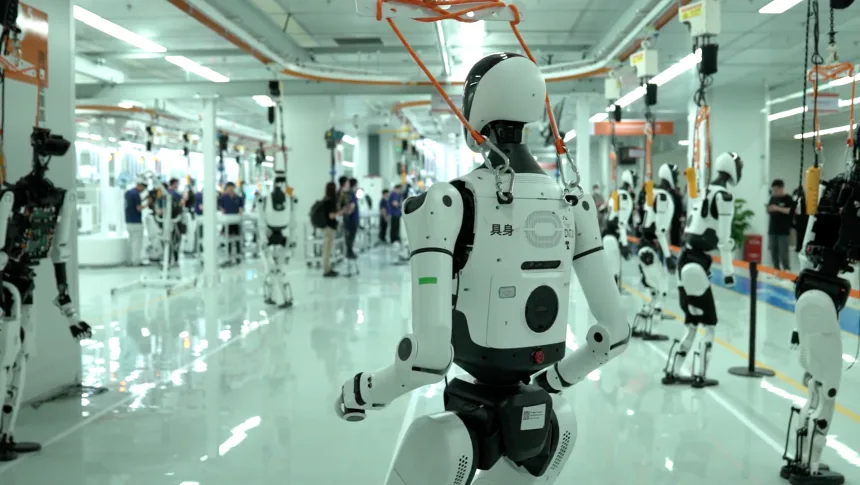
China has established specialized facilities where fleets of humanoids repeatedly practice everyday tasks while generating training data.
Spectacular Demonstrations Don’t Always Reflect Real Performance
Videos of robots performing dances, martial arts, or athletic routines often go viral.
However, these demonstrations are typically:
- heavily rehearsed
- carefully programmed
- performed in controlled environments
- supervised by engineers
Real workplaces are much less predictable.
Factories, hospitals, restaurants, and homes constantly present new obstacles that robots must interpret in real time.
Moving successfully from demonstrations to reliable daily work remains one of the industry’s biggest challenges.
Why Traditional Industrial Robots Still Dominate
Many factories already rely on industrial robots that:
- weld
- paint
- assemble parts
- package products
- move heavy materials
These specialized machines are generally:
- cheaper
- faster
- more reliable
- easier to maintain
- optimized for repetitive tasks
Humanoid robots offer greater flexibility but currently struggle to match the efficiency of purpose-built industrial systems.
Government Support Is Accelerating Development
China is aggressively encouraging commercial deployment.
Authorities have introduced national programs encouraging humanoids to be tested across dozens of practical scenarios, including manufacturing, logistics, retail, healthcare, and public services. Government-backed initiatives are intended to accelerate data collection, improve software, and create commercial demand.
Strong policy support has helped attract billions of dollars in investment while encouraging startups and established manufacturers to scale production.

The Economics of the Robot Boom
Although excitement is high, the industry faces economic challenges.
Current obstacles include:
- high manufacturing costs
- expensive maintenance
- battery limitations
- uncertain customer demand
- rapid competition among manufacturers
Analysts have also warned that enthusiasm may be outpacing real commercial demand, creating the risk of overcapacity and financial pressure on startups.
As production scales and supply chains mature, prices are expected to decline, making humanoid robots more accessible over time.
China’s Growing Advantage
China possesses several advantages in humanoid robotics:
- massive manufacturing capacity
- mature electronics supply chains
- competitive production costs
- government policy support
- abundant AI talent
- strong industrial ecosystem
Many analysts believe these strengths could make China the world’s largest producer of humanoid robots over the coming decade, even as companies in the United States, Japan, South Korea, and Europe continue developing competing technologies.
Will Humanoid Robots Replace Human Workers?
Not anytime soon.
Today’s robots perform best in:
- repetitive industrial work
- structured warehouse environments
- research laboratories
- demonstrations
- customer engagement events
Jobs requiring creativity, adaptability, empathy, complex decision-making, and fine motor skills remain firmly in the human domain.
Rather than replacing entire occupations, humanoid robots are more likely to automate specific tasks while assisting human workers.
The Future Looks Promising—But Patience Is Required
Many experts believe humanoid robots will eventually become commonplace.
However, widespread adoption depends on solving several major challenges:
- longer battery life
- better dexterity
- lower costs
- improved AI reasoning
- greater physical durability
- richer real-world training data
The path forward resembles the early days of personal computers and smartphones—promising technology that required years of refinement before reaching mass adoption.
The Bottom Line
China’s booming humanoid robot rental market offers a fascinating glimpse into the current state of one of the world’s most exciting technologies.
The robots are undeniably impressive. They can walk, interact, perform choreographed routines, and attract enormous public interest. Yet their popularity as rental attractions also reveals how dependent they remain on human supervision, structured environments, and specialized operators.
Instead of exposing failure, the rental market is exposing reality.
Humanoid robots are no longer science fiction, but they are not yet fully capable coworkers either. Their greatest value today lies in demonstrations, research, pilot projects, and data collection—not widespread replacement of human labor.
As artificial intelligence, robotics hardware, and manufacturing continue advancing, the gap between impressive demonstrations and practical everyday usefulness is likely to narrow. Until then, the future of humanoid robots will depend not only on smarter software but also on solving the many engineering challenges that remain.
Frequently Asked Questions (FAQ)
1. Why are humanoid robots becoming popular in China?
China sees humanoid robots as a strategic technology that can address labor shortages, strengthen manufacturing, support an aging population, and enhance its leadership in artificial intelligence and advanced robotics.
2. Why are companies renting humanoid robots instead of buying them?
Renting allows businesses to use robots for exhibitions, promotions, trade shows, and special events without paying the high purchase price or maintenance costs associated with ownership.
3. Can today’s humanoid robots work independently?
Not completely. Most current humanoid robots still require human supervision, programming, or remote assistance, especially in unpredictable environments.
4. What are the biggest technical challenges facing humanoid robots?
Major challenges include reliable walking and balance, dexterous hands, battery life, hardware durability, real-world training data, and AI capable of adapting to changing environments.

5. Will humanoid robots replace human workers soon?
Large-scale replacement is unlikely in the near future. Humanoid robots are expected to complement human workers by handling repetitive or hazardous tasks while people continue performing work requiring judgment, creativity, communication, and complex decision-making.
Sources CNN

