
For decades, automation was seen as a blue-collar story — robots on factory floors, machines replacing repetitive physical labor. White-collar professionals, armed with degrees and specialized knowledge, felt largely insulated.
That assumption is rapidly unraveling.
Artificial intelligence is now drafting legal briefs, writing marketing campaigns, generating financial reports, assisting in medical documentation, reviewing contracts, producing software code, and even supporting strategic planning. Tasks once associated with skilled office work are increasingly augmented — or partially automated — by AI systems.
The future of work is not simply about factory robots anymore.
It is about the transformation of professional identity, career paths, and economic structures in a world where intelligence itself can be replicated at scale.
This article explores how AI is reshaping white-collar work, which professions are most exposed, what new roles are emerging, how compensation structures may shift, and what workers and institutions can do to adapt.
Why White-Collar Work Is Vulnerable Now
Three developments have accelerated AI’s reach into professional roles:
1. Generative AI Capabilities
Modern systems can produce:
- High-quality text
- Structured analysis
- Summaries and research briefs
- Functional software code
- Presentation materials
This targets core office tasks.
2. Enterprise Integration
AI is no longer experimental. It is embedded directly into:
- Word processors
- Email clients
- CRM platforms
- Financial tools
- Legal research databases
Automation is becoming ambient.
3. Rapid Scaling
Cloud-based AI tools allow companies to deploy capabilities across entire workforces quickly.
Adoption cycles that once took years now take months.
The Tasks Most at Risk
Rather than eliminating entire professions, AI is reshaping specific functions.
Administrative Coordination
Scheduling, report compilation, and documentation are increasingly automated.
Entry-Level Analysis
Junior analysts in finance, consulting, and research may find AI handling data processing and initial drafts.
Content Production
Marketing copy, basic journalism, and corporate communications are seeing AI augmentation.
Routine Coding
AI-assisted programming tools now generate functional code, particularly for standard applications.
The “middle layer” of knowledge work faces compression.
What AI Does Not Easily Replace
Despite its capabilities, AI struggles with:
- Complex human negotiation
- Deep contextual judgment
- Ethical decision-making
- Relationship management
- High-stakes accountability
Senior roles requiring strategic oversight and nuanced interpersonal skill remain less vulnerable — for now.

The Risk of Career Path Disruption
A major concern is not immediate job loss but the erosion of entry-level pathways.
Many professions rely on:
- Junior roles as training grounds
- Gradual skill accumulation
- Mentorship structures
If AI absorbs foundational tasks, how will future experts develop?
The pipeline problem may emerge slowly but significantly.
Compensation and Productivity Shifts
AI could:
- Increase output per worker
- Reduce demand for certain roles
- Shift bargaining power toward firms
If productivity gains are not widely shared, income inequality could widen.
Alternatively, new value creation may generate fresh opportunities.
The distribution of gains will shape outcomes.
Emerging Roles in the AI Era
While some tasks shrink, others expand:
- AI oversight and auditing
- Prompt engineering and workflow design
- Data governance specialists
- AI compliance officers
- Human-AI collaboration managers
Professionals who can supervise, interpret, and integrate AI tools may thrive.
The Psychological Impact
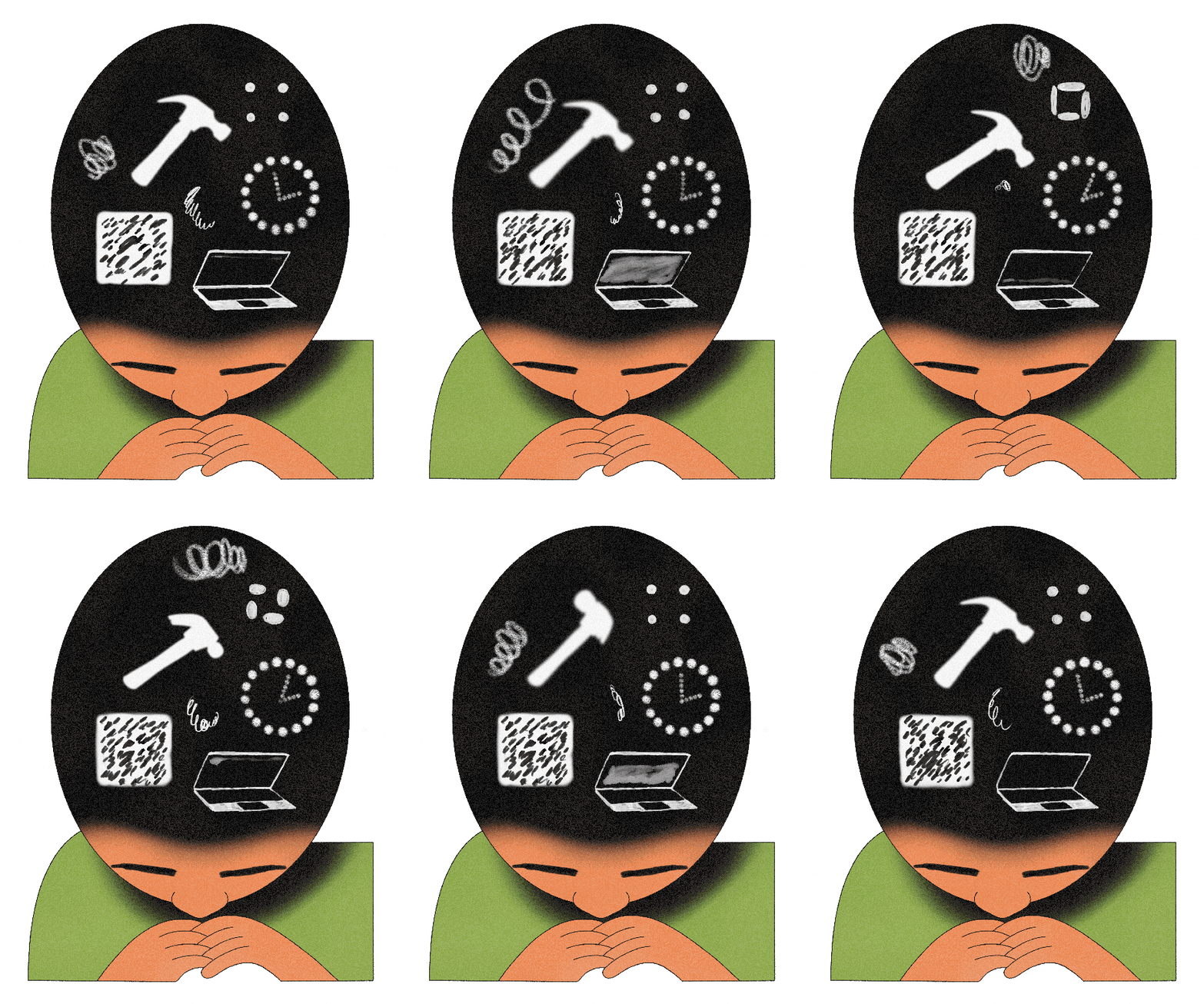
White-collar professionals often tie identity to intellectual contribution.
AI’s ability to replicate certain forms of cognition can trigger:
- Anxiety
- Loss of status
- Imposter syndrome
- Devaluation concerns
The shift is not purely economic — it is existential.
Organizational Responses
Companies are experimenting with:
- AI training programs
- Hybrid workflows
- Performance metrics adjusted for AI use
- Reskilling initiatives
However, adaptation is uneven across industries.
Education and Reskilling
Universities and business schools are reassessing curricula to emphasize:
- Critical thinking
- Strategic reasoning
- Ethical analysis
- Human-AI collaboration skills
Technical literacy is becoming foundational across disciplines.
What Often Goes Unexamined
AI May Increase Managerial Oversight
Algorithmic monitoring tools can intensify performance tracking.
Work May Become More Polarized
High-skill oversight roles may expand, while mid-level routine roles shrink.
Global Labor Competition Could Intensify
AI tools lower barriers for cross-border work, increasing global competition for white-collar tasks.
Frequently Asked Questions
Will AI eliminate white-collar jobs?
It is more likely to automate tasks within roles rather than eliminate entire professions immediately.
Which professionals are safest?
Roles emphasizing strategy, leadership, interpersonal trust, and complex judgment are less vulnerable.
How should workers prepare?
Develop AI literacy, strengthen uniquely human skills, and adapt to collaborative workflows.
Will salaries fall?
In some routine roles, wage pressure may increase. In high-skill integrative roles, compensation could rise.
Is this comparable to past automation waves?
Yes — but this wave affects cognitive labor more directly than previous ones.

Final Thoughts
AI is not staging a dramatic takeover of office towers overnight.
It is quietly rewriting workflows, redefining value, and reshaping professional hierarchies.
The future of white-collar work will not be defined by replacement alone — but by reconfiguration.
The most resilient professionals will not compete against AI.
They will learn to direct it, question it, and integrate it into higher-order thinking.
Because in the age of intelligent machines, the premium shifts from routine cognition to adaptive intelligence.
And that shift has only just begun.
Sources The Guardian