
Artificial intelligence is rapidly becoming a constant companion for college students—helping them write essays, solve problems and organize their academic lives. But as AI tools become deeply embedded in education, a new and more complex question is emerging:
What is AI doing to how students think?
Beyond productivity gains and convenience, researchers and educators are beginning to explore a deeper impact—one that touches cognitive development, critical thinking and mental health. Early findings suggest that while AI can enhance learning, it may also subtly reshape how students process information, solve problems and even perceive their own abilities.
This is not just a technological shift—it is a cognitive and psychological transformation.
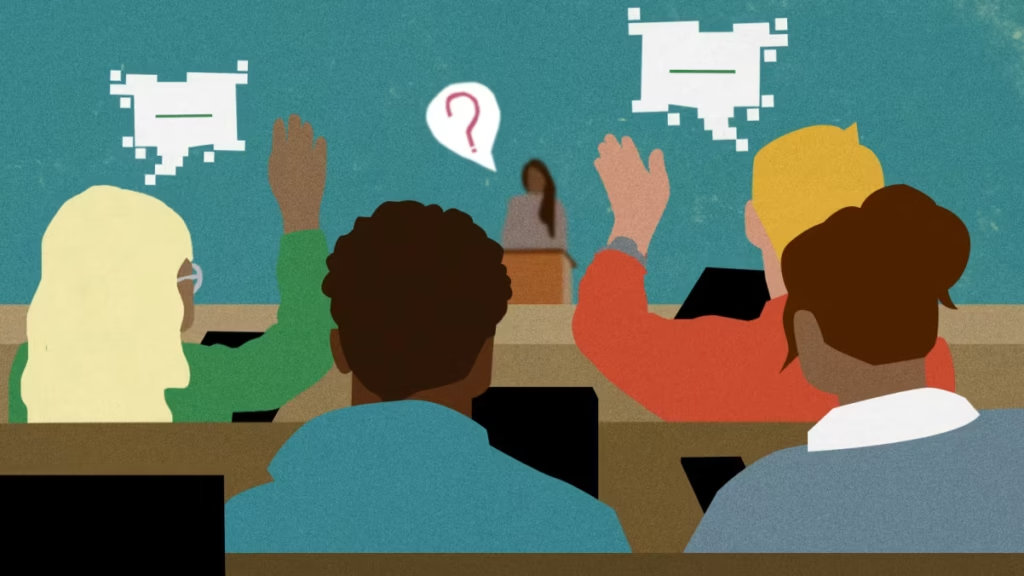
The Rise of AI as a Cognitive Partner
Today’s students are using AI for a wide range of academic tasks:
- generating essays and summaries
- solving math and coding problems
- brainstorming ideas
- organizing study schedules
- explaining complex concepts
In many cases, AI acts as a real-time tutor and assistant, available 24/7.
This changes the learning dynamic. Instead of struggling through problems independently, students can now:
- get instant answers
- receive step-by-step guidance
- bypass traditional trial-and-error learning
While this can improve efficiency, it also alters the role of effort in learning.
The Cognitive Trade-Off: Convenience vs. Deep Thinking
One of the central concerns is cognitive offloading—the tendency to rely on external tools instead of internal mental processes.
Benefits
- faster understanding of complex topics
- reduced frustration
- increased productivity
Risks
- reduced critical thinking practice
- weaker problem-solving skills
- less retention of information
When students rely heavily on AI, they may engage less in:
- deep analysis
- independent reasoning
- creative exploration
Over time, this could affect how knowledge is built and retained.
Are Students Thinking Less—or Differently?
The impact of AI is not necessarily about “thinking less,” but about thinking differently.
Students may shift from:
- generating answers
to - evaluating AI-generated responses
This introduces new skills:
- verifying accuracy
- refining prompts
- interpreting outputs
However, it also creates a dependency on AI as the starting point for thinking.
The Confidence Paradox
AI can both boost and undermine student confidence.
Increased Confidence
- students feel supported
- complex tasks become manageable
Reduced Confidence
- reliance on AI may weaken self-belief
- students may question their own abilities without assistance
This creates a paradox where students are more capable—but may feel less independent.
Mental Health and AI Use
AI’s impact extends beyond cognition into emotional well-being.
Positive Effects
- reduced academic stress
- immediate help during difficult tasks
- increased accessibility for struggling students
Negative Effects
- pressure to keep up with AI-enhanced peers
- anxiety about being replaced or outperformed
- over-reliance leading to reduced resilience
Some students may feel they must constantly use AI to remain competitive.

The Risk of Passive Learning
One of the biggest concerns is the shift toward passive learning.
Instead of actively engaging with material, students may:
- accept AI-generated answers
- skip deeper exploration
- focus on outputs rather than understanding
This can lead to:
- superficial knowledge
- difficulty applying concepts independently
What Educators Are Observing
Professors are noticing changes in student behavior:
- more polished but less original work
- reduced willingness to struggle through challenges
- increased reliance on AI for starting assignments
At the same time, some educators see opportunities to:
- redesign assessments
- emphasize critical thinking
- incorporate AI into learning strategies
The Opportunity: AI as a Learning Amplifier
When used thoughtfully, AI can enhance education.
Personalized Learning
AI can adapt explanations to individual needs.
Skill Development
Students can learn how to:
- ask better questions
- analyze information
- use technology effectively
Accessibility
AI can support students with different learning styles and needs.
The key is how AI is used—not just that it is used.
What the Original Conversation Often Misses
AI Changes How Intelligence Is Measured
Traditional metrics like memorization may become less relevant.
The Role of Effort Is Evolving
Learning may shift from effort-based to strategy-based (knowing how to use tools effectively).
Long-Term Cognitive Effects Are Still Unknown
We are in the early stages of understanding how AI affects brain development.
Social Comparison Is Increasing
Students may compare themselves not just to peers—but to AI-enhanced performance.
How Students Can Use AI Responsibly
To balance benefits and risks, students should:
- use AI as a guide, not a replacement
- attempt problems before seeking help
- verify AI outputs
- focus on understanding, not just results
The Future of Learning
AI is likely to become a permanent part of education.
Future classrooms may include:
- AI-assisted tutoring systems
- adaptive learning platforms
- hybrid teaching models combining human and AI support
The challenge will be ensuring that these tools enhance thinking rather than replace it.
Frequently Asked Questions (FAQ)
Q: Does AI make students less intelligent?
Not necessarily, but over-reliance can reduce opportunities to practice critical thinking.
Q: Is using AI for studying harmful?
It depends on how it is used. It can be beneficial if used as a support tool rather than a shortcut.
Q: Can AI improve student mental health?
It can reduce stress by providing support, but may also create new pressures.
Q: Are students becoming dependent on AI?
Some are, especially when using it for tasks they could attempt independently.
Q: How can educators respond?
By redesigning assessments and teaching students how to use AI responsibly.
Q: Will AI replace traditional learning methods?
It will likely transform them rather than fully replace them.
Q: What is the biggest risk of AI in education?
The potential loss of deep thinking and independent problem-solving skills.

Conclusion
Artificial intelligence is reshaping not just what students learn—but how they think.
It offers powerful tools that can enhance understanding, reduce barriers and personalize education. But it also introduces risks that could fundamentally alter cognitive development and learning habits.
The challenge is not to reject AI—but to use it wisely, ensuring that it strengthens human intelligence rather than weakening it.
Because in the end, the goal of education is not just to find answers—but to learn how to think.
Sources CNN