

For decades, workplace technology has evolved in predictable stages.
Employees began with desktop computers.
Laptops then became the standard.
Smartphones brought work into our pockets.
Cloud computing made information accessible from virtually anywhere.
Now, the tech industry is preparing for what could be the next major leap:
AI-powered wearable devices that stay with employees throughout the workday.
Microsoft is reportedly testing a wearable AI device designed specifically for office environments, signaling a broader effort to transform how workers interact with artificial intelligence. Instead of opening apps, switching between screens, or typing commands into a computer, employees could access AI instantly and continuously throughout the day.
This initiative is about much more than a new gadget.
It reflects a growing belief among technology leaders that the future of computing may move beyond traditional screens and toward intelligent assistants that are always available when needed.
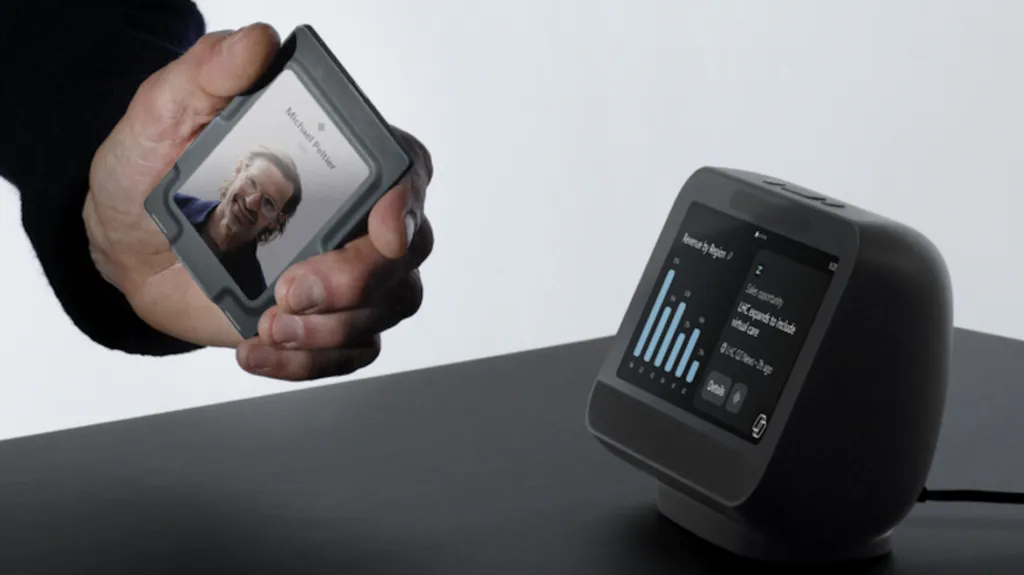
What Is Microsoft’s Wearable AI Device?
During Microsoft’s Build 2026 conference, the company revealed details about a wearable reference design known as the “badge concept.” The device resembles a workplace ID badge but includes advanced AI capabilities such as:
- A built-in camera
- Multiple microphones
- Fingerprint authentication
- Wireless connectivity
- Direct access to AI agents
The wearable is part of Microsoft’s broader Project Solara initiative, a platform designed specifically for AI-first devices rather than conventional computers. The goal is to provide immediate access to AI assistance without requiring users to interact with a laptop, smartphone, or tablet.
Microsoft has emphasized that the current version is a concept and reference design rather than a commercial product ready for sale.
Why Microsoft Believes Offices Need AI Wearables
Modern employees spend a significant portion of their day switching between tasks and applications.
A typical workday may involve:
- Attending meetings
- Responding to emails
- Searching for documents
- Updating project management tools
- Communicating with coworkers
- Reviewing reports
- Managing schedules
Each activity often requires navigating multiple platforms and devices.
Microsoft believes AI can eliminate much of this friction.
Instead of manually searching for information, workers could simply ask an AI assistant.
Instead of taking notes during meetings, AI could automatically generate summaries and action items.
Instead of checking numerous dashboards, AI could proactively deliver important updates.
The company’s vision centers on creating “agent-first” experiences where AI becomes the primary interface between workers and digital information.
The Growing Shift Toward Ambient Computing
Microsoft’s wearable strategy aligns with a broader technology trend known as ambient computing.
The concept aims to make technology less visible and more natural to use.
Rather than actively interacting with devices, users engage with intelligent systems embedded throughout their environment.
Examples include:
- Voice assistants
- Smart displays
- AI-powered glasses
- Wearable devices
- Context-aware digital assistants
In this future, AI is always available in the background, ready to assist whenever needed.
Many technology companies believe ambient computing could become the next major evolution of personal and workplace technology.
How Microsoft’s AI Wearable Could Be Used
Microsoft’s demonstrations suggest several practical workplace applications.
Meeting Assistance
The wearable could automatically generate:
- Meeting transcripts
- Summaries
- Action items
- Follow-up reminders
This could significantly reduce administrative work and improve productivity.
Personal Productivity Support
AI agents could provide:
- Daily briefings
- Priority alerts
- Schedule updates
- Workflow recommendations
Instead of searching for information, employees could receive it proactively.
Context-Aware Assistance
Using cameras and environmental awareness, AI systems could potentially understand what users are viewing and provide relevant information in real time.
Hands-Free Workplace Support
For workers who cannot easily use laptops or smartphones, wearable AI could provide instant assistance without interrupting their workflow.
Industries that may benefit include:
- Healthcare
- Retail
- Warehousing
- Manufacturing
- Field services
Why This Is Bigger Than Just Another Office Gadget
Microsoft’s project represents a much larger shift in computing.
For years, software companies competed by creating better applications.
AI is changing the competition entirely.
The new battle is about controlling the interface between people and information.
If AI assistants become the primary way workers access digital systems, traditional software interfaces may become less important.
Instead of opening multiple applications, employees could rely on AI agents to retrieve information, complete tasks, and coordinate workflows automatically.
Such a shift could dramatically reshape the enterprise software industry.
Privacy Concerns Remain a Major Challenge
Despite the excitement surrounding AI wearables, privacy concerns are unavoidable.
A device equipped with microphones and cameras could potentially collect vast amounts of information throughout the workday.
Common concerns include:
- Workplace surveillance
- Employee monitoring
- Recording consent
- Data storage policies
- Sensitive conversations
- Customer privacy
Microsoft says privacy, security, authentication, and user controls are core components of Project Solara. The concept devices reportedly include privacy switches and enterprise management features.
Even so, balancing convenience with privacy will likely be one of the biggest hurdles facing AI wearables.
Will Employees Accept Constant AI Presence?
History shows that workplace technology adoption is rarely straightforward.
Employees generally embrace tools that clearly improve productivity.
However, they often become skeptical when technology appears to monitor their behavior.
Workers may naturally ask:
- Is the device always listening?
- Who owns the recorded data?
- Can managers access conversations?
- How is information stored and used?
- Can employee performance be tracked continuously?
Even if companies provide clear answers, trust will play a critical role in adoption.
The success of AI wearables may depend as much on employee confidence as on technological capabilities.
Microsoft Faces Growing Competition
Microsoft is not the only company pursuing AI-powered wearable technology.
Several major technology firms are investing heavily in this space:
- Google is exploring AI-enhanced wearable experiences.
- Meta continues expanding its AI smart glasses initiatives.
- OpenAI is developing new hardware concepts through its partnership with legendary designer Jony Ive.
- Apple is researching future AI-powered wearable ecosystems.
Microsoft’s strategy stands out because it focuses heavily on workplace productivity rather than consumer entertainment.
Microsoft’s Biggest Advantage: Its Existing Ecosystem
Microsoft may have a significant edge over competitors.
The company already dominates workplace software through products such as:
- Microsoft 365
- Teams
- Outlook
- Azure
- Copilot
This ecosystem provides valuable workplace context that AI agents can use to deliver more personalized assistance.
A wearable connected to calendars, emails, meetings, documents, and business workflows could potentially offer far greater value than standalone consumer devices.
That deep integration may become Microsoft’s strongest competitive advantage.
Why AI Hardware Has Failed Before
The wearable technology market has seen numerous disappointments over the years.
Examples include:
- Early smart glasses
- Wearable cameras
- AI pins
- Digital assistant devices
Many struggled because of:
- Poor battery life
- Limited functionality
- Privacy concerns
- High costs
- Social discomfort
Several highly publicized AI hardware launches failed because they did not provide enough value to justify changing user habits.
Microsoft will need to prove that its wearable offers meaningful benefits beyond existing devices.
Could the Future Office Have Fewer Screens?
One of the most intriguing possibilities is that AI wearables could reduce reliance on traditional screens.
Instead of:
- Searching through folders
- Opening applications
- Navigating dashboards
Workers may increasingly interact through voice commands and AI-powered conversations.
Computers would still exist, but their role could evolve.
The AI assistant—not the application—could become the primary interface.
Such a transformation could be as significant as the shift from command-line computing to graphical user interfaces decades ago.
The Biggest Question: Will Workers Actually Want It?
This remains the ultimate test.
Technology history is filled with products that appeared revolutionary but failed because users simply did not find them useful.
AI wearables will succeed only if they solve real workplace problems.
If they can:
- Save time
- Reduce administrative tasks
- Improve productivity
- Eliminate repetitive work
adoption could accelerate rapidly.
If they create distractions, privacy concerns, or unnecessary complexity, they may struggle to gain widespread acceptance.
The lesson from past technology trends is clear:
People adopt tools that genuinely improve their lives.
The Bigger Picture
Microsoft’s wearable AI initiative reflects a broader transformation taking place across the technology industry.
Artificial intelligence is no longer confined to software.
It is beginning to shape the design of the devices themselves.
The next generation of computing may not be defined by larger screens, faster processors, or more powerful apps.
Instead, it may revolve around intelligent systems that remain continuously available, understand context, and assist users throughout their day.
Whether Microsoft’s AI badge becomes a breakthrough product or remains an experimental concept is still uncertain.
What is clear, however, is that the race to define the future of AI hardware is accelerating.
And the workplace may become one of the first places where that future arrives.
Frequently Asked Questions (FAQ)
What is Microsoft’s wearable AI device?
Microsoft has introduced a wearable “badge concept” as part of Project Solara, an AI-first platform designed to provide workplace productivity assistance through AI agents.
Is Microsoft planning to sell this wearable?
At present, Microsoft describes the device as a concept and reference design intended to guide future hardware development rather than an immediate commercial product.
What is Project Solara?
Project Solara is Microsoft’s platform for AI-powered devices and agent-first computing experiences that extend beyond traditional PCs and smartphones.
What can Microsoft’s AI wearable do?
Potential features include AI assistance, meeting transcription, automatic summaries, task management, contextual support, voice interactions, and workflow automation.
Why is Microsoft investing in AI wearables?
Microsoft believes future computing experiences will increasingly revolve around AI agents that provide continuous assistance rather than requiring users to interact with traditional applications.
Sources BBC

