
Artificial intelligence is no longer just a breakthrough technology.
It has become a weapon of economic power, military influence, and global leadership.
Around the world, governments are racing to dominate AI — not simply to build smarter machines, but to shape how economies grow, how wars are fought, and how societies are governed. At the center of this contest stand two rivals with sharply different visions: the United States and China.
This is not a race for better apps.
It is a race to define the future world order.
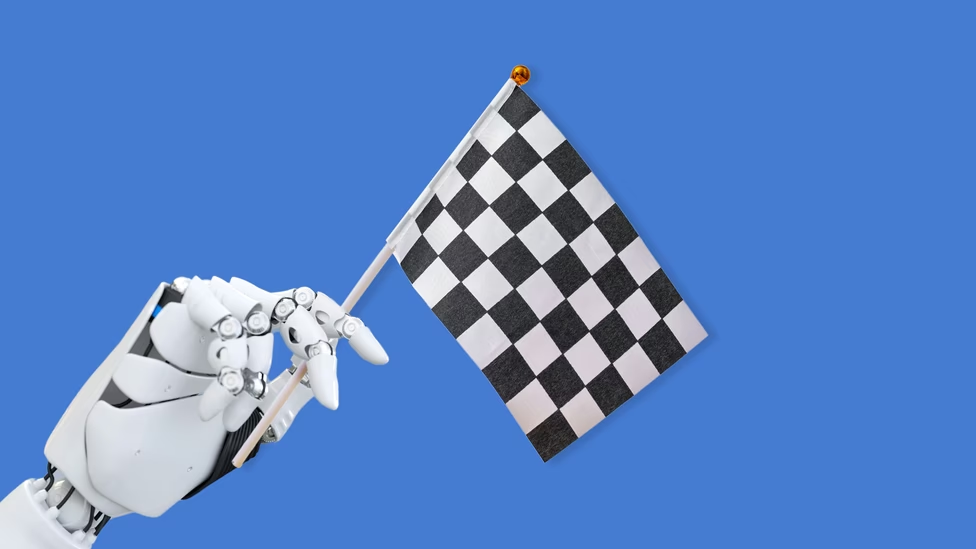
Why AI Has Become a Global Power Struggle
AI touches nearly every strategic domain:
- Military planning and autonomous weapons
- Economic productivity and industrial automation
- Surveillance, intelligence, and cybersecurity
- Media, information flow, and political influence
Unlike previous technologies, AI is a general-purpose force multiplier. Once a country gains an advantage, it can apply it everywhere — from hospitals to battlefields.
That makes AI leadership incredibly valuable — and incredibly destabilizing.
Two Rival Visions for AI Dominance
The United States: Innovation Through Open Markets
The American AI ecosystem is driven largely by private companies, universities, and venture capital.
Key traits include:
- Rapid innovation led by tech giants and startups
- Open research culture and global collaboration
- Strong university-industry pipelines
- Government influence through funding and regulation rather than control
This model excels at creativity and speed but struggles with coordination, uneven regulation, and reliance on private incentives.
China: AI as a State Power Project
China treats AI as a strategic national mission tied directly to government planning, industrial policy, and national security.
Key traits include:
- Centralized state investment and coordination
- Close integration of civilian tech and military goals
- Massive data access through population-scale platforms
- Strict information control and surveillance infrastructure
China’s approach prioritizes scale, control, and rapid deployment, particularly in surveillance, facial recognition, and smart cities.
The Real Battlefields of the AI Race
1. Chips and Semiconductors
Advanced AI requires powerful chips. Control over semiconductor design and manufacturing is one of the most critical choke points in global AI competition.
- The U.S. and allies dominate high-end chip design
- Taiwan’s manufacturing role is strategically vital
- China is racing to build domestic alternatives amid export controls
This struggle over hardware may determine who leads in AI.
2. Data: The Fuel of AI
AI systems improve with data. Countries with large populations and fewer privacy restrictions gain an advantage — often at the cost of civil liberties.
China’s data scale contrasts sharply with Western systems constrained by privacy laws and public oversight.
3. Talent and Knowledge
The AI race is also a war for people.
- Elite researchers are highly mobile
- Immigration policy directly affects innovation
- Universities act as strategic assets
Restrictions on visas, collaboration, and research sharing are now tools of competition.
4. Military and Security Applications
AI is reshaping warfare:
- Autonomous drones and weapons
- Surveillance and intelligence analysis
- Cyber operations and electronic warfare
- Decision-support systems for commanders
Both the U.S. and China see AI as essential to future military superiority — raising fears of escalation without clear rules.

Beyond Two Superpowers: The Global Chessboard
Europe
Europe focuses on rules and ethics, aiming to shape global AI norms through regulation like the EU AI Act. While less dominant in platforms, Europe seeks influence through governance.
India
India’s vast talent pool and digital expansion position it as a future AI heavyweight. Its strategic alignments could reshape the balance of power.
Middle Powers
Countries such as Japan, South Korea, Canada, and Israel play outsized roles through specialized research, alliances, and niche technologies.
AI dominance is multipolar — even if the rivalry between Washington and Beijing dominates headlines.
AI Carries Ideology Inside Its Code
AI systems embed values:
- Who controls data?
- Who decides acceptable use?
- How transparent are algorithms?
- What rights do individuals retain?
As countries export AI systems abroad, they export governance models — from surveillance-heavy systems to privacy-focused frameworks.
The AI race is also a battle over how societies should function.
The Danger of an Unchecked AI Arms Race
Experts warn that relentless competition could lead to:
- Unsafe systems deployed too quickly
- Reduced global cooperation
- Escalating military AI development
- Fragmentation of the internet into rival AI blocs
Without shared rules, AI could amplify instability rather than security.
Is Cooperation Still Possible?
Despite rivalry, some problems demand collaboration:
- AI safety and alignment
- Climate modeling and disaster response
- Pandemic prediction
- Nuclear risk reduction
Many experts argue that managed competition with shared guardrails is the only sustainable path forward.
Frequently Asked Questions
Why is AI considered a national security issue?
Because it affects military capability, intelligence, economic competitiveness, and infrastructure — all core elements of national power.
Is China winning the AI race?
China leads in scale and deployment, while the U.S. leads in foundational research and cutting-edge models. Leadership depends on how success is measured.
Why are semiconductors so critical?
Without advanced chips, AI progress stalls. Semiconductor supply chains are the backbone of AI power.
Can smaller countries compete in AI?
Yes. Specialization, alliances, and smart regulation allow smaller nations to influence AI outcomes without matching scale.
Is an AI arms race inevitable?
Not inevitable — but likely without international norms and agreements.
Will AI reshape global power?
Almost certainly. AI may matter as much as industrial capacity did in the 20th century.

The Bottom Line
The race for AI dominance is not about faster software.
It is about who sets the rules, who controls the technology, and whose values shape the digital future.
AI will influence how wars are fought, how economies grow, and how societies govern themselves.
The code may be digital — but the stakes are profoundly human.
Sources The Atlantic