

For months, headlines have suggested that artificial intelligence would wipe out traditional business software—replacing CRMs, ERPs and productivity tools with smarter, faster AI systems. But in reality, something very different is happening.
Companies are not ripping out their existing software stacks. Instead, they are layering AI on top of them—transforming how these systems work without replacing them entirely.
This quieter, more practical shift is redefining enterprise technology. Rather than a sudden revolution, businesses are embracing a gradual evolution—where AI becomes the intelligence layer that sits across everything they already use.
Why Companies Aren’t Replacing Existing Software
Despite the hype, ripping out core business systems is risky, expensive and disruptive.
Enterprise software like:
- Salesforce (CRM)
- SAP and Oracle (ERP)
- Microsoft 365 and Google Workspace
- HR and finance systems
are deeply embedded in daily operations.
Replacing them would involve:
- massive migration costs
- retraining employees
- operational downtime
- potential data loss or integration failures
For most organizations, the risk simply isn’t worth it.
The Real Strategy: AI as a Layer, Not a Replacement
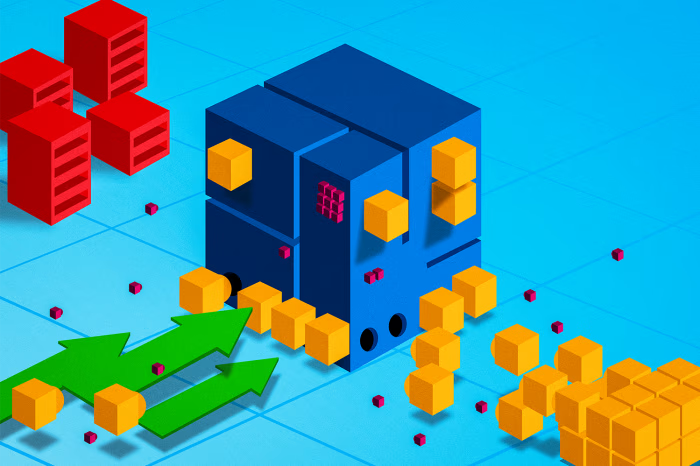
Instead of replacing software, companies are adding AI as a layer on top of existing systems.
This approach allows businesses to:
- keep their current infrastructure
- enhance functionality with AI
- improve productivity without disruption
AI becomes a co-pilot across tools, rather than a standalone replacement.
How AI Is Being Integrated Into Existing Systems
Companies are embedding AI into workflows in several practical ways.
1. AI Copilots Inside Software
Many platforms now include built-in AI assistants.
Examples include:
- drafting emails in productivity tools
- summarizing meetings
- generating reports from data
- assisting with customer interactions
These copilots work within existing applications, making adoption seamless.
2. Automation of Repetitive Tasks
AI is being used to automate routine processes such as:
- data entry
- invoice processing
- customer support responses
- scheduling and coordination
This reduces manual work without changing core systems.
3. Data Analysis and Insights
AI can analyze large datasets within existing platforms to:
- identify trends
- predict outcomes
- generate actionable insights
This enhances decision-making without requiring new software.
4. Workflow Integration
AI tools are being connected across systems using APIs and automation platforms.
This allows:
- data to flow between tools
- processes to be streamlined
- tasks to be executed automatically
The Rise of “AI Wrappers”
A growing trend is the use of AI wrappers—tools that sit on top of existing software and enhance functionality.
These wrappers can:
- connect multiple systems
- provide a unified interface
- add AI capabilities without replacing underlying tools
This approach allows companies to modernize quickly without starting from scratch.

Why This Approach Makes Sense
Lower Risk
Companies avoid disrupting critical operations.
Faster Implementation
AI can be added incrementally rather than through large-scale overhauls.
Cost Efficiency
Enhancing existing systems is often cheaper than replacing them.
Employee Adoption
Workers can continue using familiar tools while benefiting from AI enhancements.
The Role of Enterprise Software Companies
Traditional software providers are adapting quickly.
Major players are:
- embedding AI into their platforms
- launching AI copilots
- offering automation features
- integrating generative AI capabilities
This ensures they remain relevant in an AI-driven world.
Challenges of the “Layered AI” Approach
While practical, this strategy comes with challenges.
Integration Complexity
Connecting multiple systems can be technically difficult.
Data Silos
AI effectiveness depends on access to high-quality, unified data.
Cost Management
AI usage—especially token-based systems—can become expensive at scale.
Security and Privacy
Sensitive data must be protected when integrating AI tools.
The Shift from Software to Systems of Intelligence
This transformation reflects a broader shift.
Traditional software acted as a system of record—storing and organizing data.
AI turns these systems into systems of intelligence, capable of:
- understanding data
- making recommendations
- automating decisions
This fundamentally changes how businesses operate.
What This Means for the Future of Work
As AI becomes embedded in everyday tools:
- employees will rely on AI for decision support
- workflows will become more automated
- productivity expectations will increase
Rather than replacing jobs entirely, AI will reshape how work is done.
The Bigger Picture: Evolution, Not Revolution
The idea that AI will suddenly replace all existing software is largely a myth.
Instead, the transition is happening gradually:
- old systems remain in place
- new capabilities are layered on top
- workflows evolve over time
This approach allows businesses to adapt without disruption.
Frequently Asked Questions (FAQs)
1. Are companies replacing their software with AI?
No. Most companies are adding AI to existing systems rather than replacing them.
2. What is an AI layer?
It’s when AI is integrated on top of existing software to enhance functionality without replacing the underlying system.
3. What are AI copilots?
AI assistants built into software that help users perform tasks more efficiently.
4. Why don’t companies switch to entirely new AI systems?
Because replacing core systems is expensive, risky and disruptive.
5. What are AI wrappers?
Tools that sit on top of existing software and add AI capabilities without replacing it.
6. What are the risks of this approach?
Challenges include integration complexity, data management, costs and security concerns.
7. What is the future of enterprise software?
It will increasingly combine traditional systems with AI-driven intelligence.

Conclusion
The AI revolution in business is not about tearing everything down—it’s about building on what already exists. By layering intelligence onto established systems, companies are finding a practical path forward that balances innovation with stability.
This quiet transformation may not grab headlines like dramatic disruption, but it is arguably more powerful. It allows organizations to evolve step by step, turning familiar tools into smarter, more capable systems.
In the end, the future of enterprise technology won’t be defined by replacement—but by integration.
Sources The Wall Street Journal

