

China’s race to dominate artificial intelligence is rapidly expanding beyond chatbots and large language models. The next frontier is embodied AI—intelligent machines that can perceive, move, and interact with the physical world.
One of the latest major players to enter this rapidly growing market is Ant Group, the fintech affiliate closely associated with Alibaba. Through its robotics subsidiary, the company has reportedly signed a dozen partnership agreements with manufacturers and research organizations, marking one of its biggest moves into the humanoid robotics sector.
The announcement reflects a broader trend sweeping China’s technology industry. Companies that once competed primarily in e-commerce, payments, cloud computing, and AI software are now investing heavily in robotics, hoping to build the next generation of intelligent machines.
Rather than viewing humanoid robots as standalone products, Ant Group appears to be positioning itself as a provider of the AI software, robotics platforms, and ecosystem partnerships that could power millions of future robots.
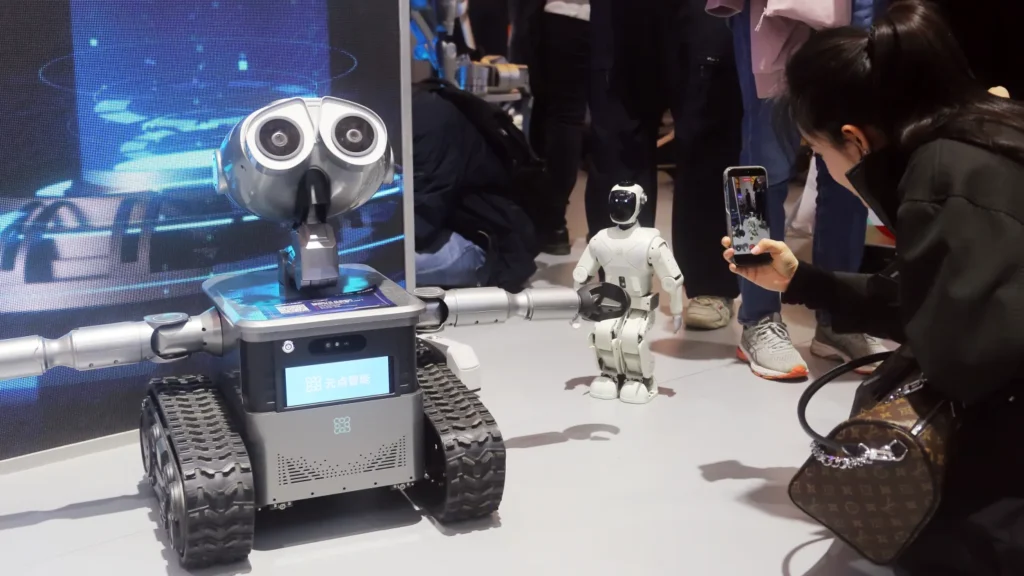
Why Is Ant Group Entering Robotics?
Ant Group is best known for digital financial services, mobile payments, cloud technology, and artificial intelligence.
Its expansion into robotics may seem unexpected, but it follows a logical evolution.
Large language models have dramatically improved a robot’s ability to understand language and reason about tasks. The next challenge is enabling AI to perform those tasks in the physical world.
Humanoid robots represent one possible solution.
By combining advanced AI with robotics, Ant hopes to extend intelligent software from smartphones and computers into factories, hospitals, retail stores, hotels, warehouses, and homes.
What Are the Reported Partnership Deals?
Instead of focusing solely on building robot hardware, Ant Group has entered multiple agreements across the robotics value chain.
These collaborations are expected to include areas such as:
- embodied AI research
- robot operating systems
- motion control
- computer vision
- robotics software
- industrial applications
- AI foundation models
- ecosystem development
This partnership-first strategy allows Ant to leverage the expertise of specialized robotics companies rather than attempting to build every component internally.
Why Embodied AI Is Becoming the Next Major Technology Wave
For several years, AI development focused primarily on digital applications.
Examples include:
- chatbots
- search engines
- image generation
- translation
- coding assistants
Embodied AI expands these capabilities into physical machines.
Instead of simply answering questions, embodied AI enables robots to:
- walk
- grasp objects
- inspect equipment
- assist workers
- deliver goods
- interact naturally with people
Many researchers believe this represents the next major evolution of artificial intelligence.
China’s National Robotics Strategy
China has identified humanoid robots as one of its strategic emerging industries.
Government initiatives encourage investment in:
- robotics research
- semiconductor development
- AI computing infrastructure
- advanced manufacturing
- intelligent factories
The objective extends beyond robotics itself.
China hopes leadership in humanoid robots will strengthen:
- manufacturing competitiveness
- productivity growth
- healthcare capacity
- logistics efficiency
- global technology leadership
Supportive industrial policies, funding, and local government incentives have accelerated development across the sector.
Why Big Tech Companies Are Joining the Robot Race
Humanoid robotics requires expertise from multiple disciplines.
These include:
- artificial intelligence
- cloud computing
- computer vision
- sensors
- robotics engineering
- semiconductor design
Large technology companies already possess many of these capabilities.
For companies like Ant Group, robotics represents an opportunity to expand existing AI investments into entirely new markets.
Rather than competing solely in software, they can become providers of intelligent robotic ecosystems.
Hardware Alone Is No Longer Enough
Early robotics companies often concentrated primarily on mechanical engineering.
Today’s competition increasingly centers on software intelligence.
Modern humanoid robots require AI capable of:
- understanding spoken language
- planning actions
- recognizing objects
- adapting to changing environments
- coordinating movement
- learning from experience
The robot’s “brain” may ultimately become more valuable than its hardware.
This explains why AI companies are investing aggressively in robotics despite limited experience building physical machines.
The Rise of Open Robotics Platforms
Many industry observers expect robotics to follow a path similar to smartphones.
Instead of every manufacturer developing everything independently, specialized companies may provide:
- AI operating systems
- vision models
- navigation software
- simulation tools
- cloud services
- developer platforms
Hardware manufacturers could then build robots using these shared technologies.
This modular ecosystem would accelerate innovation while lowering development costs.

The Industries That Could Benefit Most
Humanoid robots are unlikely to appear everywhere at once.
Instead, adoption will likely begin in sectors facing labor shortages or repetitive work.
Potential applications include:
Manufacturing
Robots may assist with assembly, inspection, and material handling.
Warehousing
Humanoids could eventually support picking, sorting, palletizing, and inventory movement.
Healthcare
Hospitals may deploy robots for logistics, patient assistance, and routine support tasks.
Elder Care
Countries with aging populations could use robots to assist caregivers with non-medical activities.
Hospitality
Hotels may employ humanoids for concierge services, luggage delivery, and guest assistance.
Retail
Robots could restock shelves, answer customer questions, and support inventory management.
Challenges Still Facing Humanoid Robots
Despite rapid progress, major technical obstacles remain.
Battery Life
Most humanoid robots can operate only for limited periods before requiring recharging or battery replacement.
Dexterity
Human hands remain extraordinarily difficult to replicate.
Tasks involving delicate manipulation continue to challenge robotic systems.
Mobility
Walking reliably across uneven surfaces remains one of robotics’ most difficult engineering problems.
Cost
Current humanoid robots remain expensive to manufacture, purchase, and maintain.
Mass adoption depends on substantial cost reductions.
AI Reliability
Robots must safely interpret unpredictable real-world situations while avoiding mistakes that could damage property or endanger people.
AI Models Are Becoming the Robot Brain
One of the industry’s biggest shifts is the development of foundation models specifically designed for robotics.
Unlike traditional AI systems trained primarily on text, robotics models learn from:
- video
- images
- motion data
- sensor readings
- physical interactions
These multimodal systems help robots understand both language and the physical environment.
As AI reasoning improves, robots become increasingly adaptable instead of relying solely on pre-programmed routines.
Global Competition Is Intensifying
China is not alone in pursuing humanoid robotics.
Major investments are also occurring across:
- the United States
- Japan
- South Korea
- Germany
- Europe
Competition now involves not only hardware but also:
- AI chips
- cloud infrastructure
- simulation software
- robotics operating systems
- manufacturing supply chains
Success will likely depend on integrating all of these technologies into scalable commercial products.
What This Means for Investors and Businesses
Ant Group’s expansion signals that humanoid robotics is transitioning from experimental research toward commercial deployment.
Businesses should expect continued investment in:
- industrial automation
- intelligent logistics
- service robots
- embodied AI software
- robotics infrastructure
However, widespread adoption will likely occur gradually as hardware costs decline and AI capabilities improve.
For investors, the opportunity extends far beyond robot manufacturers themselves.
Potential beneficiaries include:
- semiconductor companies
- sensor manufacturers
- battery developers
- cloud providers
- AI software companies
- industrial automation firms
The Future of Humanoid Robotics
The next decade will likely determine whether humanoid robots become mainstream business tools or remain specialized industrial equipment.
Several trends are expected to accelerate progress:
- better AI reasoning
- improved batteries
- lower hardware costs
- more powerful AI chips
- faster robot learning through simulation
- standardized robotics software platforms
Rather than replacing human workers entirely, humanoid robots are expected to complement people by performing repetitive, hazardous, or physically demanding tasks while humans focus on creativity, judgment, and complex decision-making.
The Bottom Line
Ant Group’s entry into the humanoid robot market marks another milestone in China’s broader strategy to lead the next era of artificial intelligence.
Instead of treating robotics as a separate industry, companies increasingly view humanoid machines as the physical extension of AI. Success will depend not only on building capable hardware but also on creating intelligent software ecosystems that allow robots to learn, adapt, and collaborate safely with humans.
While commercial humanoid robots still face challenges related to cost, battery life, dexterity, and reliability, the rapid involvement of major technology companies suggests the industry is entering a new phase of accelerated innovation.
If the past decade belonged to smartphones and cloud computing, the next may well belong to embodied AI—and Ant Group intends to be one of the companies helping shape that future.
Frequently Asked Questions (FAQ)
1. Why is Ant Group investing in humanoid robots?
Ant Group sees humanoid robotics as a natural extension of its artificial intelligence capabilities. By combining AI models with physical robots, the company aims to bring intelligent automation into industries such as manufacturing, logistics, healthcare, hospitality, and retail.
2. What is embodied AI?
Embodied AI refers to artificial intelligence integrated into physical machines, allowing robots to perceive, reason, move, and interact with the real world rather than operating only through software or digital interfaces.
3. Why are partnerships important in the humanoid robot industry?
Developing humanoid robots requires expertise in AI, robotics, sensors, software, and manufacturing. Partnerships allow companies to combine specialized knowledge, accelerate innovation, and reduce development costs instead of building every component independently.
4. What are the biggest challenges facing humanoid robots today?
Major challenges include improving battery life, reducing manufacturing costs, increasing hand dexterity, achieving reliable movement across different environments, and ensuring AI systems can safely adapt to unpredictable real-world situations.

5. Will humanoid robots replace human workers?
Not in the foreseeable future. Humanoid robots are more likely to assist people by handling repetitive, hazardous, or physically demanding tasks while humans continue performing work that requires creativity, critical thinking, empathy, communication, and complex decision-making.
Sources CNBC

