
Artificial intelligence is transforming industries, accelerating scientific research, and reshaping the global economy. But behind every AI-generated response lies a vast network of energy-intensive data centers that consume enormous amounts of electricity and water.
As a powerful heatwave swept across much of the United States, utilities, policymakers, and environmental experts raised fresh concerns about whether America’s power grid can keep pace with the rapidly growing demands of AI infrastructure. Extreme temperatures increase electricity consumption for both air conditioning and data center cooling, creating a double burden on already stressed electrical systems.
The situation highlights a growing challenge facing governments and technology companies worldwide: how to support the explosive growth of artificial intelligence while maintaining reliable electricity supplies, protecting water resources, and meeting climate goals.
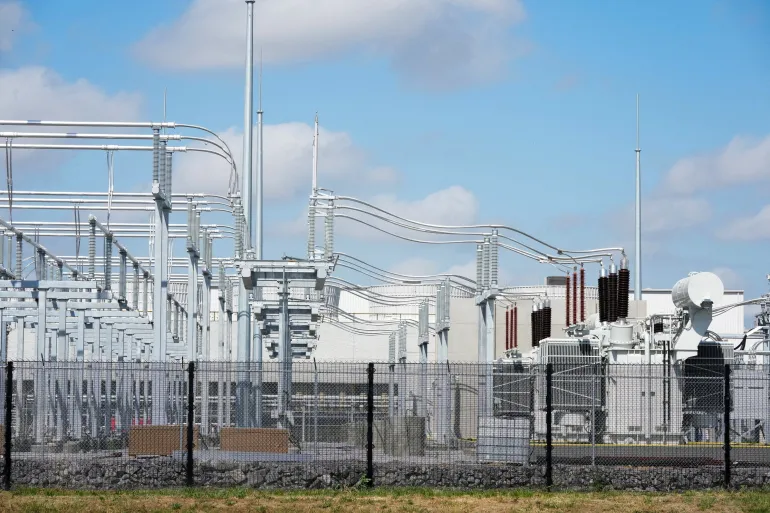
Why AI Data Centers Consume So Much Energy
Every interaction with a modern AI chatbot, image generator, or coding assistant is processed inside data centers filled with thousands of high-performance servers.
Unlike traditional web hosting, AI workloads require enormous computing resources because advanced models perform billions or even trillions of mathematical calculations.
A typical AI data center operates continuously, 24 hours a day, requiring:
- powerful AI processors (GPUs and AI accelerators)
- high-speed networking equipment
- massive storage systems
- sophisticated cooling infrastructure
- redundant power supplies
- backup generators
As AI adoption grows, so does the demand for these facilities.
Heatwaves Create a Double Energy Challenge
During periods of extreme heat, electricity demand rises sharply because millions of homes and businesses use more air conditioning.
At the same time, AI data centers also require additional energy.
Why?
As outdoor temperatures rise, cooling systems must work much harder to keep servers within safe operating temperatures. In many facilities, cooling alone can account for a significant share of total electricity consumption, and that share increases during heatwaves.
This creates two simultaneous pressures:
- households demand more electricity for cooling
- data centers consume more electricity to prevent overheating
The combined effect can push electrical grids toward record demand.
America’s Electrical Grid Faces New Pressures
For decades, U.S. electricity demand grew relatively slowly.
Today, several trends are driving rapid increases:
- artificial intelligence
- cloud computing
- electric vehicles
- advanced manufacturing
- electrification of buildings
Grid operators have warned that new demand is growing faster than new power generation and transmission infrastructure can be added. During the recent heatwave, some regional grid operators sought emergency measures to preserve reliability, including asking certain data centers to switch to backup generators during critical periods.
Water: The Overlooked Resource
Electricity is only part of the story.
Many AI data centers rely on water-based cooling systems.
Water helps absorb and remove heat generated by thousands of servers operating simultaneously.
A single large hyperscale AI data center may consume millions of gallons of water each day during peak summer conditions, especially when evaporative cooling systems are used. Much of that water is lost through evaporation rather than being recycled.
In drought-prone regions, this creates additional concerns for nearby communities that also depend on limited freshwater supplies.
What Is a Hyperscale Data Center?
Hyperscale data centers are among the largest computing facilities in the world.
They typically support cloud computing and AI services for millions of users.
Common characteristics include:
- tens of thousands of servers
- advanced liquid or air cooling
- dedicated substations
- redundant networking
- continuous operation
- massive electrical capacity
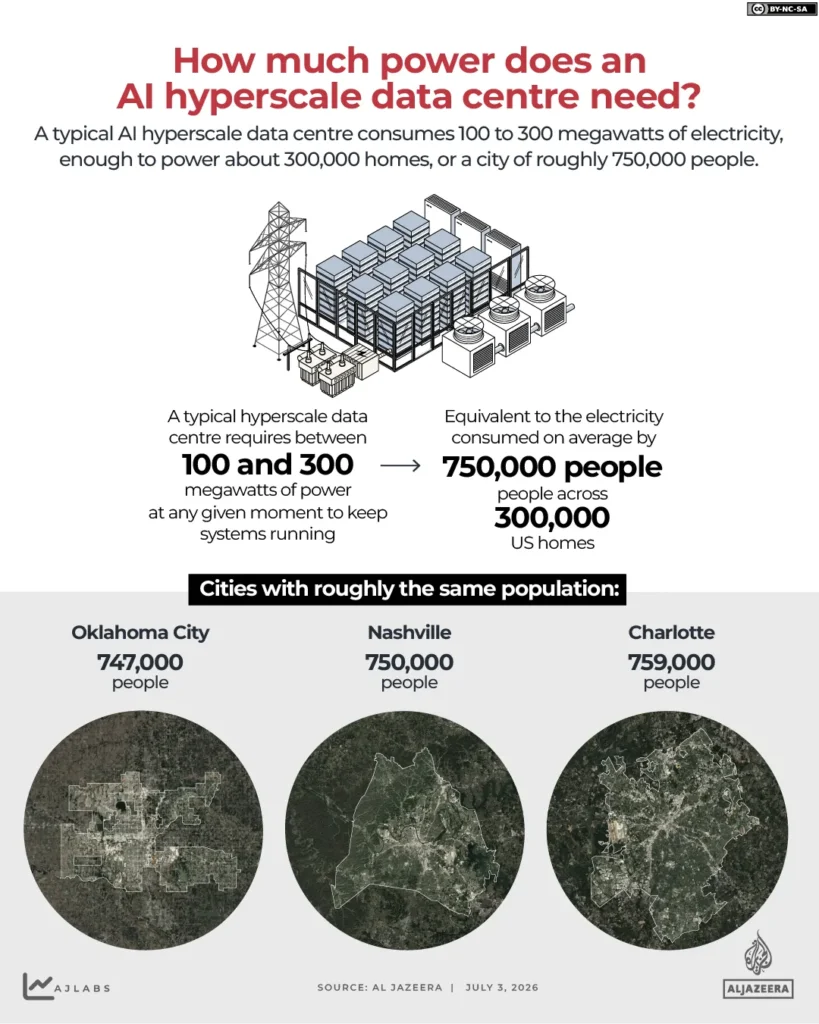
Some facilities require between 100 and 300 megawatts of electricity—comparable to the power needs of hundreds of thousands of homes.
The Rise of the “Data Heat Island”
Researchers have identified a phenomenon known as the data heat island effect.
Like urban heat islands, large data centers release substantial amounts of waste heat into the surrounding environment.
Studies have found that land surface temperatures near some data centers can increase measurably, with localized warming extending beyond the facility itself.
Although the precise impact varies by location and design, this has become another factor in discussions about where future facilities should be built.
Communities Are Becoming More Vocal
While AI investment brings jobs and tax revenue, residents in some communities are expressing concerns about:
- increased electricity demand
- water consumption
- diesel backup generator emissions
- industrial noise
- traffic
- environmental impacts
In several areas, proposals for new data centers have faced growing public opposition, moratoriums, or calls for stricter oversight. Recent debates in communities hosting data centers illustrate the tension between economic development and local environmental quality.
Renewable Energy Can Help—but It Isn’t a Complete Solution
Technology companies have pledged billions of dollars toward renewable energy projects.
These investments include:
- solar farms
- wind farms
- battery storage
- geothermal energy
- advanced nuclear technologies
However, renewable generation alone cannot fully solve the challenge.
Electricity must be available precisely when demand peaks.
Heatwaves often coincide with periods of exceptionally high electricity consumption, making grid balancing increasingly complex.
Future solutions will require:
- energy storage
- smarter grids
- flexible demand management
- expanded transmission networks
Smarter Cooling Technologies
Engineers are developing more efficient cooling methods to reduce both electricity and water consumption.
Emerging technologies include:
- direct liquid cooling
- immersion cooling
- closed-loop water systems
- AI-optimized cooling controls
- heat recovery systems
Some facilities are also exploring ways to capture waste heat and reuse it for district heating, industrial processes, or nearby buildings.
AI Can Also Improve Energy Efficiency
Ironically, AI contributes to solving some of the problems it creates.
Utilities increasingly use AI for:
- predicting electricity demand
- balancing renewable energy
- detecting equipment failures
- optimizing transmission networks
- improving power plant efficiency
Data center operators also use AI to optimize cooling, reducing unnecessary energy consumption.
The challenge is ensuring that efficiency gains outpace the rapid growth of AI workloads.
Governments Face Difficult Policy Choices
Policymakers must balance multiple priorities:
- encouraging AI innovation
- maintaining reliable electricity
- protecting water resources
- reducing carbon emissions
- supporting economic growth
- addressing community concerns
Potential policy approaches include:
- stricter efficiency standards
- water-use regulations
- incentives for renewable energy
- requirements for backup power planning
- improved grid infrastructure
- environmental impact assessments
Many experts argue that planning must occur years before new AI facilities become operational.
What Businesses Should Learn
Organizations adopting AI often focus on software capabilities while overlooking infrastructure costs.
Business leaders should increasingly consider:
- cloud sustainability
- carbon footprint
- electricity availability
- water usage
- data center location
- energy-efficient AI models
Responsible AI strategies now extend beyond ethics and cybersecurity to include environmental sustainability.
The Long-Term Outlook
Global demand for AI shows little sign of slowing.
As businesses, governments, and consumers rely more heavily on intelligent systems, demand for computing infrastructure will continue to grow.
Future success will depend on several parallel developments:
- more efficient AI chips
- lower-power AI models
- advanced cooling technologies
- renewable energy expansion
- modernized electrical grids
- improved water conservation
Rather than limiting AI innovation, these advances aim to ensure that digital progress remains compatible with environmental and infrastructure realities.
The Bottom Line
The recent U.S. heatwave has highlighted an increasingly important reality: artificial intelligence depends on physical infrastructure every bit as much as digital innovation.
AI data centers are becoming essential to the modern economy, but their growing appetite for electricity and water is exposing weaknesses in aging power grids and raising new environmental questions. As climate change contributes to more frequent extreme weather, balancing AI expansion with sustainable infrastructure will become one of the defining challenges of the coming decade.
The future of AI will not be determined solely by faster algorithms or larger models. It will also depend on cleaner energy, smarter cooling systems, resilient electrical grids, responsible resource management, and thoughtful public policy that allows technological progress without overwhelming the communities that host the infrastructure behind it.
Frequently Asked Questions (FAQ)
1. Why do AI data centers use so much electricity?
AI models require powerful processors that perform massive numbers of calculations around the clock. In addition to powering servers, significant electricity is needed for networking, storage, and cooling systems.
2. Why do heatwaves make AI data centers consume even more energy?
Higher outdoor temperatures make it harder to remove heat from servers, forcing cooling systems to work harder. At the same time, residential and commercial air-conditioning demand also rises, increasing overall pressure on the power grid.
3. Why do AI data centers use large amounts of water?
Many facilities use evaporative cooling to dissipate heat. During hot weather, water consumption increases because cooling systems must remove more heat to keep equipment operating safely.
4. Can renewable energy solve the AI electricity problem?
Renewable energy is an important part of the solution, but additional investments in battery storage, transmission lines, grid modernization, and energy-efficient hardware are also necessary to ensure reliable power during periods of peak demand.
5. Can AI itself help reduce energy consumption?
Yes. AI is increasingly used to optimize cooling systems, predict electricity demand, improve grid management, detect equipment failures, and enhance overall energy efficiency. These improvements can partially offset AI’s growing resource requirements, although continued infrastructure investment remains essential.
Sources Aljazeera