

For years, the global robotics industry has been focused on one major challenge:
Can humanoid robots be produced at scale?
China increasingly appears to have solved that problem.
Backed by powerful manufacturing capabilities, government support, sophisticated supply chains, and rapid advances in artificial intelligence, China has become one of the world’s fastest-growing hubs for humanoid robot production. Startups and established companies alike are unveiling increasingly capable machines, factories are expanding output, and investors are pouring billions into the sector.
But as production accelerates, a new obstacle is emerging.
Building humanoid robots may be far easier than convincing businesses to buy them.
While China’s robot makers are scaling up manufacturing, demand has yet to keep pace. The industry now faces a crucial challenge: proving that humanoid robots can generate enough real-world value to justify their cost and complexity.
The answer could determine whether humanoid robots become the next transformative technology revolution—or remain a promising innovation searching for a profitable market.
Why China Is Investing Heavily in Humanoid Robots
China’s enthusiasm for humanoid robotics is driven by several major economic and strategic factors.
An Aging Population
China is confronting significant demographic changes.
Its working-age population is shrinking while the number of elderly citizens continues to grow.
This trend is creating labor shortages across industries such as:
- Manufacturing
- Logistics
- Healthcare
- Elder care
- Hospitality
Humanoid robots are increasingly viewed as a potential solution to help fill workforce gaps.
Rising Labor Costs
China’s economic growth has led to steadily increasing wages.
While this has improved living standards, it has also raised operating costs for businesses.
Automation offers companies a way to maintain productivity and competitiveness while reducing dependence on manual labor.
Strategic Technology Leadership
China considers robotics a key strategic industry alongside:
- Artificial intelligence
- Semiconductors
- Electric vehicles
- Advanced manufacturing
- Renewable energy
Achieving leadership in humanoid robotics could strengthen China’s position in the global technology race.
What Makes Humanoid Robots Different?
Traditional industrial robots have been used in factories for decades.
However, most are designed for highly specialized tasks such as:
- Welding
- Assembly
- Painting
- Packaging
Humanoid robots are designed to be much more adaptable.
Because they resemble humans in form and movement, they can operate in environments originally built for people.
Potential applications include:
- Carrying materials
- Using tools
- Navigating offices and warehouses
- Assisting customers
- Conducting inspections
- Supporting healthcare workers
In theory, a single humanoid robot could perform multiple tasks without requiring major workplace redesigns.
This flexibility is one of the industry’s most attractive selling points.
China’s Manufacturing Edge
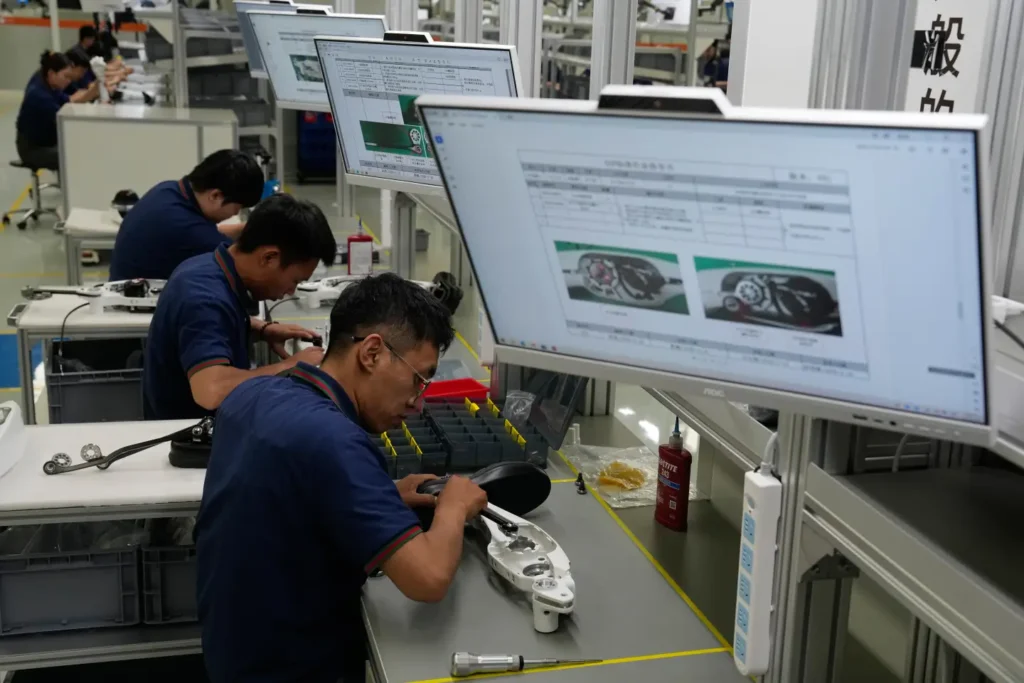
One of China’s greatest strengths in the humanoid robot race is its manufacturing ecosystem.
The country already dominates production of many critical components, including:
- Batteries
- Electric motors
- Sensors
- Electronics
- Precision-engineered parts
The same industrial infrastructure that helped China become a leader in electric vehicles and consumer electronics is now supporting robot production.
As a result, Chinese manufacturers often enjoy significant cost advantages over competitors in other countries.
This could become increasingly important as global competition intensifies.
The Biggest Challenge: Demand Is Lagging Behind Supply
Despite impressive technological progress, the commercial reality remains uncertain.
Many businesses are still evaluating whether humanoid robots provide enough value to justify the investment.
Several factors are slowing adoption.
High Upfront Costs
Although prices are gradually declining, advanced humanoid robots remain expensive.
Businesses may need to spend tens of thousands—or even hundreds of thousands—of dollars for a single unit.
Questions About Productivity
Many companies are still unsure whether humanoid robots can outperform existing automation systems.
For certain tasks, simpler machines may be:
- Less expensive
- Faster
- Easier to maintain
Ongoing Maintenance Expenses
Humanoid robots require continuous support, including:
- Repairs
- Software updates
- Technical maintenance
- System integration
These ongoing costs can significantly affect return on investment.
Limited Real-World Success Stories
Many deployments remain pilot programs rather than large-scale commercial operations.
Potential buyers often prefer to wait until there is stronger evidence of long-term benefits.
Artificial Intelligence Is the Key to Success
Artificial intelligence is rapidly becoming the most important component of humanoid robotics.
Without advanced AI, humanoid robots are essentially sophisticated machines with limited adaptability.
Modern AI allows robots to:
- Understand spoken and written instructions
- Recognize objects and people
- Navigate complex environments
- Adapt to changing situations
- Communicate naturally with humans
Recent breakthroughs in generative AI and large language models have dramatically expanded what robots can do.
Many experts believe future advances in AI may be even more important than improvements in hardware.
Together, robotics and AI are creating machines capable of performing tasks that once seemed uniquely human.
Which Industries Are Most Likely to Adopt Humanoid Robots?
Not every industry will embrace humanoid robots at the same speed.
Several sectors appear particularly well-positioned for early adoption.
Manufacturing
Factories remain one of the most promising markets.
Humanoid robots could complement existing automation systems while handling tasks that require greater flexibility.
Warehousing and Logistics
Distribution centers are increasingly automated.
Humanoid robots could assist with:
- Picking products
- Sorting inventory
- Managing stock
- Moving materials
Healthcare and Elder Care
As populations age worldwide, demand for caregiving support continues to rise.
Robots may eventually help with routine tasks, allowing healthcare professionals to focus on more complex responsibilities.
Retail and Hospitality
Customer-service robots could provide information, guide visitors, and handle repetitive service tasks.
Global Competition Is Heating Up
China is not the only country pursuing humanoid robotics.
Major competitors include companies from:
- The United States
- Japan
- South Korea
- Germany
Several leading technology firms are investing heavily in humanoid robot development.
The industry increasingly resembles the early days of the electric vehicle market, with numerous companies competing for leadership in what could become a trillion-dollar sector.
However, history suggests that only a small number of manufacturers may ultimately dominate the market.
Lessons From the Electric Vehicle Revolution
Today’s humanoid robot industry shares many similarities with the electric vehicle boom.
In both industries:
- Governments offered support
- Investors supplied large amounts of capital
- Companies rapidly expanded production
- Market optimism surged
Yet the EV industry also demonstrated an important lesson:
Manufacturing capacity alone does not guarantee success.
Companies must create products that customers genuinely need and can afford.
Humanoid robot manufacturers may soon face the same reality.
Why Demand Could Eventually Catch Up
Despite current challenges, many analysts remain optimistic about the industry’s future.
Several long-term trends support broader adoption.
Lower Costs
As production scales up, robot prices are expected to decline.
Smarter AI
More capable AI systems will make robots increasingly useful.
Labor Shortages
Many countries face demographic pressures similar to China’s.
Strong Economic Incentives
Businesses continue searching for ways to improve productivity and reduce labor costs.
Growing Familiarity
As robots become more common in workplaces, public acceptance is likely to increase.
The question may not be whether humanoid robots become mainstream—but how quickly that transition occurs.
The Risk of an Industry Shakeout
Rapid growth often attracts excessive investment.
If demand fails to meet expectations, the industry could experience significant consolidation.
Possible outcomes include:
- Company closures
- Mergers and acquisitions
- Reduced investment
- Slower expansion plans
Such shakeouts are common in emerging technology sectors.
The companies that survive often emerge stronger and more competitive.
What Success Really Looks Like
Many people assume humanoid robots must become household assistants to succeed.
In reality, widespread commercial adoption is likely to happen first.
Success may initially look like:
- Robots assisting factory workers
- Automated warehouse operations
- Hospital support staff powered by robotics
- Hotels using robots for routine services
Consumer adoption could arrive much later.
Many transformative technologies follow a similar path.
The Bigger Picture
China’s humanoid robot industry highlights an important truth about technological innovation.
Creating advanced machines is only part of the challenge.
Building sustainable markets is often far more difficult.
History is filled with technologies that worked brilliantly from a technical perspective but struggled commercially.
The winners in the humanoid robot race may not be the companies that build the most impressive machines.
Instead, they may be the companies that solve real-world problems at a price customers are willing to pay.
China’s manufacturing strength has already made it a major player in the global robotics race.
The next phase of competition will not be decided solely in factories or research labs.
It will be decided in the marketplace.
And in that arena, customer demand—not technological capability—may ultimately determine who wins.
Frequently Asked Questions (FAQ)
1. Why is China investing heavily in humanoid robots?
China views humanoid robotics as a strategic industry that can help address labor shortages, boost economic growth, strengthen manufacturing competitiveness, and enhance technological leadership.
2. What is a humanoid robot?
A humanoid robot is a machine designed with a human-like body structure that allows it to operate in environments built for people and perform a wide range of tasks.
3. Why are companies struggling to find buyers?
Many businesses remain concerned about high costs, maintenance requirements, reliability, and whether humanoid robots can deliver sufficient productivity gains to justify the investment.
4. Which industries are expected to adopt humanoid robots first?
Manufacturing, logistics, warehousing, healthcare, elder care, retail, and hospitality are considered the most likely early adopters.
5. How does artificial intelligence improve humanoid robots?
AI enables robots to understand instructions, recognize objects, navigate environments, make decisions, learn from experience, and interact naturally with humans.
6. Will humanoid robots replace human workers?
Most current applications focus on assisting workers rather than replacing them entirely. The long-term impact on employment will vary by industry and technological progress.
7. Why does China have an advantage in robot manufacturing?
China benefits from extensive supply chains, large-scale manufacturing expertise, component production capabilities, and economies of scale that help reduce costs.
8. How much do humanoid robots cost today?
Prices vary significantly depending on capabilities, but many advanced humanoid robots currently cost anywhere from tens of thousands to hundreds of thousands of dollars.
9. Will humanoid robots eventually become common in homes?
Possibly, but widespread adoption is likely to occur first in commercial and industrial settings where businesses can more easily justify the investment through productivity gains.

10. What is the biggest challenge facing the humanoid robot industry?
The industry’s biggest challenge is proving economic value. Manufacturers must demonstrate that humanoid robots can perform useful work reliably, efficiently, and affordably enough to create sustained demand.
Sources AP News

