

The rise of artificial intelligence is often framed as a story of innovation, productivity and economic transformation. But increasingly, experts are warning that AI is not emerging in a stable world—it is unfolding in the middle of what many call a “polycrisis”: a tangled web of global challenges including geopolitical tensions, economic uncertainty, climate change and social instability.
Rather than operating in isolation, AI is interacting with—and sometimes amplifying—these overlapping crises. The result is a complex and unpredictable landscape where technological progress could either help solve global problems or intensify them.
Understanding this intersection is critical. The AI boom is not just a technological shift—it is a force that is reshaping how societies respond to multiple crises at once.
What Is a “Polycrisis”?
The term polycrisis describes a situation where multiple crises occur simultaneously and interact with each other in ways that make them harder to solve.
Examples of today’s polycrisis include:
- geopolitical conflicts and rising nationalism
- economic instability and inflation
- climate change and environmental stress
- public health challenges
- technological disruption
These crises are interconnected. For instance, climate change can drive migration, which can increase political tensions, which can impact economic stability.
AI is entering this already fragile system—and influencing it in real time.
The AI Boom: A New Layer of Complexity
Artificial intelligence is advancing at extraordinary speed.
Companies are investing billions in:
- large language models
- autonomous systems
- AI-driven automation
- data infrastructure
Governments are also racing to develop AI capabilities for economic and strategic advantage.
But unlike previous technological revolutions, AI is emerging during a period of global instability. This makes its impact harder to predict.
How AI Interacts With Global Crises
1. Geopolitics and Power Competition
AI is becoming a central element of geopolitical rivalry.
Countries are competing to dominate:
- AI research and talent
- semiconductor production
- data infrastructure
- military AI capabilities
This competition can intensify tensions between nations.
At the same time, AI tools are being used in:
- surveillance systems
- information warfare
- cybersecurity operations
These applications can both stabilize and destabilize global relations.
2. Economic Disruption and Inequality
AI has the potential to dramatically increase productivity—but also to disrupt labor markets.
Potential impacts include:
- automation of white-collar jobs
- concentration of wealth among tech companies
- reduced opportunities for entry-level workers
- widening income inequality
In a world already facing economic stress, these changes could amplify social tensions.
3. Climate and Energy Pressures
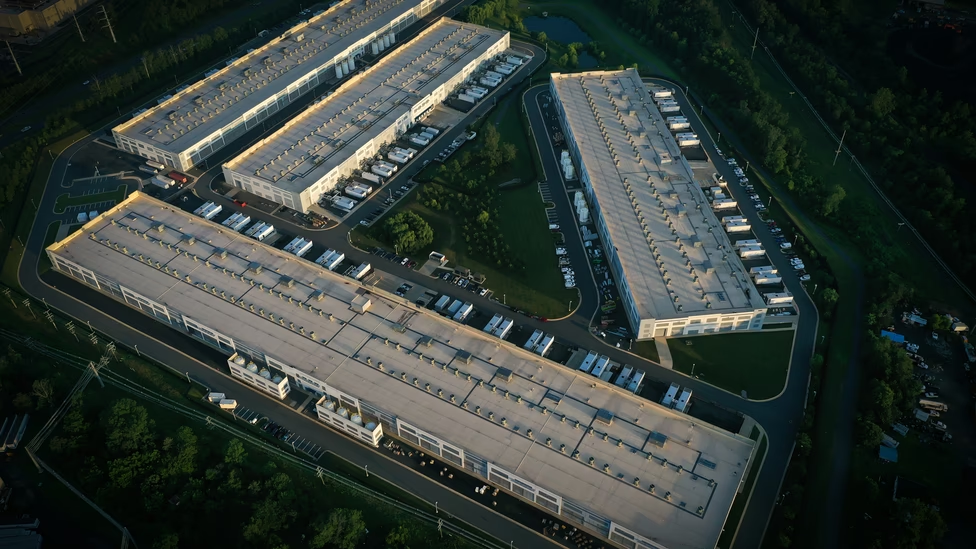
AI development requires enormous computational resources.
Training large models consumes significant energy, contributing to:
- increased electricity demand
- pressure on energy infrastructure
- environmental concerns
At the same time, AI can help address climate challenges through:
- improved energy optimization
- climate modeling
- resource management
AI is both part of the problem and part of the solution.
4. Information Overload and Misinformation
AI-generated content is flooding digital platforms.
This creates new risks:
- misinformation campaigns
- deepfakes and synthetic media
- erosion of trust in information sources
In times of crisis, reliable information is critical. AI complicates this by making it harder to distinguish truth from fabrication.
5. Governance and Regulation Challenges
Governments are struggling to keep pace with AI development.
Regulatory challenges include:
- balancing innovation with safety
- managing cross-border AI systems
- ensuring accountability for AI decisions
In a polycrisis environment, delayed or ineffective regulation can worsen existing problems.

AI as a Crisis Multiplier—or Solver
AI has a dual role in the polycrisis.
As a Multiplier
AI can amplify existing challenges by:
- accelerating misinformation
- increasing economic inequality
- intensifying geopolitical competition
As a Solver
AI can also help address crises by:
- improving disaster response
- optimizing supply chains
- advancing medical research
- supporting climate solutions
The outcome depends on how the technology is governed and deployed.
The Speed Problem
One of the biggest risks is the speed mismatch between AI development and societal adaptation.
AI systems evolve rapidly, while institutions—governments, education systems, legal frameworks—change slowly.
This creates a gap where:
- technology outpaces regulation
- risks emerge faster than solutions
- societies struggle to adapt
Managing this gap is one of the central challenges of the AI era.
Corporate Power and Global Influence
The AI boom is largely driven by a small number of powerful companies.
These firms control:
- advanced AI models
- computing infrastructure
- massive datasets
This concentration of power raises concerns about:
- accountability
- market dominance
- influence over public discourse
In a polycrisis context, corporate decisions can have global consequences.
The Role of International Cooperation
Addressing the intersection of AI and global crises will likely require international collaboration.
Potential areas of cooperation include:
- AI safety standards
- data governance frameworks
- ethical guidelines for AI use
- climate-focused AI initiatives
However, geopolitical competition may make cooperation difficult.
The Future: Managing Complexity
The AI boom is not occurring in a vacuum. It is unfolding within a world already under strain.
The key challenge is not just building powerful AI systems—but ensuring they are aligned with human needs in a complex and unstable environment.
This requires:
- thoughtful governance
- responsible innovation
- global coordination
- public awareness and education
Without these elements, AI could exacerbate the very crises it has the potential to solve.
Frequently Asked Questions (FAQ)
Q: What is a polycrisis?
A polycrisis refers to multiple interconnected global crises that interact and amplify each other.
Q: How does AI affect global crises?
AI can both worsen and help solve issues such as economic inequality, climate change and misinformation.
Q: Is AI making the world more unstable?
It has the potential to increase instability if not managed properly, particularly through misinformation and economic disruption.
Q: Can AI help solve climate change?
Yes. AI can improve energy efficiency, climate modeling and resource management.
Q: Why is AI linked to geopolitics?
Countries see AI as a strategic asset that can influence economic power, military capabilities and global leadership.
Q: Who controls AI development?
A small number of large technology companies and governments currently dominate AI development.
Q: What is the biggest risk of AI in a polycrisis?
The biggest risk is that AI amplifies existing problems faster than societies can respond.

Conclusion
Artificial intelligence is one of the most powerful technologies ever created—but it is emerging at a time when the world is already facing multiple, interconnected crises.
This convergence creates both opportunity and danger.
AI could help humanity navigate complex global challenges, or it could intensify them in ways that are difficult to control.
The outcome will depend not just on technological progress, but on how wisely—and collectively—we choose to use it.
Sources The Atlantic

