
When Nvidia’s CEO Jensen Huang — the man behind the chips that power nearly every AI breakthrough today — speaks, the world listens.
So when he recently declared that China will win the AI race with the United States, his words didn’t just make headlines — they sparked a global debate about the future of artificial intelligence, geopolitics, and innovation itself.
Is Huang right? Is America really losing its lead in the technology it invented? Or is this a calculated warning from the most powerful chipmaker on Earth?
Let’s break down what’s really going on — and what the media missed.
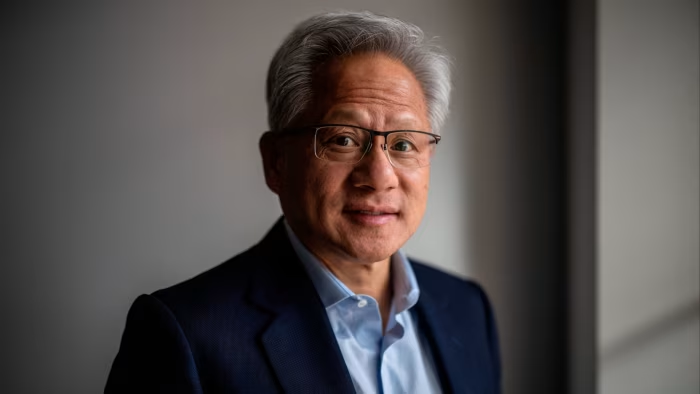
The Quote That Shook Silicon Valley
Speaking at the Financial Times Future of AI Summit, Huang made a bold statement:
“China is going to win the AI race.”
He didn’t say it with defiance — he said it with realism.
According to Huang, China’s edge comes from scale, speed, and strategy:
- A massive developer community,
- Cheaper and faster data center infrastructure,
- And fewer regulatory hurdles than the U.S.
He also warned that U.S. export bans and tech restrictions may be backfiring — accelerating China’s self-reliance instead of slowing it down.
“If our technology doesn’t run in China,” Huang said, “we’ve lost half the world’s developers.”
In other words: America might be protecting its tech but losing its influence.
The Bigger Picture: The AI Race Is About Ecosystems, Not Just Chips
At first glance, Huang’s remarks sound like a geopolitical soundbite. But his warning is deeper — the AI race isn’t about who builds the best chip or model. It’s about who builds the most complete ecosystem.
China has been investing aggressively across every layer of that ecosystem:
- Chips: Domestic alternatives to Nvidia’s GPUs (like Huawei’s Ascend and Biren chips).
- Infrastructure: Massive, government-backed data centers powered by cheap energy.
- Talent: The world’s largest pool of AI engineers and researchers.
- Policy: A top-down, long-term national strategy for AI dominance.
Meanwhile, the U.S. — despite leading in chip design and AI research — faces headwinds:
- Fragmented federal regulation.
- Talent shortages due to immigration restrictions.
- Higher infrastructure costs and slower permitting.
- Export controls that cut off access to one of the world’s biggest markets.
As Huang pointed out, the combination is dangerous: “The U.S. is regulating itself into irrelevance.”
What the Headlines Didn’t Tell You
Most articles quoted Huang’s line about China “winning” — but left out why he’s really concerned. Here are the hidden layers:
1. He’s Talking About Market Share, Not Ideology
Nvidia’s chips power the world’s AI systems — from OpenAI to Tesla. China was once one of Nvidia’s biggest markets. But U.S. sanctions now bar exports of high-end GPUs. For Nvidia, losing China isn’t just political — it’s billions in lost revenue and a shrinking global footprint.
2. He’s Warning About a “Decoupled” AI World
If China builds its own AI stack — from chips to models to cloud — it could split the world into two incompatible systems. Think of the internet divide (Google vs Baidu, Android vs HarmonyOS) — only this time, it’s AI. That would fragment global innovation and standards.

3. He’s Highlighting Energy and Infrastructure Gaps
AI’s future depends on compute power — and compute power depends on energy.
China has cheaper electricity, abundant coal and renewables, and government-backed power guarantees for AI training clusters.
In the U.S., data centers are facing blackouts, community resistance, and rising costs. Infrastructure may become America’s biggest bottleneck.
4. He’s Challenging America’s Strategy
Export controls were meant to slow China down. Instead, they may be doing the opposite.
By cutting China off from U.S. chips, Washington has forced Beijing to build its own semiconductor industry faster — and invest in local innovation at record speed.
Why This Conversation Matters for Everyone
This isn’t just a tech rivalry. It’s about who controls the next era of the digital economy.
AI isn’t a single technology — it’s the foundation of future industries: healthcare, defense, energy, finance, transportation, even governance. Whoever leads in AI will shape the rules of the digital world.
And right now, Huang warns, that world is tilting east.
For Governments:
Policies that protect short-term security must not cripple long-term innovation. Leadership comes not just from invention — but from global adoption.
For Companies:
The future will favor those who can build globally — not just locally. Supply chains, developer access, and open ecosystems will determine who scales fastest.
For Workers and Innovators:
Talent is still the ultimate differentiator. The AI race is powered by people — engineers, researchers, and visionaries. Keeping borders open to talent might matter more than building walls around chips.
Frequently Asked Questions (FAQ)
Q: Did Huang mean China has already won?
No. He meant China is positioned to win if current trends continue — especially if U.S. policy isolates itself from global markets.
Q: What advantages does China actually have?
Massive data resources, cheaper energy, government coordination, a huge developer base, and rapid implementation cycles.
Q: What about America’s strengths?
The U.S. still leads in chip design (Nvidia, AMD), foundational models (OpenAI, Anthropic), and venture funding. But scaling globally is becoming harder due to regulation and export barriers.
Q: Are export bans hurting Nvidia?
Yes — China was one of Nvidia’s biggest markets. Losing access affects revenue, innovation feedback loops, and global ecosystem influence.
Q: Will this split the world into two AI systems?
It’s already happening. Western AI ecosystems (OpenAI, Anthropic, Meta) vs. Chinese ones (Baidu, Tencent, Alibaba). Huang’s fear is that decoupling will make collaboration — and innovation — harder.
Q: Can the U.S. catch up?
Absolutely. But it will require smarter policy — investing in infrastructure, expanding STEM education, supporting energy for AI, and rethinking tech diplomacy.

Final Thoughts: A Wake-Up Call for the West
Jensen Huang isn’t cheering for China — he’s warning America.
He’s saying that leadership in AI isn’t won in laboratories or legislation. It’s won in scale, strategy, and deployment.
It’s not about who has the best idea — it’s about who builds the future faster, smarter, and more globally.
As Huang put it:
“If our technology doesn’t run everywhere, we’ve already lost.”
The message is clear: the U.S. can’t lead the AI era by closing doors. It must lead by opening them — to innovation, to talent, and to the world.
Sources Financial Times